
Insolvency disputes can affect a company, its directors, creditors and people facing personal bankruptcy. A barrister for insolvency proceedings can advise on the legal issues and represent clients in court. A half-day hearing typically lasts up to three hours.
When a business, personal finances or a director’s future is at stake, clear advice matters. A barrister can help you understand the case, identify the key issues and prepare for the next legal step.
This article explains how an insolvency and bankruptcy barrister may assist with director disqualification, company insolvency, asset recovery and personal bankruptcy. It also outlines what to expect from legal advice and court representation, helping you assess how barrister support could fit your situation.
Key Takeaways
- Understand how barrister advice and court representation can support directors, creditors and individuals facing insolvency disputes.
- The Directors Disqualification Act 1986 governs proceedings involving disqualification claims, according to the UK legislation register.
- Learn how administration, receivership and liquidation differ, and which issues can shape the way a company insolvency proceeds.
- See how document review and evidence-based case strategy can support asset recovery and claims by insolvency office-holders.
- Explore the factors that matter in personal bankruptcy cases and how to prepare for the next legal step.
Why Choose an Insolvency and Bankruptcy Barrister?
Corporate insolvency can put a company’s future, creditor recovery and directors’ decisions under scrutiny. A barrister can assess the dispute, explain the legal issues and represent a party in court.
Corporate insolvency advice
Advice can help directors, creditors and office-holders understand a corporate insolvency dispute. A barrister examines the company’s financial position, relevant documents and the outcome each party seeks. They can advise on proceedings, prepare legal arguments and represent a party at a hearing. For example, a creditor may need to assess its response to a proposed restructuring before deciding what to do next.
When instructing a barrister for insolvency proceedings, focus on the question the court must resolve. This may concern a creditor’s recovery, the company’s ability to continue trading or the evidence behind a disputed decision. Clear advice can help you identify relevant documents, understand the strengths and weaknesses of your position, and prepare for an application or negotiation.
Court rules and deadlines
In England and Wales, the applicable court rules and deadlines depend on the type of proceeding and any directions made in the case. A barrister can identify the relevant procedure and map required filings and hearing dates against the court’s timetable. Organise the claim, application, notices and directions before preparing submissions.
A barrister can explain the issues, advise on evidence and legal arguments, draft or review court documents, and represent you in court. If a deadline is approaching, check the sealed notice or order first to identify the date and action required. Insolvency proceedings may be heard in different courts, depending on the case. The proceeding and court arrangements determine the venue.
This support can be particularly useful in corporate disputes where legal and commercial interests overlap. In a shareholder dispute, for example, parties may disagree about company control, financial records or the value of a proposed settlement. A barrister can analyse the disputed issues and help present a focused case, rather than allowing separate disagreements to obscure the central question.
Insolvency proceedings and corporate restructuring can involve competing views about whether a proposed solution addresses the company’s problems. Directors’ duties and governance decisions may be examined alongside company records and the steps taken before proceedings began. Reviewing the sequence of decisions helps clarify which matters need evidence, legal argument or a court application.
Directors’ disqualification proceedings
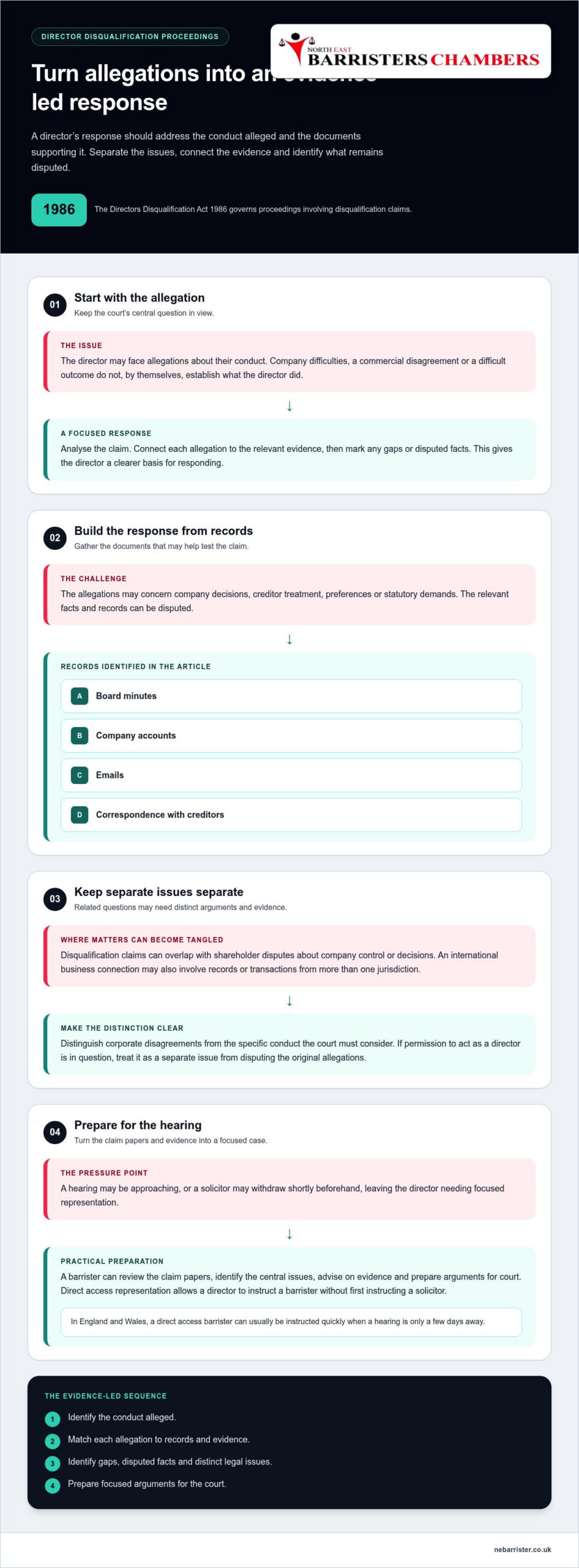
A disqualification claim can affect a director’s ability to manage a company and their professional future. The Directors Disqualification Act 1986 governs proceedings in which No5 barristers act for the Secretary of State and directors facing disqualification claims, according to the UK legislation register. The director’s response should address the conduct alleged and the documents supporting it.
A barrister can analyse the claim, advise on evidence and help prepare a director’s case for court. Useful records may include board minutes, company accounts, emails and correspondence with creditors. Connect each allegation to the relevant evidence, then identify any gaps or disputed facts. This gives the director a clearer basis for responding.
Directors’ duties may come under scrutiny when a company struggles financially or enters insolvency proceedings. The dispute may involve company decisions, creditor treatment, preferences or statutory demands. These issues need careful separation: a commercial disagreement or difficult outcome does not, by itself, establish what a director did. The allegations and available evidence determine the case.
If disqualification is in question, permission to act as a director is a distinct issue. A barrister can explain the implications and help prepare relevant arguments and supporting material. Focus on the director’s proposed role, the circumstances behind the claim and the evidence supporting the application. Keep the permission issue separate from arguments disputing the original allegations.
Direct access representation can help a director obtain advice and advocacy without first instructing a solicitor. A barrister can review the claim papers, identify the central issues and prepare for a hearing. This can be particularly useful when a solicitor withdraws shortly before a hearing and the director needs focused representation. For a director seeking court advocacy, direct access barrister representation provides a way to instruct a barrister directly.
Shareholder disputes can overlap with disqualification claims when parties disagree about company control or decisions. For example, a shareholder may challenge a director’s conduct while the director disputes the account given by another party. An international business connection may involve records or transactions from more than one jurisdiction. A barrister can distinguish those corporate disputes from the specific conduct the court must consider.
In England and Wales, a direct access barrister can usually be instructed quickly when a court hearing is only a few days away, helping address urgent preparation needs.
Administrations, receiverships and liquidations
Administration, receivership and liquidation address different problems for companies and creditors. The right analysis starts with the company’s position, the application or dispute, and the outcome sought.
Administration orders and winding-up petitions
An administration order may be sought when a company’s circumstances call for court involvement. A barrister can advise on the application, supporting evidence and the proposed administration’s effects on the company and its creditors. Start by identifying the immediate objective, such as preserving the business or managing creditor claims.
A winding-up petition can threaten a company’s continued operation, so review the petition and its supporting grounds promptly. Advice may cover an application to restrain the petition or its advertisement. In one example, an Insolvency and Companies Court judge dismissed a winding-up petition against a company established to run a school.
Administration and receivership
Administration and receivership take different approaches to a company’s assets and affairs. Administration focuses on the company and its position as a whole, while a receiver’s role centres on the assets covered by the relevant appointment. Directors and creditors should identify who controls the decisions at issue and which documents explain that authority.
A barrister can assess the appointment, company records and practical effects on creditors or members. For example, a dispute may concern whether an asset falls within a receiver’s remit or how an administrator’s decision affects a creditor’s recovery. Counsel can help frame the issue for advice, negotiation or an application.
Liquidation and receivership
Liquidation focuses on bringing a company’s affairs to an end and dealing with its assets and liabilities. Receivership concerns control of specified assets under the receiver’s appointment. This distinction matters if a creditor challenges how an asset is handled or company members need to understand the effects of competing processes.
Start by reviewing the appointment documents, asset information and any disputed decisions. A barrister can advise on the evidence and arguments for a challenge, including a disagreement over a proof of debt. This preparation helps identify whether the issue concerns the liquidator’s decision, the receiver’s authority or the evidence supporting a creditor’s claim.
Restructuring options
Restructuring may be considered alongside administration or receivership when parties assess whether a company can continue in some form. Voluntary arrangements may also feature in discussions with creditors. Compare the practical effects of each option on trading, assets, creditors and company members.
A barrister can assess the proposal, explain the disputed legal issues and advise on applications arising from the chosen route. In a cross-border case, the parties may also need to identify which jurisdictions and company records relate to the dispute. This groundwork helps focus on the particular decision before the court or the parties.
Asset recovery and office-holder claims
Asset recovery claims can arise when an office-holder investigates a company’s finances and transactions. Start with a clear timeline: identify the asset, trace its movement through available records and connect each transaction to the parties involved. A barrister can review relevant financial and legal documents and help develop an evidence-based case strategy. This gives creditors and office-holders a practical way to assess the evidence before litigation.
Tracing may involve comparing company accounts, contracts, bank records and correspondence. For example, match a payment recorded in the accounts against an invoice and the company’s transaction records. The aim is to establish what happened, when it happened and who received value. These details help shape the next step, whether seeking further evidence, responding to a defence or pursuing a recovery claim.
Office-holder claims can raise disputed questions about transactions made before insolvency. An allegation of fraudulent trading, for example, requires careful analysis of the available documents and the conduct alleged. A barrister can help distinguish evidence supporting the claim from material pointing to another explanation. This assessment can clarify the issues for negotiation or litigation and focus attention on the relevant facts.
Creditors often need to assess how an office-holder’s decision affects their claim. In Brown v Ulrick, insolvency barrister Rebecca Farrell assisted a landlord seeking to set aside a liquidator’s rejection of its proof of debt. The example shows why a creditor should understand the reason for a decision, identify records supporting the claim and prepare a focused response. Relevant evidence may include contracts, invoices and correspondence relating to the debt.
Asset recovery can also involve difficult questions about transfers and the purpose behind them. The Supreme Court appeal in El Husseiny v Invest Bank PSC, cited as [2025] UKSC 4, concerned the interpretation of section 423 of the Insolvency Act 1986. That makes the case relevant to disputes involving asset transfers and creditor interests, without replacing close analysis of the particular facts and evidence.
For a company or creditor in England and Wales, organise documents by transaction and date. Separate confirmed records from disputed accounts, then note which person or entity each document relates to. A barrister can use that structure to identify gaps, explain the legal issues and assess the route to recovery. A focused case theory keeps complex financial records connected to the claim.
Personal insolvency and bankruptcy
Personal bankruptcy can affect finances, property and future decisions. A barrister can help you understand the issues, assess documents and prepare for court. Start by organising the bankruptcy papers, financial records and correspondence. This makes it easier to identify disputed facts and explain your position clearly.
Personal insolvency may also involve disputes about how a bankruptcy order was made or whether it should remain in place. Kavil Singh Rao’s case shows the lasting impact an order can have. The Post Office made him bankrupt on 20 December 2012, and the High Court took over eleven years to correct his bankruptcy. It later annulled the order on the grounds that it should never have been made.
The order, its supporting evidence and the events leading to it need careful review. A barrister can help you set out the timeline, identify errors or disputed information, and prepare arguments relating to the order. Keep original documents together, including notices, financial records and correspondence with the people involved. A clear chronology separates what happened from what remains contested.
Personal liability and fiduciary duty may arise when a person’s responsibilities or decisions are disputed. Focus on the particular conduct alleged, the person’s role and records explaining their decisions. For example, meeting notes and financial documents may clarify who made a decision and what information they had. A barrister can assess these details and explain how they relate to the claim.
Insolvency practitioners and other office-holders may hold records relevant to a personal bankruptcy dispute. List the available documents, note who holds each record and identify what is missing from the timeline. If receivership or company insolvency forms part of the background, separate those events from the individual’s own bankruptcy issues. This keeps the case focused.
A barrister can advise on the evidence, prepare legal arguments and represent a person in court. The focus is the case’s central issue, whether that concerns the bankruptcy order, disputed financial information or personal responsibility. For a clear assessment of your position and representation in court, seek advice about your bankruptcy case.
The Post Office initiated Kavil Singh Rao’s bankruptcy because of Horizon errors, making the reason for the action important. A careful review can compare the material relied on with the individual’s records and chronology. The High Court took over eleven years to correct his bankruptcy. Preserving relevant evidence and identifying the issue clearly can help a person explain their position, particularly when the events leading to an order are disputed.
North East Barristers Chambers: Direct Access Barrister Services
North East Barristers Chambers provides Direct Access Barrister Services for individuals and businesses seeking legal advice and representation. If an insolvency dispute involves a hearing, a director’s position or a creditor’s claim, direct access lets you instruct a barrister without first instructing a solicitor. Court representation can help you present your case and address the legal issues before the court.
To prepare, organise relevant court papers, financial records and correspondence, then note the decision or dispute you need help with. This gives the barrister a clear starting point for understanding your position and the representation required. If you’re ready to discuss your situation, contact North East Barristers Chambers.
Take the next step with a clear case plan
Turn the immediate concern into a clear legal question. Identify the decision, hearing or claim that needs attention, then gather the papers and records explaining how it arose. This helps make an initial discussion focused on the key issues and what needs to happen next.
Choosing a barrister for insolvency proceedings means seeking advice and advocacy suited to the issue in dispute. North East Barristers Chambers provides direct access barrister services and court representation, including in criminal, civil and family law.
You can take the first step by setting out your position and the outcome you are seeking. Contact North East Barristers Chambers to discuss your legal matter. A clear starting point can make a complex process easier to approach, and help you move forward with greater confidence.
Frequently Asked Questions
When should a business or individual instruct an insolvency barrister?
Instruct a barrister when a formal claim, court application or hearing calls for specialist legal analysis or advocacy. For example, a director facing a disqualification claim may need help assessing the allegations, while a creditor may need advice about a disputed debt. Early advice can clarify the issues and help organise relevant papers. If a hearing is approaching, provide the barrister with the court documents and any stated hearing dates.
Can I instruct an insolvency barrister directly through public access?
Yes, you can instruct a barrister directly through public access when the barrister accepts the instruction and the work is suitable for that route. You don’t need a solicitor simply to approach a barrister for advice or advocacy. Before instructing, identify the work required, such as reviewing papers, advising on arguments or representing you at a hearing. Direct access does not mean the barrister takes on every administrative task associated with a case.
How can a barrister challenge a winding-up petition or bankruptcy application?
A barrister can examine the application, the evidence relied on and the grounds for challenging it. For a winding-up petition, this may include advice on an application to restrain the petition or its advertisement. For a bankruptcy application, the focus may be the disputed debt, supporting documents or account of events. Gather the application papers, correspondence and relevant financial records so the issues can be assessed together.
How does an insolvency barrister compare with a solicitor or insolvency practitioner?
An insolvency barrister provides legal advice and advocacy on disputes and court proceedings. A solicitor commonly handles broader legal casework and client administration, while an insolvency practitioner’s role centres on managing an insolvency process. For example, a creditor might need an office-holder to administer a company’s affairs, but seek a barrister’s advice on challenging a legal decision. The roles can address different parts of the same matter.
What are the steps in winding-up, bankruptcy, and administration proceedings?
For administration, identify the immediate objective, review the application and supporting evidence, and assess the effects on the company and creditors. For a winding-up petition, promptly review the petition and its grounds, then consider whether to apply to restrain the petition or its advertisement.
What risks and costs should directors and creditors consider in insolvency litigation?
Directors may face scrutiny of their decisions and future ability to manage a company. Creditors may be concerned about recovery, while a winding-up petition can threaten a company’s continued operation. Applicable court deadlines and required filings also matter.