
The red line on your Land Registry title plan may not show the exact legal boundary. If you and your neighbour interpret it differently, the disagreement can affect a fence, garden or access, and make everyday conversations harder. The boundary dispute legal advice UK residents need often starts with checking the evidence, not rushing towards court.
It’s understandable to want a clear answer, especially when informal discussions haven’t helped. But deeds, older plans, photographs and a surveyor’s report may each add useful context. In England and Wales, title plans usually show general boundaries rather than a precise line. Legal rules and processes can differ elsewhere in the UK.
This guide explains what to check, how to compare discussion, mediation and court, and what evidence may be involved. It also looks at when a property professional or barrister may help. A direct access barrister can advise, review evidence or represent you where the case and required work are suitable. Clarifying the factual boundary question first can help you choose a proportionate next step.
Key Takeaways
- Identify whether the disagreement concerns the boundary’s position, ownership or use, as different issues may call for different next steps.
- Build a clear record of documents, events and each neighbour’s position before deciding what remains unresolved.
- Compare direct discussion, solicitor-led correspondence, mediation and court proceedings by their purpose, formality and practical limits.
- Use boundary dispute legal advice UK readers can act on to clarify the evidence, possible routes and the outcome they want to achieve.
- A direct access barrister may advise, review material or represent you if the case and required tasks are suitable. Check what work is within scope.
Boundary dispute legal advice UK: what counts as a boundary dispute?
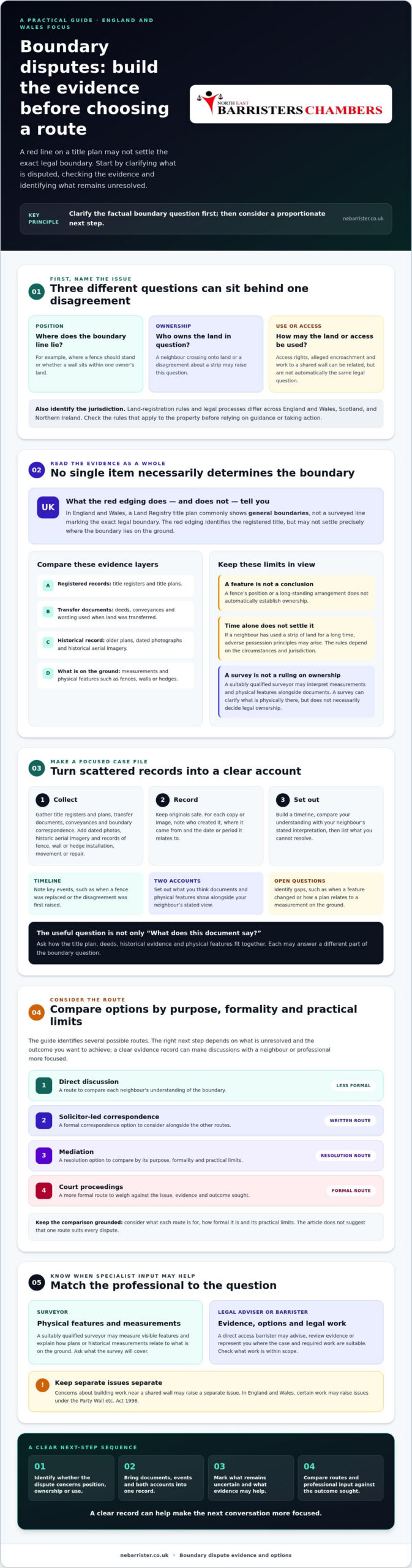
A boundary dispute is a disagreement about the position, ownership or use of the line separating properties. It might concern where a fence should stand, whether a wall sits within one owner’s land, or whether a neighbour has crossed onto the land. The issue could instead involve access rights, an alleged encroachment or work to a shared wall. These are related property problems, but they are not automatically the same legal question.
The applicable law and land-registration system differ across England and Wales, Scotland, and Northern Ireland. For example, Land Registry title plans and the general boundaries principle apply to registered land in England and Wales. Check the rules for the relevant jurisdiction before relying on guidance or taking action. Start by identifying both where the property is and precisely what is in dispute.
What evidence can help establish a property boundary?
Collect the title registers and plans, transfer deeds and any older conveyance documents for your property. Compare them with historical plans, dated photographs and records showing when fences, walls or hedges were installed or changed. Keep originals safe and note where each copy or image came from. Treat each item as part of the picture, rather than proof on its own.
A suitably qualified surveyor may help interpret measurements and physical features on the ground, then compare them with documentary evidence. A survey can clarify what is physically there, but it does not necessarily decide legal ownership.
Why can a title plan leave room for disagreement?
In England and Wales, a Land Registry title plan commonly shows general boundaries rather than a surveyed line marking the exact legal boundary. Its red edging identifies the registered title, but may not settle precisely where the boundary lies on the ground. The registered title is important evidence, but other material may also need to be considered.
Deeds, the wording used when land was transferred, historical evidence and physical features may all be relevant. A fence’s position or a long-standing arrangement does not automatically establish ownership. If one neighbour has used a strip of land for a long time, adverse possession principles may also arise. The rules depend on the circumstances and jurisdiction, so don’t assume that time alone settles the question.
Keep concerns about building work near a shared wall separate. In England and Wales, certain work may raise separate issues under the Party Wall etc. Act 1996. Identifying the type of disagreement helps you gather relevant evidence and choose an appropriate next step.
How to assess boundary evidence before taking legal action
Before choosing a route, organise what you know and identify what remains uncertain. A clear evidence record can help you explain the disagreement calmly and make a discussion with a professional more focused. It isn’t a legal test, and no single document or photograph will necessarily determine the boundary.
Which records should you collect first?
Gather the relevant title registers and plans, transfer documents, conveyances and correspondence about the boundary. Add dated photographs, historic aerial imagery and records that show when a fence, wall or hedge was installed, moved or repaired. Keep original documents safe. For each copy or image, note who created it, where you obtained it and the date or period it relates to.
Then work through the material in order:
- Build a timeline: record key events, such as when a fence was replaced or the disagreement was first raised.
- Compare accounts: set out what you understand the documents and physical features to show, alongside your neighbour’s stated interpretation.
- Identify gaps: list the points you can’t resolve, such as when a feature changed or how a plan relates to a measurement on the ground.
For England and Wales, UK government guidance on property boundaries explains what title plans can show and outlines related steps. Check that the guidance applies to your property’s jurisdiction.
Title plans, deeds and physical evidence are most useful when reviewed together, because each may answer a different part of the boundary question.
When might a surveyor or legal adviser add value?
A suitably qualified surveyor may measure visible features and explain how plans or historical measurements relate to what is on the ground. Ask what the survey will cover and how its findings will be presented. A surveyor’s observations can help clarify physical evidence, but they don’t guarantee a legal conclusion.
A barrister may be able to review your papers, advise on relevant legal issues or provide advocacy, depending on the case and work required. Expert evidence and legal advice serve different purposes: a surveyor may address measurements and features, while a barrister can help assess the legal significance of the material. Neither guarantees an outcome.
If you’re considering boundary dispute legal advice UK residents can access directly, first check whether your case and the tasks you need are suitable for direct access. Explore direct access barrister services as one possible part of a proportionate plan.
Compare boundary dispute resolution options before choosing a route
There isn’t one route that suits every disagreement. The right choice depends on what you need to clarify, how willing both sides are to engage and whether a formal decision is needed. Use this comparison as a starting point, not a prediction of what will happen.
| Route | Purpose and participants | Formality and limitations |
|---|---|---|
| Direct discussion | Neighbours compare their understanding and explore practical options, such as checking plans together or discussing a fence position. | Informal and flexible. It depends on constructive communication and won’t produce a binding legal decision by itself. |
| Solicitor-led correspondence | A solicitor communicates a client’s position, raises questions and may seek agreement or set out the issues formally. | More formal than a direct conversation. Letters can clarify positions, but correspondence alone may not resolve disputed facts or ownership. |
| Mediation | A mediator facilitates discussion between the parties, helping them explore the issues and possible terms for agreement. | Structured but generally focused on reaching agreement. A mediator doesn’t rule on ownership, and settlement isn’t guaranteed. |
| Court proceedings | Parties present their case through the relevant legal process when seeking a formal determination or remedy. | The most formal route. It involves procedural requirements and may require evidence and advocacy. The result depends on the facts and applicable law. |
Try to preserve a workable neighbour relationship where you can, but don’t let that stop you from understanding and safeguarding your legal position. Keep communications factual and retain copies. For properties in England and Wales, government guidance on property boundaries outlines options including boundary agreements and applying for a determined boundary. The process and terminology may differ elsewhere in the UK.
When could discussion or mediation be proportionate?
A focused discussion can help separate the facts in dispute from possible solutions. For example, neighbours could agree to review particular documents or consider a practical change without first arguing every legal point. Mediation adds an independent facilitator to help both sides communicate. It doesn’t decide who owns the disputed strip or guarantee an agreement.
If you feel unsafe, work is urgent or the disagreement is entrenched, get tailored advice before approaching the other party or agreeing to a process. A proportionate step should fit the circumstances, not simply be the least formal option.
When might formal legal proceedings need consideration?
Proceedings may need to be considered if informal routes have failed or a legal determination is required. Court isn’t inevitable, and starting a claim doesn’t guarantee success. Before taking that step, ask a qualified adviser to check the relevant jurisdiction’s procedure, any deadlines and the remedies that may be available. Advice should account for differences between England and Wales, Scotland, and Northern Ireland, as the rules are not interchangeable.
Prepare for boundary dispute legal advice with a focused case file
A well-organised case file helps an adviser understand the disagreement and focus on the decisions ahead. It doesn’t need to be elaborate. Bring the key documents, explain what has happened and be clear about what you want to achieve.
What should you take to an initial legal discussion?
Arrange your material in date order and label it clearly. A concise file might include:
- Property title documents, plans, transfer papers and relevant correspondence.
- A neutral timeline of events, with dates where known.
- Photographs labelled with the date, location and who took them.
- Your neighbour’s stated position, recorded accurately and separately from your interpretation.
- Details of any deadlines, ongoing work or immediate practical concerns.
Separate what you personally observed from assumptions or disputed accounts. For example, state that a fence was moved in a particular year only if you know that, and identify the source if the date comes from a photograph or another person. If work is under way or a deadline is approaching, flag this at the outset and ask how it affects the next steps.
Decide what practical result you are seeking. You may want clarity about the boundary, an agreed line, or disputed work to stop while the position is assessed. A specific aim helps shape a useful discussion, even if the available options need further assessment.
How can you make the advice discussion useful?
Prepare questions in advance. Ask which points are legal issues and which may need surveying or other professional input. Find out what evidence matters, what routes may be available, what risks or responsibilities to consider, and what decision you’ll need to make next.
If you’re considering a direct access barrister, ask whether your case and the tasks you need are suitable. Clarify the proposed work, what it will deliver, any limitations and whether you’ll need separate support for administrative or other litigation tasks. A barrister may advise, review material or provide representation where appropriate, but won’t necessarily handle every task involved in a case.
For an overview of the process, read the chambers’ direct access barrister guide. To help define the scope of work you may need, see the UK legal costs guide. If you’re weighing up boundary dispute legal advice UK options, you can also explore direct access barrister services as one possible step.
When a direct access barrister may help with a boundary dispute
A direct access barrister may be able to advise on legal issues, review documents and other evidence, or represent you in court, if the case and requested work are suitable. Direct access means you may instruct a barrister without first instructing a solicitor, where appropriate. It can form one part of a resolution plan, but is not a complete service for every stage of every dispute.
Is direct access suitable for every boundary dispute?
No. Suitability depends on the dispute’s complexity, the work you need, your circumstances and the barrister’s authorised role. A focused request for advice on documents may differ from a case requiring extensive correspondence, evidence gathering or ongoing litigation administration. Ask whether the barrister can undertake each task you have in mind, rather than assuming all casework is included.
You may need a solicitor or another professional alongside a barrister, or instead of one. For example, a surveyor may be needed to address measurements or physical features, while some procedural or administrative tasks may fall outside a barrister’s work. Don’t assume direct access will be cheaper or faster, or replace every service a solicitor might provide.
What should you confirm before instructing a barrister?
Before proceeding, explain the dispute and ask the barrister to confirm their relevant experience, current authorisation and availability. Check that they can work on the legal issues and tasks your case requires. Ask what the proposed work includes, how you’ll communicate, what the likely stages are and what deliverables you can expect. Confirm the fee arrangements directly, including what is and isn’t covered.
Discuss any gaps in the evidence, whether surveying input may be needed and how jurisdiction-specific issues will be addressed. Property law differs across England and Wales, Scotland, and Northern Ireland, so make sure the advice relates to the property’s location. If further support is needed, clarify who would arrange it and what responsibilities remain with you.
For boundary dispute legal advice UK residents are considering, a direct access barrister may be an appropriate option where the case and instructions fit. North East Barristers Chambers provides direct access civil legal advice and court representation nationally, but suitability and scope should be confirmed for your circumstances. Discuss your civil law matter with North East Barristers Chambers to ask whether direct access may be suitable.
Take a clear, proportionate next step
A boundary disagreement can feel personal, but a measured approach can make the issues easier to assess. Bring deeds, plans, photographs and correspondence together, then identify what remains unclear and the outcome you want. You can compare discussion, mediation and formal proceedings without assuming court is the only option. Property law and procedures vary across the UK, so advice should relate to your property’s jurisdiction.
Boundary dispute legal advice UK residents seek may include a barrister reviewing evidence, advising on legal issues or representing them where the case and work are suitable. North East Barristers Chambers provides direct access barrister services nationally, including civil legal advice and court representation. Confirm the proposed scope and any work that may need separate support.
Discuss whether direct access may suit your civil dispute. With organised evidence and a clear understanding of your options, you can take the next step with greater confidence.
Frequently Asked Questions
What is the first step in a boundary dispute in the UK?
Start by clarifying exactly what you and your neighbour disagree about, then collect the relevant property documents. Compare title plans and deeds with photographs, correspondence and what can be seen on the ground. Make a short timeline and note which facts are uncertain. If it feels safe and appropriate, a calm discussion may help identify the issue. Seek tailored advice before taking action if work is urgent or the disagreement is serious.
Can a Land Registry title plan settle a boundary dispute?
Not necessarily. For registered land in England and Wales, a Land Registry title plan usually shows general boundaries rather than a precise surveyed line. It can help identify the registered title, but may not resolve the exact position on the ground. Deeds, historical records and physical evidence may also matter. Read a title plan in context, rather than treating it as a conclusive measurement or decision about ownership.
Do I need a surveyor or a barrister for a boundary dispute?
That depends on what you need to establish. A suitably qualified surveyor may measure physical features and explain how plans relate to the land. A barrister may advise on legal issues, review evidence or represent you if the case and work are suitable. Their roles differ: a surveyor’s observations don’t determine the legal outcome, and a barrister’s advice doesn’t replace specialist measurement where that is needed.
Can I instruct a barrister directly for a boundary dispute?
Yes, you may be able to instruct a barrister directly without first instructing a solicitor, if the case and required work are suitable. A barrister may advise, review documents or provide court representation, subject to their authorisation and the agreed scope. Consider whether administrative or other litigation tasks need separate support. Confirm the work, limitations and arrangements directly before instructing.
Is mediation suitable for a neighbour boundary dispute?
Mediation may be suitable if both neighbours are willing to discuss the issues with help from an independent facilitator. It can provide a structured setting to explore practical options, but the mediator doesn’t rule on ownership and an agreement isn’t guaranteed. Consider tailored advice first if there are safety concerns, urgent work or a strongly entrenched disagreement. The right approach depends on the circumstances and the outcome you are seeking.
What evidence is useful in a boundary dispute?
Useful material may include title registers and plans, transfer documents, conveyances, historic plans, dated photographs and correspondence about the boundary. Records showing when a fence or wall was installed or changed may also help. Keep originals safe and note who created each item and when. Consider the evidence together: no single photograph, map or boundary feature automatically proves ownership or settles the precise legal line.
Do boundary dispute laws differ across the UK?
Yes. Property law, land-registration systems, procedures and available remedies can differ between England and Wales, Scotland, and Northern Ireland. Guidance about Land Registry title plans in England and Wales may not apply in the same way elsewhere. Identify where the property is before relying on a process or legal explanation, and ask a qualified adviser to confirm the rules relevant to that jurisdiction and your particular dispute.