
When a commercial partner fails to deliver, exchanging endless rounds of cautious solicitor letters rarely solves the problem; it just drains your working capital. You are left absorbing painful financial losses, stuck wondering whether you should terminate the agreement immediately or fight to compel performance. If you need clarity on the breach of contract remedies UK courts will genuinely enforce, you aren’t alone, and you shouldn’t let the fear of escalating legal fees paralyse your response.
You deserve clear, practical guidance on how to protect your commercial position and recover what you’re owed. In this guide, I’ll walk you through the primary remedies available under English law, whether that means pursuing compensatory damages, accepting a repudiatory breach, or applying for an injunction. We’ll explore the critical rules surrounding financial recovery, mitigation, and causation, whilst showing you how direct access advocacy can resolve contractual disputes decisively without disproportionate legal expenditure.
Key Takeaways
- Explore the full spectrum of breach of contract remedies UK courts enforce, helping you identify whether damages, termination, or restitution best protects your bottom line.
- Identify when financial compensation is insufficient and learn the legal thresholds required to secure equitable orders such as specific performance or injunctions.
- Avoid costly procedural mistakes by understanding the strict English legal principles governing causation, remoteness of loss, and your commercial duty to mitigate damages.
- Determine the critical difference between a standard breach and a repudiatory breach to ensure you do not inadvertently trigger an unlawful contract termination.
- Learn how instructing an expert civil barrister directly through the Public Access scheme provides early tactical clarity and court advocacy without paying duplicate solicitor fees.
Understanding Breach of Contract Remedies Under English Law
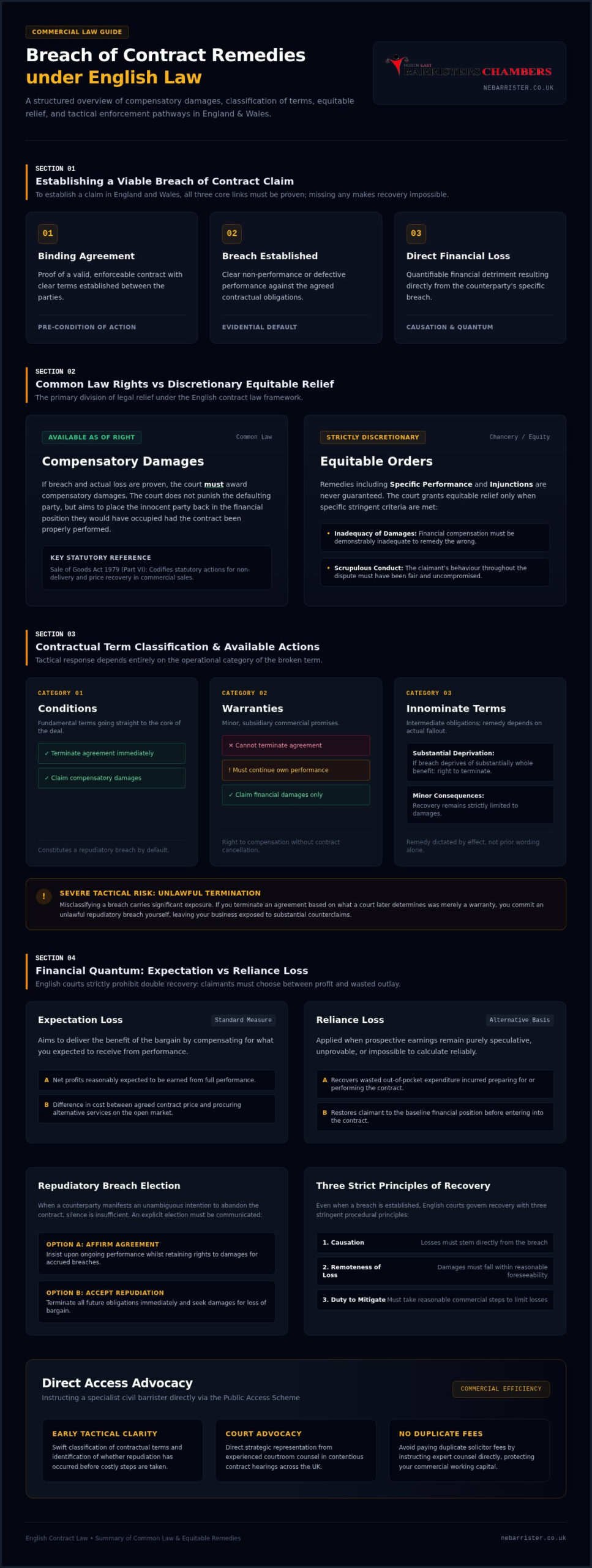
A contractual remedy is the formal legal relief granted to an innocent party when their counterparty fails or refuses to perform agreed obligations. Rather than punishing the defaulting party, the English contract law framework aims to put you back in the financial position you would have occupied had the contract been performed properly. Navigating breach of contract remedies UK claimants can access requires understanding that relief splits into two distinct categories: common law remedies available as of right, and discretionary equitable orders.
To establish a viable breach of contract claim in England and Wales, you must prove three core elements: the existence of a binding agreement, clear non-performance or defective performance, and quantifiable financial loss resulting directly from that breach. Missing any of these links makes recovery impossible, which is why early legal analysis of your contract terms is essential.
Common Law Rights vs Discretionary Equitable Relief
Damages represent an automatic common law right. If you establish a breach and actual loss, the court must award compensatory damages. Equitable remedies, such as injunctions or specific performance, work entirely differently. They remain strictly discretionary. The court will only grant equitable relief if financial damages are demonstrably inadequate and your own conduct throughout the dispute has been scrupulously fair.
Classifying the Breach: Conditions, Warranties, and Innominate Terms
Your tactical response depends entirely on which type of term your counterparty broke. English law classifies terms into three operational categories:
- Conditions: Fundamental terms going to the core of the deal. Breaching a condition constitutes a repudiatory breach, entitling you to terminate the contract immediately and claim damages.
- Warranties: Minor, subsidiary promises. A breach gives you a right to claim financial damages, but you cannot terminate; you must continue performing your own contractual obligations.
- Innominate terms: Intermediate obligations where the remedy depends on the actual fallout. If the breach deprives you of substantially the whole benefit intended, you can terminate; otherwise, your recovery remains limited to damages.
Misclassifying a breach carries severe risks. If you terminate an agreement based on what the court later decides was merely a warranty, you commit an unlawful repudiatory breach yourself, exposing your business to counterclaims.
Primary Legal Remedies: Damages, Repudiation, and Restitution
When an agreement collapses, identifying the correct financial recovery mechanism is your immediate priority. English courts provide several distinct avenues to redress contractual default. In commercial transactions involving goods, statutory rules under Part VI of the Sale of Goods Act 1979 codify these rights, including actions for non-delivery and price recovery. In wider commercial contexts, establishing appropriate breach of contract remedies UK claimants rely on requires selecting the correct basis of assessment.
Calculating Expectation Loss and Reliance Damages
Expectation loss serves as the standard measure of contractual damages. It awards the net profits you expected to earn or covers the difference in cost between the agreed price and procuring alternative services on the open market. When prospective profits remain purely speculative or unprovable, you can claim reliance loss instead. This mechanism recovers out-of-pocket expenditure wasted preparing for performance. Crucially, the court forbids double recovery; you must choose between expectation profits and wasted expenses.
Accepting Repudiatory Breach and Contractual Termination
A repudiatory breach occurs when one party demonstrates an unambiguous intention to abandon the contract. You face a critical decision. You can affirm the agreement and demand performance, or accept the repudiation, terminate future obligations immediately, and claim damages for loss of bargain. Silence is not enough. You must communicate your election clearly and unequivocally.
Proceed with extreme caution here. If you stop performing without establishing a genuine repudiatory breach, you become the party in breach. Seeking advice from counsel specialising in commercial contract disputes helps you evaluate whether termination is legally justified before you act.
Restitutionary Claims and Quantum Meruit
Restitution focuses on stripping wrongful gains rather than compensating losses. If you paid an upfront deposit and received nothing in return, you can claim restitution based on a total failure of consideration. Similarly, where you supplied work or materials under an agreement terminated prematurely, a quantum meruit claim secures reasonable payment for the value delivered. In rare circumstances involving deliberate breaches for profit, courts may even order an account of profits, compelling the defaulting party to surrender gains earned from their violation.
Discretionary Equitable Remedies: Specific Performance and Injunctions
Financial compensation does not always fix the commercial fallout of a broken promise. When monetary payments cannot replace what you lost, English courts can deploy equitable remedies to compel action or halt damaging behaviour. Unlike damages, equitable relief is never an automatic right. A judge will examine the overall fairness of the situation and refuse the application if standard compensatory damages provide an adequate solution. For commercial parties evaluating breach of contract remedies UK courts enforce, securing an equitable order requires meeting rigorous legal tests.
Securing Specific Performance in Commercial Transactions
An order for specific performance compels a defaulting counterparty to execute their positive contractual obligations. The threshold is intentionally high. Courts routinely grant these orders for transactions involving unique assets, such as commercial freehold land, intellectual property assignments, or irreplaceable machinery where open-market substitutes do not exist. Conversely, judges refuse specific performance for personal service contracts, employment disputes, or ongoing commercial duties that require constant judicial supervision.
Prohibitory, Mandatory, and Interim Injunctions
Injunctions operate to protect your commercial position before irreversible harm occurs. English civil courts grant three primary forms:
- Prohibitory Injunctions: Restrain a party from committing or continuing a breach, such as violating a non-compete covenant or disclosing proprietary data.
- Mandatory Injunctions: Compel an opponent to take positive restorative steps, such as returning seized equipment or restoring vital systems access.
- Interim Injunctions: Emergency orders granted swiftly before trial to preserve essential commercial assets while substantive legal arguments unfold.
You can instruct specialist counsel through the Bar Council Direct Access Portal framework to draft urgent injunction applications directly, bypassing administrative delays when time is critical.
Equitable Defences: Clean Hands and the Doctrine of Laches
Securing equitable intervention requires strict adherence to ancient legal maxims. You must come to court with “clean hands”; any sharp practice or unconscionable conduct on your part will prove fatal to your application. Judges also apply the doctrine of laches, dismissing applications brought after unreasonable delay. If granting the order creates severe hardship for the defendant that vastly outweighs your benefit, the court will decline relief and remit your case to financial damages alone.
Assessing Dispute Strategy: Causation, Remoteness, and Mitigation
Proving that a counterparty failed to perform is only half the battle. To win substantial compensatory damages under English law, you must establish an unbroken causal chain between their failure and your financial detriment. The breach must serve as the dominant, effective cause of the loss under the “but-for” test. If independent commercial variables or intervening acts caused your shortfall, the court will disallow those figures. Successfully securing breach of contract remedies UK courts provide requires stress-testing your financial claims against causation, remoteness, and mitigation before initiating litigation.
The Rule in Hadley v Baxendale: Foreseeability of Losses
Recoverable damages are strictly confined by the doctrine of legal remoteness. Established in Hadley v Baxendale, this rule limits compensable loss to two specific categories:
- Limb One: Losses arising naturally and directly according to the usual course of business. These represent ordinary commercial outcomes that any prudent party would expect upon breach.
- Limb Two: Exceptional or indirect losses that were reasonably within the contemplation of both parties when the contract was formed. Crucially, this requires proving that special circumstances were explicitly communicated before signing.
Any unexpected commercial fallout outside these two limbs will be ruled legally remote and entirely struck from your claim.
The Legal Duty to Mitigate Contractual Losses
English law imposes a strict positive duty on innocent parties to take reasonable commercial measures to minimise their loss. You cannot sit back, allow damages to accumulate, and expect the defaulting party to cover the bill. If a judge finds you could have secured alternative suppliers or replacement goods on reasonable terms, the court will deduct those avoidable losses from your final award. Reasonable expenses you incur whilst taking active steps to mitigate are, however, fully recoverable as part of your damages claim.
Strategic Evidence Gathering and Pre-Action Protocols
Rushing into formal litigation without adequate preparation invites heavy costs penalties. English civil courts require parties to comply with pre-action protocols before issuing proceedings in the High Court or County Court. You must serve a detailed letter of claim, provide clear supporting evidence, and grant your opponent a reasonable window to respond.
Collating contemporaneous correspondence, draft agreements, internal communications, and rigorous financial audit trails early on is vital. Courts increasingly expect parties to explore alternative dispute resolution or mediation to settle claims quickly and reduce legal costs UK businesses face. If you require strategic dispute evaluation or trial representation, you can instruct an experienced civil barrister directly to manage your contractual claim efficiently.
Instructing a Direct Access Barrister for Contract Disputes Across the UK
Traditional commercial litigation often feels needlessly slow and prohibitively expensive. In standard practice, instructing a solicitor who then instructs a barrister introduces double handling, communication lag, and compounding legal fees. Under the Bar Standards Board Public Access Scheme, commercial enterprises and individuals across England and Wales can instruct specialist court advocates directly. This modern direct access approach bypasses traditional intermediaries, giving you immediate contact with the advocate who will ultimately argue your position in court.
By engaging a barrister from day one, you receive candid, authoritative guidance on the exact breach of contract remedies UK courts will award in your specific scenario. This early assessment prevents costly missteps and establishes a clear litigation strategy from the outset.
The Direct Access Advantage in Commercial Litigation
Engaging counsel directly delivers significant strategic and financial benefits. Instead of funding two separate legal teams, you pay transparent fixed or agreed fees directly to your barrister, securing substantial savings compared to traditional law firm models. You gain an immediate, realistic appraisal of your prospects of success, the quantifiable strength of your damages claim, and the viability of seeking interim injunctions.
Specialist Advocacy for High Court and County Court Claims
Barristers spend their professional lives in the courtroom, mastering trial advocacy and procedural tactics. When you instruct counsel directly, you secure specialist drafting for Particulars of Claim, formal defences, and strike-out applications designed to dismantle poorly pleaded claims early. Whether your dispute sits in the County Court or involves complex High Court proceedings, your advocate manages the substantive legal arguments, including disputes overlapping with a civil negligence claim barrister instruction.
How to Prepare and Instruct Counsel Directly
Instructing a direct access barrister is straightforward. To ensure an efficient initial assessment, organise your documentation systematically:
- Collate core documents: Assemble the signed agreement, written variations, purchase orders, and default correspondence in chronological order.
- Summarise key events: Draft a concise factual chronology outlining the operational failure and key communications between the parties.
- Quantify your losses: Provide invoices, balance sheets, and replacement cost calculations demonstrating the financial harm suffered.
With this foundation in place, your barrister can evaluate your breach of contract remedies UK options swiftly, advise on pre-action tactics, and represent your commercial interests robustly in court.
Enforce Your Contractual Rights with Confidence
Securing the right commercial outcome after an agreement breaks down requires fast, tactical decision-making. Knowing how to assess breach of contract remedies UK courts enforce ensures you don’t jeopardise your position through premature termination or avoidable failures to mitigate your loss. Whether your dispute demands compensatory expectation damages, restitution of funds, or urgent equitable orders to preserve vital assets, swift action is critical.
You don’t have to absorb crippling losses or face escalating solicitor bills to protect your interests. Under the Public Access scheme, you can engage an experienced court advocate directly. This approach eliminates duplicate fees and provides specialist civil litigation representation across England and Wales. I offer straightforward advice on financial recovery and dedicated trial advocacy from day one. You can instruct a Direct Access barrister for your contract dispute today to evaluate your remedy options and safeguard your commercial position.
Frequently Asked Questions
What are the main remedies for breach of contract in the UK?
The primary breach of contract remedies UK courts provide divide into common law awards and discretionary equitable relief. Common law entitles you to compensatory damages (covering expectation or reliance losses) and the right to repudiate the contract if a fundamental condition is breached. Restitution allows recovery of money where consideration completely failed. If financial compensation is inadequate, the court can grant equitable remedies such as specific performance or prohibitory and mandatory injunctions.
Can I claim compensation if a contract was breached without written terms?
Yes, verbal contracts are legally binding and enforceable under English law, provided you can prove offer, acceptance, consideration, and an intention to create legal relations. Establishing a breach without written terms requires corroborating evidence. You should gather email exchanges, text messages, invoices, witness statements, and banking records that reflect the agreement. Once you demonstrate the agreed terms and subsequent non-performance, you can pursue damages for your actual financial loss.
How much can I claim in damages for a commercial contract breach?
You can claim the sum required to put your business back in the financial position it would have occupied had the contract been performed properly. This generally includes lost profits, extra costs incurred to find replacement suppliers, and wasted expenditure. You cannot claim speculative profits or losses deemed too remote under the rule in Hadley v Baxendale. Damages are purely compensatory in English civil courts; they don’t serve to punish the breaching party.
What is the difference between specific performance and an injunction?
Both are discretionary equitable remedies, but they compel different actions. Specific performance requires a party to carry out their positive contractual obligations, such as completing a commercial land sale or transferring unique intellectual property. An injunction, by contrast, usually restrains a party from doing something prohibited by the contract, such as breaching a restrictive covenant or misusing confidential trade secrets. Interim injunctions can also freeze disputed assets ahead of trial.
What happens if I fail to mitigate my losses after a breach?
If you fail to mitigate your losses, the court will reduce your damages award by the amount you could have reasonably avoided. English law requires innocent parties to take sensible commercial steps to minimise their financial exposure following a breach. While you aren’t forced to take unreasonable risks, sitting idle and allowing losses to mount means you will personally absorb the avoidable portion of that financial harm.
Can I instruct a barrister directly to handle my contract dispute in court?
Yes, commercial clients and individuals can instruct a civil barrister directly under the Bar Standards Board Public Access Scheme without hiring a solicitor. When seeking breach of contract remedies UK practitioners evaluate, direct access advocacy allows you to obtain strategic legal advice, expertly drafted court pleadings, and robust courtroom representation. This direct route cuts out intermediary costs and duplicate fees whilst delivering experienced trial advocacy across England and Wales.
Is there a time limit for claiming breach of contract remedies in the UK?
Under the Limitation Act 1980, the standard statutory limitation period for a simple breach of contract is six years from the date the breach occurred, not when you discovered the damage. For agreements executed as formal deeds, the limitation period extends to twelve years. If you require equitable remedies like an injunction or specific performance, you must act much faster; unreasonable delay can result in your claim being barred under the doctrine of laches.