
Yes, you can change your legal representative. In England and Wales, Form N434 can be used to tell the court that your representative has changed, has stopped acting and you are acting for yourself, or has been appointed, according to HM Courts & Tribunals Service. For an immigration matter, you may need to notify the relevant immigration service about a change in legal representation.
Changing your legal representative can feel like another complication when a case is already demanding. In most cases, you can change representatives, but you need to manage the handover carefully so court communications, documents and deadlines are not missed.
This article explains when Form N434 applies, who completes it and who should receive copies. It also covers the UKVI update service, so you can identify the right notification step for your situation.
Key Takeaways
- In England and Wales, Form N434 can notify the court that a representative has changed, stopped acting or been appointed. Your representative completes the form when you appoint or change one.
- Plan the handover clearly: understand what notice to give your current solicitor and how to arrange the transfer of your case papers.
- Send copies of the court notice to the court, every other party and any previous legal representative, and consider how the change fits around your case timetable.
- For court representation or direct access barrister services in criminal or civil law, North East Barristers Chambers may be a practical option to consider.
Changing or appointing a legal representative
You can change your legal representative or appoint one during a case. In England and Wales, Form N434 is one step for notifying the court.
Notice to the Current Solicitor
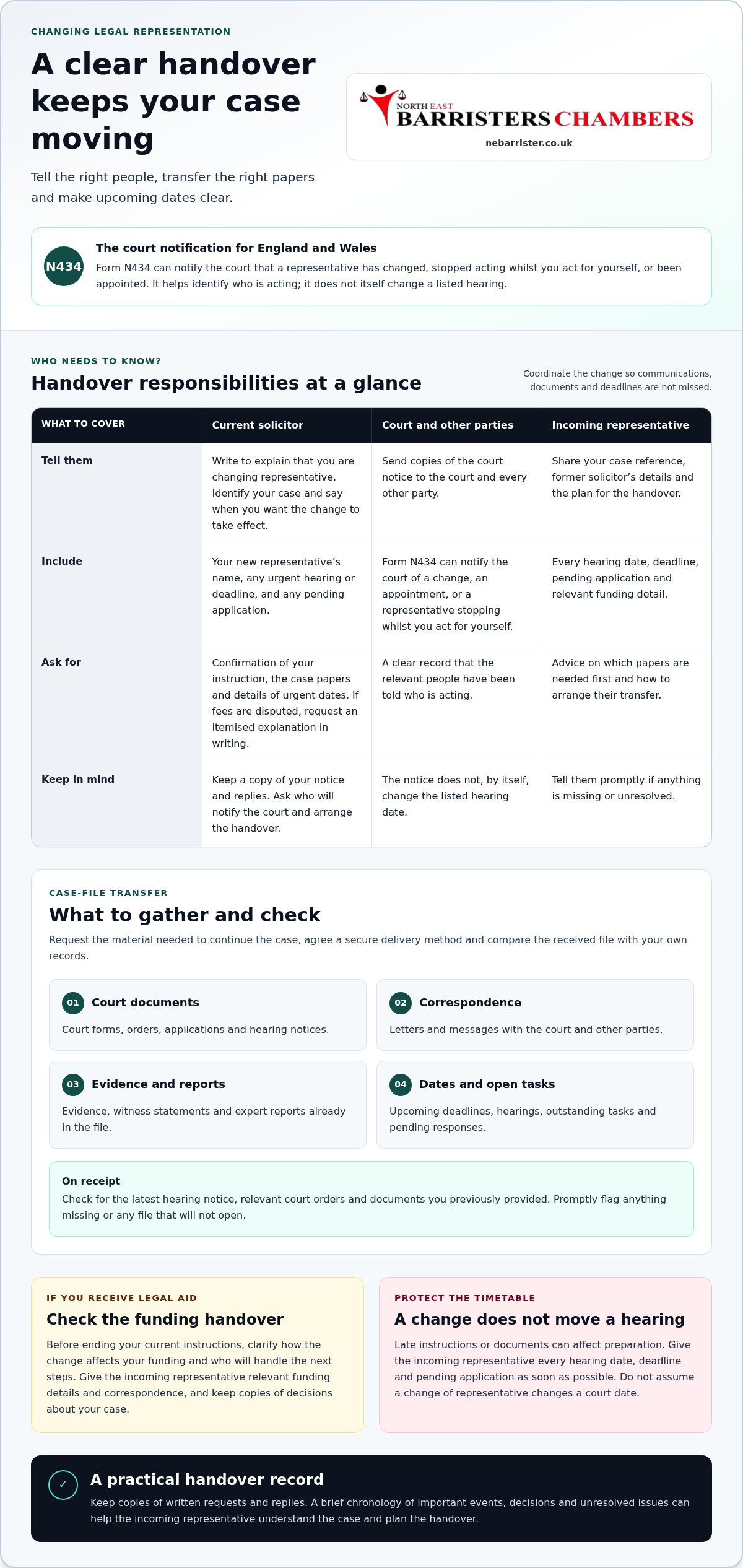
Write to your current solicitor to explain that you are changing representative. State when you want the change to take effect, give your new representative’s name and mention any urgent hearing or deadline. Ask who will notify the court and arrange the handover. If your solicitor disputes fees or refuses to release papers, request the documents and an itemised explanation in writing. Keep the reply and tell your new representative what remains unresolved.
Legal Aid and Changing Representatives
You can request a different representative while receiving legal aid, but arrange the change around your funding. Before ending your current instructions, clarify how the change affects your funding and who will handle the next steps. Give your new representative the relevant funding details and correspondence. Keep copies of decisions about your case so the incoming representative can understand the position and plan the handover.
Transferring Case Files and Papers
A case-file transfer is the handover of documents needed to continue your matter. Write to request the relevant court papers, correspondence and evidence, identifying your case clearly. Ask your former solicitor to send the material directly to your new representative, or agree a secure delivery method. Include the case number if available, and list upcoming deadlines or hearings. When the papers arrive, compare them with your records and promptly flag anything missing.
Effects on the Case and Court Hearing
A change of representative can affect preparation if instructions or documents arrive late. Give the incoming representative every hearing date, deadline and pending application as soon as possible. Do not assume that changing representative changes a court date. In England and Wales, HM Courts & Tribunals Service says Form N434 can notify the court that a representative has changed, stopped acting whilst you act for yourself, or been appointed. Send copies of the notice to the court, all parties and any previous legal representative. This helps the relevant people know who is acting, but does not itself change the listed hearing.
What notice must I give my current solicitor when changing representatives?
Written notice tells your current solicitor that you are ending their instructions. Send it directly, identify your case and state when you want the change to take effect. Keep a copy of your message and any reply. This gives you a clear record of what you requested and when.
Before sending notice, organise the handover with your incoming representative. Confirm their name and contact details, then agree who will notify the court and other parties. Include practical details in your message, such as an upcoming hearing, a filing deadline or an application awaiting a response. Do not assume the new representative already has this information.
Your notice can briefly explain the change and set out the next actions. For example, you could ask your solicitor to:
- Confirm receipt of your instruction to end the current arrangement.
- Provide a final account and explain any disputed fee in writing.
- Arrange transfer of your case papers to your new representative.
- Identify urgent deadlines or court dates in the file.
If your solicitor disputes fees or will not release papers, keep the issue separate from urgent case dates. Write again, explain which documents you need and request an itemised account of the disputed work. Save the correspondence and tell your new representative what remains unresolved. Do not rely on a phone call alone: a written record can clarify the request and response.
Check that the handover plan covers court notifications as well as correspondence between solicitors. If the matter involves a hearing, give the incoming representative its date and any related directions. For help with advocacy after changing representatives, court representation may be relevant to your next step. Keep your notice concise, specific and focused on the case.
How to transfer my case file and papers to a new solicitor
A case-file transfer moves the documents and information needed to continue your matter. Start by giving your new representative your case reference, your former solicitor’s details and any approaching hearing or deadline. This helps them identify the file and prioritise urgent material.
Make a written request to your former solicitor, naming the case and asking them to arrange the handover. Ask your new representative which documents they need first. A court order or approaching hearing may make some papers more urgent than background correspondence.
Use a short checklist to make the transfer easier to track:
- List court forms, orders, applications and hearing notices.
- Include correspondence with the court and other parties.
- Identify evidence, witness statements and expert reports already in the file.
- Ask for key dates, outstanding tasks and pending responses.
- Agree how electronic documents and any original papers will be sent.
When the file arrives, compare its contents with your records. Check, for example, that it includes the latest hearing notice, relevant court orders and documents you previously provided. Tell your new representative promptly if an item appears to be missing or a document will not open. Keep your own copy of the request and transfer correspondence.
A useful handover explains the case history as well as transferring paperwork. Write a brief chronology of important events, decisions and unresolved issues. Clearly mark deadlines and hearing dates, distinguishing confirmed dates from those you are still waiting to hear about. This gives your new representative a practical starting point.
Keep original documents organised until you know how they will be handled. If you send an original, record what it is and when it left your possession. For digital material, preserve the original email or file where possible rather than relying only on a printed copy. A clear, traceable handover helps your new representative locate essential papers and understand what needs to happen next.
Will changing my legal representative delay my case or affect a court hearing?
A case delay is a pause or disruption to planned steps in proceedings. Changing representative can affect preparation if deadlines, documents or hearing arrangements are left unattended during the handover. The priority is continuity: make sure the incoming representative knows what needs to happen next.
A listed hearing is a court date already arranged for your case. Changing representative does not tell you whether that date has changed. Check the latest court notice, give the date to your new representative and ask them to review any directions or work due before the hearing. For example, a pending application may need attention while the papers are being transferred.
In England and Wales, Form N434 can tell the court that representation has changed, according to HM Courts & Tribunals Service. It can also notify the court that a representative has stopped acting and you are acting for yourself, or that a representative has been appointed. The form records the change; it is not a request to move a hearing.
To reduce disruption, prepare a short handover list for your new representative:
- Give them every hearing date and deadline shown in court correspondence.
- Identify applications awaiting a decision or documents awaiting submission.
- Share contact details for the other parties and previous representative.
- Ask who will notify the court and distribute copies of the notice.
Copies of the notice should go to the court, all parties and any previous legal representative. Send them promptly, then retain proof of sending with your case papers. If you need to discuss advocacy for a hearing, arrange court representation and provide the case timetable and relevant documents. This gives the representative practical information for preparing, rather than leaving key dates unclear during the transition.
North East Barristers Chambers: Direct Access Barrister Services
North East Barristers Chambers provides Direct Access Barrister Services for people seeking legal advice or court representation without instructing a solicitor. If you are changing representative, you can instruct a barrister directly for advice or representation in a criminal or civil matter.
For a hearing, share the court date, case papers and outstanding deadlines when discussing representation. This helps the barrister understand the stage of your case and the work required. Direct access does not replace notifying the court or completing the necessary handover steps, so keep those arrangements moving alongside your new instructions.
If you’d like to discuss direct access or court representation, contact North East Barristers Chambers.
Make your next step a deliberate one
“Can I change my legal representative?” The change is only one part of moving your case forward. Decide what support you need now, whether advice on a developing issue or representation at a hearing. A clear view of your priorities can help you explain your position and focus the discussion on the work ahead.
Before getting in touch, note the current stage of your case, any immediate concern and what you want help with. This gives you a focused starting point. North East Barristers Chambers offers Direct Access Barrister Services and Court Representation, including in criminal law. Contact the chambers to discuss direct advice or representation for your case.
When you’re ready to discuss your situation, contact North East Barristers Chambers. Taking a considered next step can help you approach the change with greater clarity.
Frequently Asked Questions
Can I change my solicitor or barrister during a case in the UK?
Yes, you can change your solicitor or barrister during a case. The change may involve moving from solicitor-led support to instructing a barrister directly, depending on what help you need. For example, you may want a barrister to advise on a specific issue or represent you at a hearing. Keep the case timetable in view as you arrange new representation.
How do I change my legal representative in the UK?
Choose your new representative, agree the work they will handle, then notify your current representative in writing. HM Courts & Tribunals Service says that, in England and Wales, Form N434 can be used to tell a court that a legal representative has changed. For an immigration representation change, notify the relevant immigration service. EU Settlement Scheme applicants updating an address use a different service.
Do I need to give a reason or get permission from the court to change my lawyer?
For a representation change in England and Wales, Form N434 notifies the court; it covers a representative changing, stopping acting or being appointed. That notification is distinct from asking the court to alter a hearing date or another case arrangement. If you also need a court decision about a separate issue, explain it clearly to your incoming representative so they can address that request appropriately.