
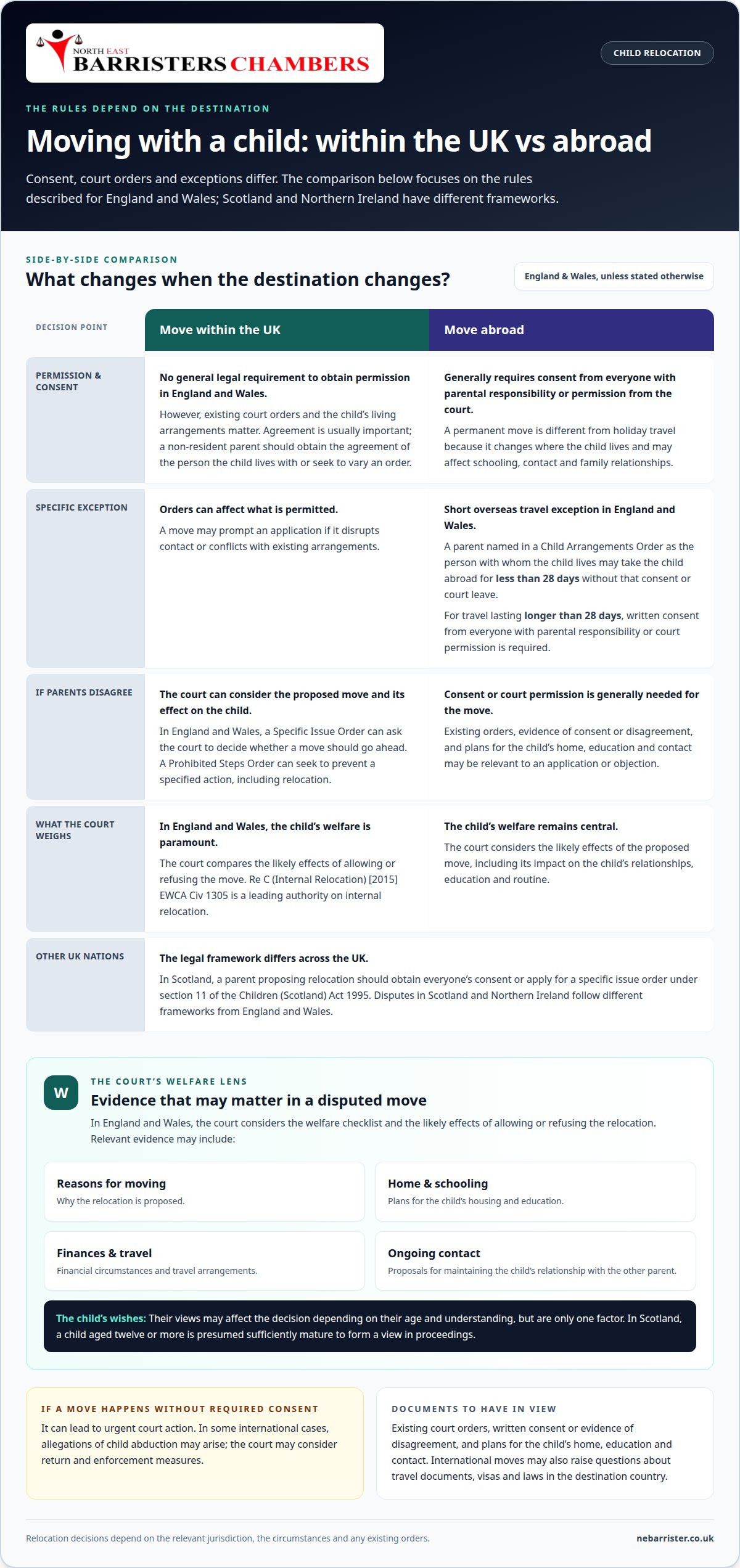
In child relocation disputes under UK law, moving within the UK is treated differently from moving abroad. In England and Wales, there is no general legal requirement to obtain permission to move within the UK, but existing court orders matter and agreement is usually important. Taking a child abroad generally requires the consent of everyone with parental responsibility or the court’s permission, subject to specific exceptions.
It is understandable to think a parent can simply decide where a child lives, or that an unauthorised move is only a private disagreement. But moving without the required consent or permission can lead to urgent court action and, in some international cases, allegations of child abduction.
This article explains when consent or a court order is needed, how courts assess a disputed move, and what may happen if a parent relocates without permission. The rules differ across the UK, so the relevant jurisdiction and any existing orders are central to understanding your position.
Key Takeaways
- Separate a move within the UK from a move abroad: the consent rules differ, and any existing court order can affect what is permitted.
- Understand how the child’s welfare guides a court’s decision, including the likely effects on their relationships, education and routine.
- Learn which court applications may help when parents disagree, and how a proposed move can be challenged or considered for approval.
- Act promptly if a child has been moved without the required consent or permission, as the court may consider return and enforcement measures.
What is a Relocation Child Case?
A relocation case arises when a parent proposes moving with a child, either within the UK or abroad. Disputes about child relocation under UK law depend on the proposed destination and the legal framework that applies to the family.
Internal and International Moves
An internal move changes a child’s home within the UK; an international move takes the child outside the UK. The distinction matters because consent rules differ, and a move can affect existing child arrangements or court orders.
In England and Wales, there’s no general legal requirement for permission to move within the UK, but existing orders matter. Parents should seek agreement from everyone with parental responsibility or court permission. Re C (Internal Relocation) [2015] EWCA Civ 1305 is a leading authority on internal relocation. Disputes about child relocation under UK law follow different frameworks in Scotland and Northern Ireland.
The Child’s Welfare and Best Interests
In England and Wales, the child’s welfare is the court’s paramount consideration under section 1 of the Children Act 1989. The court considers the section 1(3) welfare checklist and compares the likely effects of allowing or refusing the move.
The court assesses a proposed internal relocation by considering whether it would serve the child’s welfare and best interests. Relevant evidence may include the reasons for moving, plans for housing and schooling, finances, travel arrangements, and proposals for maintaining contact with the other parent.
The child’s wishes may affect the decision, depending on their age and understanding, but are only one factor in the assessment. According to UK Government legislation on legislation.gov.uk, in Scotland a child aged twelve or more is presumed sufficiently mature to form a view in proceedings.
Permission for International Relocation
Taking a child to live outside the UK generally requires consent from everyone with parental responsibility or permission from the court. Permanent relocation is different from holiday travel because it changes where the child lives and may affect schooling, contact and family relationships.
For an application or objection, relevant documents include existing court orders, written consent or evidence of disagreement, and plans for the child’s home, education and contact. International moves may also raise questions about travel documents, visas and laws affecting child arrangements in the destination country.
Parental responsibility and consent
Parental responsibility gives a parent a role in important decisions about a child’s upbringing. In England and Wales, the Children Act 1989 governs these responsibilities; separation doesn’t by itself remove a parent’s responsibility. A father named on a birth certificate for a birth registered on or after 1st December 2003 automatically has parental responsibility.
For a move within the UK, there is no general statutory requirement to obtain permission, but existing orders and the child’s living arrangements matter. A non-resident parent should obtain the agreement of the person the child lives with or seek to vary the order. A parent with court-ordered contact can travel within the UK with the child during their allotted contact time. The proposed move may still prompt an application if it disrupts contact.
Moving abroad is different. A parent generally needs consent from everyone with parental responsibility or permission from the court. In England and Wales, a parent named in a Child Arrangements Order as the person with whom the child lives may take the child abroad for less than 28 days without that consent or court leave. For travel lasting longer than 28 days, written consent from everyone with parental responsibility or court permission is required.
After separation in Scotland, both parents generally retain parental rights and responsibilities. A parent proposing a relocation should obtain everyone’s consent or apply for a specific issue order under section 11 of the Children (Scotland) Act 1995. In England and Wales, Re C (Internal Relocation) says courts will resist preventing a parent from choosing where to live in the UK unless the child’s welfare requires it. That balance recognises parental choice while keeping the child’s welfare central.
There’s no single total for applying: court fees and legal fees are separate, and legal costs depend on the work and complexity involved. For help presenting a family law position in court, family law court representation can support you through the proceedings.
Specific Issue Orders
In England and Wales, parents can ask the Family Court to resolve a relocation disagreement through orders under the Children Act 1989. The right application depends on whether a parent seeks permission or wants to prevent a move.
Specific Issue and Prohibited Steps Orders
A Specific Issue Order asks the court to decide a particular question about a child’s upbringing, such as whether a proposed move should go ahead. A Prohibited Steps Order seeks to prevent a parent from taking a specified action, including relocating with the child.
There is no separate English court order called a “relocation order”. A parent seeking approval may apply for a Specific Issue Order; the objecting parent may seek a Prohibited Steps Order. A parent opposing an internal move must justify the order sought, with the child’s welfare central to the court’s decision.
Parental responsibility matters because it identifies who should be involved in decisions. Parents can explore mediation first, then seek legal advice to clarify which order addresses their concern and what evidence supports their position.
Court Orders for Relocation Disputes
For an internal relocation, the court may consider a Specific Issue Order, Prohibited Steps Order or Child Arrangements Order. It compares the effects of allowing and refusing the move, rather than applying a presumption in favour of either parent.
A parent named in an order as the person with whom the child lives should consider varying it if relocation would make contact arrangements impractical. In contested proceedings, the court may direct CAFCASS to prepare a welfare report. The child’s wishes can inform that assessment, depending on their age and understanding.
Application Process and Timeline
The process usually begins with mediation before a parent applies to court, followed by an application setting out the issue and the order sought. The other parent can respond, and the court considers the evidence and the child’s welfare before making a decision.
The timetable depends on court directions, any CAFCASS welfare report, the urgency of the proposed move and whether the parents agree. A clear proposal should explain the reasons for moving, the practical arrangements and the effect on the child’s relationship with each parent. Delay can affect the child’s welfare, so timing matters.
Unauthorised relocation and child abduction
Moving a child without required consent or court permission can trigger urgent proceedings. In England and Wales, taking a child outside the UK without the necessary consent or court order can amount to child abduction under the Child Abduction Act 1984. An unauthorised move within the UK may also breach a Child Arrangements Order or lack lawful justification.
If a child has been moved without agreement, the parent left behind can seek the child’s return. Act promptly: apply to court as soon as you discover the move, and provide relevant orders and details of when and where the child travelled. The court may order a return, particularly if the move bypassed consideration of the child’s welfare or the other parent’s involvement.
For an international move, the Hague Convention on the Civil Aspects of International Child Abduction may apply. It provides a route to seek a child’s return across participating countries when a move is alleged to be wrongful. The destination country, the child’s habitual residence and the circumstances of the removal can affect the proceedings. Travel documents, visas and international arrangements may also be relevant.
A parent concerned about a proposed move can apply for a Prohibited Steps Order to prevent the child being taken abroad or relocated without consent. If relocation has already happened, the court may consider enforcement, including an order for the child’s return. Breaching an order can have serious consequences, including fines, a transfer of residence or imprisonment for persistent breaches. The child’s emotional welfare remains central, alongside existing orders and each parent’s position.
Keep copies of court orders, messages about agreement and travel details. If your child has been moved without permission, seek court representation for an urgent relocation dispute to understand the available legal steps.
North East Barristers Chambers: Direct Access Barrister Services
North East Barristers Chambers provides direct access barrister services and court representation for people dealing with legal disputes. If a relocation disagreement is heading to court, a barrister can help you understand the proceedings and present your position clearly. Direct access lets you instruct a barrister without a solicitor.
Prepare the current court orders, a clear account of the proposed move, and documents showing how it could affect the child’s arrangements and contact with each parent. These details help focus the legal issues and the evidence relevant to your case. Court representation may be appropriate when you need an advocate to present your arguments at a hearing.
For information about instructing a barrister or arranging representation, visit North East Barristers Chambers online.
Take a clear next step
Before taking further action, decide what outcome you are seeking. You may want to pause a proposed move, agree on workable contact arrangements, or reconsider an existing order. A clear objective helps keep discussions and court proceedings focused on the child’s needs, rather than the conflict between parents.
For parents facing child relocation disputes under UK law, timing and preparation can help make their position clear. Set out the practical change you seek and your reasons for it. If the matter is heading to a hearing, consider what you need the court to decide and how you will explain your request.
North East Barristers Chambers offers Direct Access Barrister Services and Court Representation. If you’d like to discuss your circumstances and possible next steps, contact North East Barristers Chambers. A clear, considered approach can help you move forward with greater confidence.
Frequently Asked Questions
Do I Need Permission to Move With My Child Within the UK?
In England and Wales, there is no general legal requirement to obtain court permission to move within the UK, but an existing order may affect your plans. For example, a move that makes ordered contact difficult may require changes to the arrangements. If the other parent has parental responsibility, discuss the proposed move and its practical effects before moving. Scotland and Northern Ireland have separate legal frameworks.
How does the court decide such cases?
The court decides relocation disputes by assessing the child’s welfare and comparing the likely effects of allowing or refusing the move. It may consider schooling, relationships with each parent, the child’s wishes in light of their age and understanding, and how contact could continue. For example, a detailed travel plan can show how the child could maintain regular contact after a move.
Can I stop my ex from moving away with my child?
You can ask the court to prevent a proposed move by applying for a Prohibited Steps Order. Set out the specific action you want stopped and explain its likely effect on the child. If the move is already underway or an existing order may be breached, act promptly and provide the relevant order and information about the planned or completed move.
How Can Disputes About Relocation Be Resolved Amicably?
Parents can use family mediation to discuss a proposed move with an independent mediator and explore workable arrangements. For instance, they could discuss school holidays, travel responsibilities and contact by telephone or video call. A written agreement can record the arrangements reached. If parents cannot agree, mediation may clarify which issues remain for the court to decide.
Is There a ‘Live With’ Order for a Child in the UK?
In England and Wales, a Child Arrangements Order can state who the child lives with. That wording matters when considering travel abroad or a proposed relocation, because specific exceptions apply to the person named in the order. The order may also set contact arrangements. Scotland and Northern Ireland have separate legal frameworks, so the terminology and relevant orders can differ.
What Is Internal Relocation and How Does It Differ From International Relocation?
Internal relocation means moving a child’s home within the UK; international relocation means moving the child outside the UK. The distinction matters because taking a child abroad generally requires the agreement of everyone with parental responsibility or the court’s permission, subject to specific exceptions. An international move can also raise practical issues involving travel documents, visas and arrangements for maintaining family contact.