
What if the most important stages of a civil claim happen before you reach a courtroom? The civil claim process step-by-step involves more than filing a form: early correspondence, evidence, decisions and deadlines can all shape what happens next. It’s understandable to worry that missing a step could affect your case, especially when the rules and documents feel unfamiliar.
This guide explains the usual stages, from trying to resolve a dispute before court to a hearing and possible judgment. You’ll learn what to prepare, which deadlines to track and how a claim may progress through the court system. Procedures differ across the UK, so check which rules apply to your jurisdiction.
We cover pre-action steps, issuing and responding to a claim, gathering and presenting evidence, and preparing for a hearing. We also explain decisions that may arise along the way, including whether to settle, and how barrister advice or court representation may help you assess your options.
Key Takeaways
- The civil claim process step-by-step guide explains how a dispute can move from early correspondence towards court proceedings.
- Learn what to consider before issuing a claim, including relevant pre-action conduct and preparing key documents.
- Understand the roles of the claim form, particulars of claim and the defendant’s response, and why the correct route depends on the case.
- See how court directions organise evidence and preparation, including disclosure, witness statements and expert evidence.
- Explore possible outcomes, what enforcement involves if a judgment is not followed, and when barrister advice or representation may help.
Civil claim process step-by-step: what happens before court?
The civil claim process step-by-step starts with a dispute, not necessarily a court hearing. A civil claim is a formal way to ask a court to decide a legal dispute and, where appropriate, provide a remedy. Issuing proceedings is only one possible route. The parties may first try to resolve the disagreement through correspondence or negotiation. Court proceedings begin when a party asks the court to determine the claim.
This guide focuses on civil procedure in England and Wales. Scotland and Northern Ireland have distinct legal procedures, so the steps described here may not apply there. For a broader overview of the system covered in this guide, see Civil procedure in England and Wales.
Which disputes may become civil claims?
Contract disagreements, unpaid debts, property disputes, personal injury matters and professional negligence allegations can all give rise to civil claims. That doesn’t mean every disagreement belongs in court. The right approach depends on the legal basis of the complaint, the outcome sought and the available evidence. Whether seeking support from legal specialists like Indre Zukaityte or consulting a barrister, professional advice can help assess the strengths and risks of a proposed claim before you decide how to proceed.
For example, an unpaid invoice dispute may involve the contract, the work completed and records of payment requests. A property dispute may turn on different documents and facts. The label alone doesn’t establish that a claim will succeed; the details matter.
Who is the claimant and who is the defendant?
The claimant is the person or organisation bringing the claim. The defendant is the person or organisation responding to it. Either role may be held by an individual or a business. These labels describe each party’s position in the proceedings, not whether the court has decided who is right.
In plain English, a civil claim is a request for a court to resolve a legal dispute between parties. If proceedings are issued, the defendant has an opportunity to respond. The claim then follows the relevant procedure, which depends on its type and circumstances.
Keep negotiations distinct from court proceedings so you know where you are in the process. Discussions may resolve the dispute without a court decision. If they don’t, a party may consider issuing a claim after weighing the evidence, risks and practical consequences. These early choices can shape what happens next.
Before issuing a civil claim: resolve the dispute and prepare
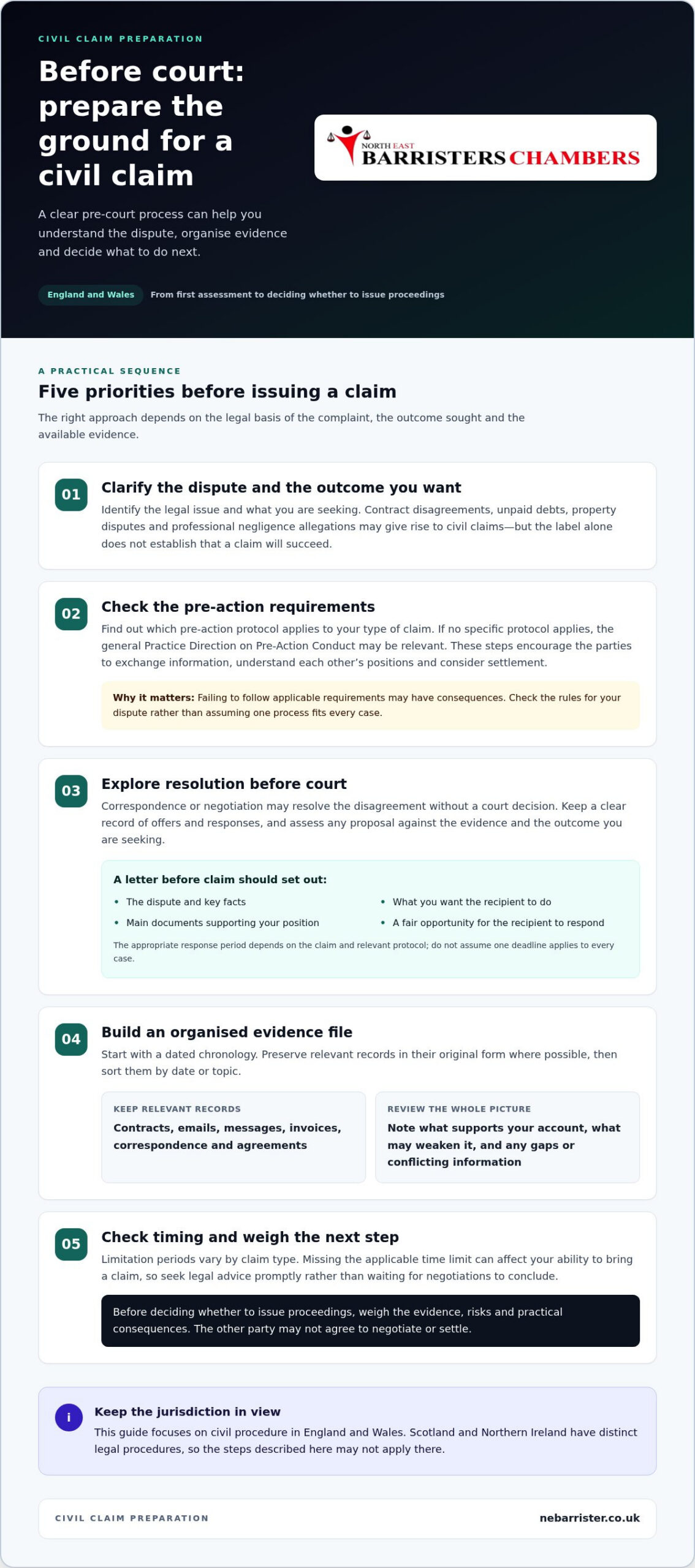
Good preparation helps clarify whether court proceedings are appropriate and what you may need to prove. Start by identifying the legal issue and the outcome you want. Then gather and organise relevant records, check the applicable pre-action protocol, and consider whether correspondence or negotiation could resolve the dispute. A barrister can advise on the strengths and risks of a potential claim before you decide what to do next.
Pre-action protocols set out steps parties should take before certain types of claim. Where no specific protocol applies, the general Practice Direction on Pre-Action Conduct may be relevant. These steps encourage parties to exchange information, understand each other’s positions and consider settlement before proceedings begin. Failing to follow applicable requirements may have consequences, so identify the rules that apply to your dispute.
Negotiation may resolve a disagreement without a court deciding it, but the other party may not agree. Keep a clear record of offers and responses, and assess any proposal against the evidence and the outcome you’re seeking. In a professional negligence claim, a barrister can help assess the legal and factual issues involved.
What should a letter before claim include?
A letter before claim should explain the dispute, identify the key facts and say what you want the recipient to do. Set out the main documents supporting your position and give the recipient a fair opportunity to respond. The appropriate response period depends on the claim and relevant protocol, so check the protocol’s requirements rather than assuming one deadline applies to every case.
How should you organise evidence before making a claim?
Start with a dated chronology. Preserve relevant contracts, emails, messages, invoices and other records in their original form where possible. Sort the material by date or topic, and note which documents support your account and which may weaken it. Reviewing both helps you understand the risks and avoid surprises later.
- Record important events and conversations in date order.
- Keep copies of relevant correspondence and agreements.
- Note what each document shows, including gaps or conflicting information.
Limitation periods vary by claim type. Missing the applicable time limit can affect your ability to bring a claim, so seek legal advice promptly rather than waiting for negotiations to conclude. For practical guidance on starting a money claim, see GOV.UK’s Make a court claim for money guide. A barrister can also advise on how evidence and timing affect your civil claim process step-by-step. Find out more about direct access civil law advice.
Issuing a civil claim: forms, service and the defendant’s response
If early discussions don’t resolve the dispute, the next step may be to issue a claim. The appropriate court and route depend on the type of case, the remedy sought and other features of the dispute. Some money claims can be started online, but the process and documents required vary. GOV.UK explains the route for eligible money claims in its Make a court claim for money guide.
A claim usually sets out the claimant’s case in a claim form and particulars of claim. The form identifies the parties and the remedy sought. The particulars explain the legal basis and key facts relied on. Together, these documents tell the defendant what the claim is about and enable them to respond. They should be accurate and consistent with the evidence. This is an overview, not a guide to completing court forms.
What happens when a claim form is issued and served?
Issue is the formal step that starts court proceedings. The claim is submitted through the relevant court process, administered by HM Courts & Tribunals Service (HMCTS). Service is the formal delivery of the claim documents to the defendant under the applicable rules. Issue and service are separate events, and the route used affects how the documents are handled. Keep records of key dates and documents because service can affect the time available for a response.
After receiving the claim, the defendant must decide how to respond. The available steps and deadline depend on the claim type, how it was issued and served, and the current procedural rules. Don’t assume the same response period applies to every case.
How can a defendant respond to a civil claim?
A defendant may admit the claim, dispute all or part of it, or acknowledge the claim before taking a further procedural step. They may also challenge an issue such as the court’s jurisdiction. The appropriate response depends on the circumstances, and each option affects how the case proceeds.
Ignoring a claim is risky. If a defendant doesn’t respond within the applicable time, the claimant may be able to seek judgment in default, subject to the rules and the court’s decision. That can have serious consequences. Check the response deadline and instructions on the documents promptly, and get advice if the position is unclear.
Understanding what has been issued, when it was served and what response is required can help avoid preventable errors. A barrister can advise on the claim’s strengths and risks, or provide court representation where appropriate.
Evidence, court directions and hearings: how a civil claim progresses
Once a claim is underway, the court may give directions to manage the steps needed before a hearing. These can specify what each party must do, which evidence to provide and when. Directions depend on the case, so read each order carefully and diarise its deadlines. Missing a step can affect how the court manages the claim.
Court directions turn a claim into an ordered plan, setting out what the parties must do before the judge can decide the dispute. The court may also encourage or require the parties to consider settlement at appropriate points. If they agree terms, the case may conclude without a final hearing. If not, it can continue towards a hearing, where the judge considers the evidence and arguments. Settlement may avoid the time and demands of a hearing, but whether an offer is suitable depends on the case and its risks.
What are disclosure and witness statements?
Disclosure means sharing relevant documents in line with the court’s directions. This may include material that supports a party’s case as well as documents that don’t. Witness statements set out the evidence a witness may give, usually based on what they saw, heard or did. They help each side understand the evidence before the hearing. Expert evidence is different: it gives an independent specialist opinion on an issue requiring expertise, and is used only where the case and court allow it.
Keep evidence organised and follow the court’s instructions about what to exchange and when. Documents, witness accounts and any permitted expert evidence should address the issues the court needs to decide, rather than add irrelevant material.
What happens at a civil hearing or trial?
At a hearing, each side may make submissions explaining its position and how the law applies. The judge considers those arguments alongside the evidence, which may include documents and questions put to witnesses. The judge then decides the issues before the court. The format varies: hearings may take place in person or remotely where permitted, depending on the case and the court’s arrangements.
Advocacy can help present a case clearly, respond to the other side’s arguments and focus the court on the relevant evidence. A barrister can provide civil law advice and, where appropriate, court representation. Find out about barrister support for a civil claim through direct instruction. Knowing what to expect at this stage can help you prepare for the decisions and responsibilities ahead.
Civil claim outcomes, enforcement and getting the right legal support
A civil claim can end in different ways. The parties may settle, the claimant may discontinue the claim, or the dispute may proceed to judgment. Settlement records the parties’ agreement. Discontinuance means the claimant formally ends the claim, although the consequences can depend on the circumstances. If the case reaches judgment, the court decides the issues and makes an order. The outcome depends on the case; none of these routes is automatic.
What happens after a civil court judgment?
The court order sets out its decision and any action a party must take, such as paying a sum or meeting another requirement. Read it carefully and note any dates or conditions. A judgment doesn’t always lead to immediate payment or compliance. If the other party doesn’t follow the order, enforcement is a separate process. The available route depends on the judgment and circumstances, and enforcement cannot guarantee recovery.
If you think the decision may be wrong, get advice promptly. Appeal routes, grounds and deadlines depend on the case, and the time to act may be limited. Don’t assume an appeal is simply a second hearing or wait until enforcement begins before considering your options.
How can a barrister support a civil claim?
A barrister can provide direct access advice to help you assess the issues, evidence, risks and possible next steps. Depending on the agreed engagement, support may include advice on the case, drafting particular documents or advocacy at a hearing. These tasks aren’t the same. Advocacy means presenting arguments in court; conducting litigation involves managing the proceedings, including procedural steps and correspondence. The scope of a barrister’s role depends on the engagement and any relevant authorisation, so make sure it’s clear who is responsible for each task.
Individuals and businesses can instruct a barrister directly for legal advice and professional advocacy without the requirement to instruct a solicitor. A barrister’s advice can help you understand your options before you act, but no result can be promised.
To prepare for a discussion about your matter, gather the court order or claim documents, note important dates and write down the questions you need answered. This gives the barrister a practical starting point to assess the position and advise on next steps.
If you’re weighing a settlement, considering an appeal or dealing with a judgment that hasn’t been followed, direct access civil law advice can help you understand your options.
Take your next step with a clearer view
The civil claim process step-by-step is shaped by decisions made well before a hearing. Check the pre-action requirements, organise your evidence and track important deadlines. If proceedings are issued, understand what the court documents require and respond promptly. A claim may settle, end by discontinuance or proceed to judgment; any enforcement or appeal requires separate attention.
The right advice can help you assess the strengths and risks of your position and decide what to do next. Barristers can be instructed directly to provide advice and, where appropriate, professional advocacy and court representation in civil matters.
For advice on your civil claim, instruct North East Barristers Chambers directly for civil law advice and representation.
Frequently Asked Questions
How long does a civil claim take in England and Wales?
There’s no fixed timescale; the duration depends on the case, the court’s timetable and whether the parties settle. Ministry of Justice Civil Justice Statistics Quarterly data for January to March 2026 reports a median of 37.6 weeks from issue to small claims trial, and 54.3 weeks for fast, intermediate and multi-track claims. These figures measure time to trial, not the full duration of every claim, and shouldn’t be treated as a prediction for an individual case.
Can I bring a civil claim without a solicitor?
Yes. You can represent yourself, and individuals or businesses may also instruct a barrister directly for legal advice and professional advocacy. If you choose to represent yourself and need practical support at hearings, services like Find a McKenzie Friend can connect you with vetted assistance. The civil claim process step-by-step still involves formal documents, court rules and deadlines, so consider what support you need before proceedings begin. A barrister can advise on the strengths and risks of your case or represent you in court. The scope of an engagement may vary, particularly for managing procedural steps.
What happens if a defendant does not respond to a civil claim?
If a defendant doesn’t respond within the applicable deadline, the claimant may be able to request judgment in default. This isn’t automatic in every case: the court rules, claim type and procedural position matter. A defendant who has missed a deadline should act promptly and get advice about possible next steps. A response might include admitting or disputing the claim, acknowledging it, or raising a procedural challenge, depending on the circumstances.
Do I have to send a letter before claim?
Before most civil claims, parties are expected to follow the relevant pre-action protocol or the general Practice Direction on Pre-Action Conduct. This will often involve sending a letter before claim, setting out the dispute and allowing a reasonable time for a response. The precise requirements depend on the type of claim, so check the applicable protocol before writing. Non-compliance may have consequences, and a letter doesn’t itself start court proceedings.
What evidence do I need to support a civil claim?
The evidence depends on what the claim is about and what you need to prove. It may include contracts, emails, letters, invoices, photographs, payment records or witness accounts. Make a dated chronology and keep relevant records, including material that may not support your position. The court may later give directions about disclosure, witness statements and, where appropriate, expert evidence. A barrister can help assess whether the evidence supports the legal basis of your claim.
Can a civil claim be settled before trial?
Yes. The parties can reach an agreement before a trial, including during pre-action discussions or after proceedings have started. A settlement may resolve some or all of the dispute, but neither party is guaranteed to accept an offer. Consider the proposed terms against the evidence, risks and outcome you’re seeking. Record any agreement clearly and understand its effect on the claim before treating the matter as resolved.
What is the difference between a County Court and High Court claim?
Both courts deal with civil disputes, but the appropriate court depends on factors such as the claim’s value, subject matter, complexity and the remedies sought. The County Court handles a wide range of civil claims; the High Court deals with specified categories and cases that warrant its jurisdiction. The correct court and route aren’t determined by claim value alone. Check the relevant rules and get advice if you’re unsure where proceedings should be brought.