
A civil fraud claim is about proving that dishonest conduct caused a loss, not merely that a deal went wrong. For civil fraud claims in the UK, the civil standard is the balance of probabilities. A deceit claim requires a false representation, knowledge or recklessness about its truth, intended and actual reliance, and resulting loss. The precise claim depends on what happened and the available evidence.
It can be difficult to determine whether suspicious conduct amounts to civil fraud, particularly if documents or assets may be concealed. This guide explains what civil fraud means, what a claimant must establish, and how the elements fit together.
You’ll also learn how an Anton Piller search order may preserve evidence at risk of destruction, and how asset tracing and recovery may work. The focus is on practical steps in England and Wales, from identifying a potential claim to seeking court orders that may protect evidence or assets.
Key Takeaways
- Understand when an Anton Piller search order may help preserve evidence, and how it differs from an order that freezes assets.
- Follow the practical steps involved in tracing property and considering claims connected to the proceeds of fraud.
- Learn how a breach of fiduciary duty may form part of a civil fraud claim and what the relationship between the parties means.
- Use the key elements of a claim to assess the evidence, including what may show dishonesty, reliance and loss.
What is an Anton Pillar order?
An Anton Piller order is a search order used in England and Wales to preserve evidence at risk of destruction or concealment. It may let a claimant’s representative search a defendant’s home or business for records linked to fraud or assets.
Third-party asset freezing and information orders
A search order targets evidence; a Chabra order addresses assets held by someone other than the defendant. It can freeze a third party’s assets if they belong to the defendant, without alleging that the third party committed fraud. The key question is whether the evidence connects those assets to the defendant. Information orders may also help identify accounts or clarify who received funds. Norwich Pharmacal, Bankers Trust and Bankers Book Orders may assist with these investigations.
In King and others v Stiefel and others, the High Court of England and Wales issued the judgment cited as [2021] EWHC 1045 (Comm), according to the Judiciary of England and Wales.
Interim relief
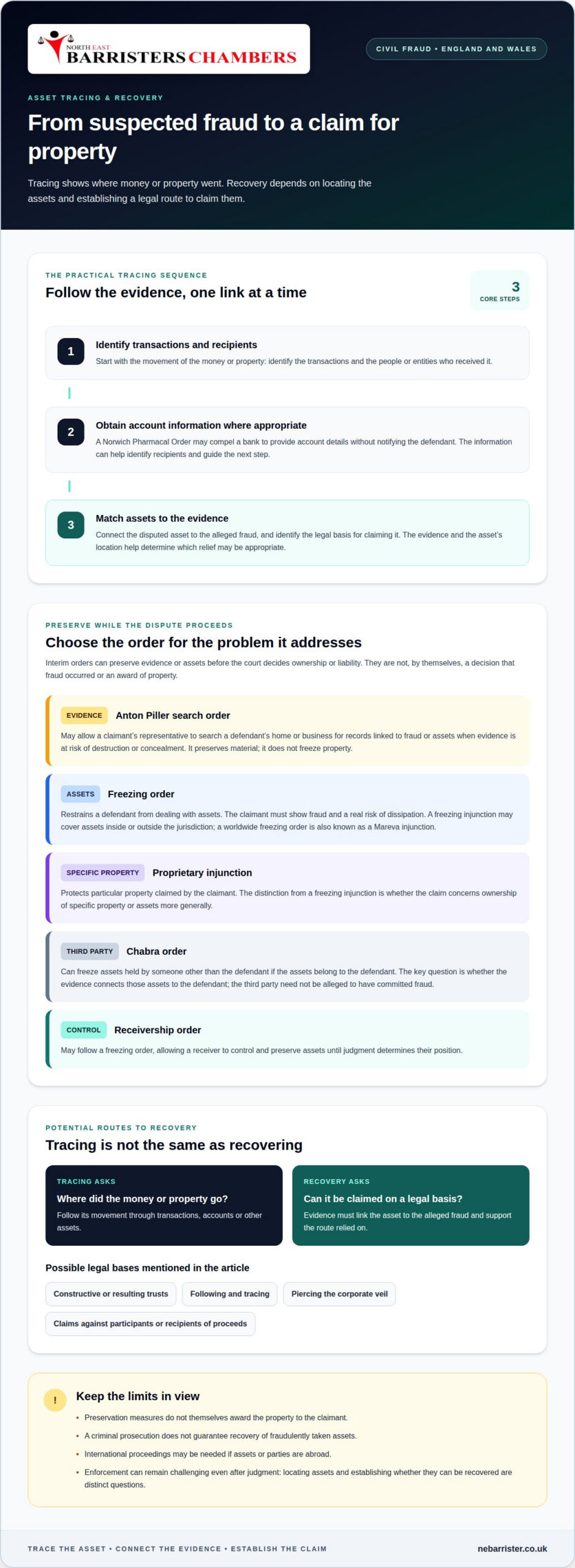
Interim relief can preserve evidence or assets while a civil fraud dispute proceeds. A freezing order restrains a defendant from dealing with assets, while a proprietary injunction protects specific property claimed by the claimant. The choice depends on whether the allegation concerns assets generally or ownership of particular property.
To obtain a freezing order in England and Wales, a claimant must show fraud and a real risk of dissipation. Most freezing orders are made without notice to the defendant. If the evidence supports urgency, an interim order may be obtained within a day or sooner. The court assesses the evidence and the risk of assets being moved or hidden.
A freezing injunction can restrain dealings with assets inside or outside the jurisdiction, according to the UK Government. A worldwide freezing order, also known as a Mareva injunction, can therefore address assets beyond England and Wales. An Anton Piller order has a different purpose: it preserves material for the claim rather than freezing property.
These orders are powerful steps in a dispute, not findings that fraud has occurred. A clear account of the allegations, the evidence sought and the assets at risk helps the court assess the application. The judgment and available documents can shape the route to resolving the dispute.
Asset tracing and recovery of money or property
Yes. An injunction may freeze assets, while tracing helps establish where money or property went. Recovery depends on locating assets and establishing a legal route to claim them.
Interim relief to preserve assets
A freezing order can prevent a defendant from dealing with assets while proceedings continue. The application should link the alleged fraud to evidence of a real risk that assets may be dissipated. A receivership order may follow, allowing a receiver to control and preserve assets until judgment determines their position. These measures preserve property; they do not themselves award it to the claimant.
Asset tracing and recoverability
Tracing follows the movement of money or property through transactions, accounts or other assets. In England and Wales, a Norwich Pharmacal Order can compel a bank to provide account details without notifying the defendant. The information may help identify recipients and guide the next step. A civil fraud case may also involve claims against parties who participated in fraud or received its proceeds.
Recovery may involve claims based on constructive or resulting trusts, following and tracing, or piercing the corporate veil. The evidence must connect the disputed asset to the alleged fraud and support the legal basis for claiming it. International proceedings may be needed if assets or parties are abroad. Enforcement can remain challenging even after judgment, so tracing assets and establishing whether they can be recovered are distinct questions.
Injunctions and asset tracing
Injunctions can preserve assets before the court decides ownership or liability. A freezing injunction may restrain dealings with assets within or outside the jurisdiction; a proprietary injunction focuses on property claimed as belonging to the claimant. The evidence and the asset’s location help determine which relief to seek.
Use a practical sequence: identify transactions and recipients, obtain account information where appropriate, then match assets to the evidence. A criminal prosecution does not guarantee recovery of fraudulently taken assets. For guidance on the civil proceedings involved, civil law advice can help clarify the available legal steps.
What is civil fraud?
Civil fraud claims in the UK concern dishonest conduct that causes loss or gives rise to a claim for property. This section focuses on England and Wales. Scotland and Northern Ireland have distinct legal systems and civil procedures, so applicable claims, terminology and court processes differ.
Misrepresentation and breach of trust
A misrepresentation claim may arise when someone makes a false statement to prompt another person to act, such as investing or entering a contract. The Misrepresentation Act 1967 may provide an alternative route, depending on the circumstances. Identify the statement, who made it, what action followed and the resulting loss.
Breach of trust and breach of fiduciary duty concern different responsibilities. A trustee may misuse property held for beneficiaries; a fiduciary may put personal interests ahead of duties owed to another person. For example, evidence that a company director diverted a business opportunity for personal gain may support an allegation of breach of fiduciary duty. The relationship, conduct and financial consequences matter. In civil fraud claims in the UK, identifying the duty involved helps distinguish the allegation from an ordinary commercial disagreement.
Data protection issues can arise alongside alleged breaches of fiduciary duty, such as misuse of confidential customer records. That overlap does not itself prove fraud. Evidence must support the relevant dishonest conduct and loss. A civil claim may seek compensation or an injunction, while enforcement becomes relevant if a judgment must later be acted on. Criminal proceedings may concern the same conduct, but follow a separate process.
Inducing breach of contract
Inducing breach of contract concerns a third party’s alleged role in causing someone to break an existing agreement. Assess the contract, the conduct said to have prompted the breach, and the resulting loss. For example, messages between a supplier and a rival may help establish what was communicated and when.
Keep the agreement, relevant emails, transaction records and a timeline together. This evidence can help distinguish deliberate interference from an ordinary contract breach. The appropriate claim depends on the parties’ relationships, the alleged acts and the loss being pursued.
Elements of a civil fraud claim
A claimant must prove the elements of the particular cause of action, not simply show that a commercial transaction failed. In England and Wales, civil claims are decided on the balance of probabilities, using evidence to establish what the defendant said or did and how it caused loss.
For deceit, the claimant must establish a false representation, made knowingly, without belief in its truth, or recklessly. The defendant must have intended the claimant to rely on it, and the claimant must actually have relied on it and suffered resulting loss. Emails, contracts and contemporaneous meeting notes can help test each step. In Three Rivers District Council [2001] UKHL 16, Lord Millett said the facts must tilt the balance and justify an inference of dishonesty.
A conspiracy allegation needs a separate evidential route. The claimant must establish an agreement, an intention to injure, unlawful acts used as the means of injury, and resulting loss. In commercial litigation, messages between parties may help show an agreement or intention. Disclosure, including obligations under PD 57AD, can bring relevant documents into the case. Organise the evidence around each required element, rather than relying on the allegation alone.
There is no single limitation period for every civil fraud claim. The applicable period and its start depend on the cause of action and when it accrued; alleged concealment can affect the limitation analysis. Build a chronology of representations, transactions, discovery and loss, then assess it against the proposed claim before proceedings begin.
Court fees and legal costs vary by claim. Court fees depend on the claim and any applications made; legal costs are shaped by complexity, evidence, disclosure and hearings. A fraud dispute involving extensive records will require different preparation from one supported by a clear contract and a small set of communications.
Litigation carries risks for claimants and defendants. Weak evidence can undermine an allegation or defence, while disclosure failures can damage a party’s position. The court may also make an adverse costs order. Assess the evidence, likely procedural demands and available resources before deciding how to proceed.
For help presenting a civil fraud case in court, discuss court representation and the evidence your claim needs.
North East Barristers Chambers: Direct Access Barrister Services
North East Barristers Chambers provides direct access barrister services and court representation for people facing civil fraud disputes. Dr. John Brown – North East Barristers Chambers can help you assess a claim, organise relevant evidence and understand the arguments to present in court. This may be useful when you need focused legal advice about a potential claim, a defence or the next stage of proceedings.
Gather key documents before seeking advice, such as contracts, communications, transaction records and a clear timeline. These materials help explain what happened and identify the issues that may need attention. If the matter also involves possible criminal allegations, criminal law advice may help clarify that aspect alongside the civil dispute. To discuss your situation, contact North East Barristers Chambers or visit nebarrister.co.uk.
Choose a clear next step
Before taking action, turn your concerns into a focused case plan. Set out what happened, who was involved, what evidence you hold and what outcome you want. This makes it easier to discuss priorities, including whether to pursue a claim, respond to allegations or seek a resolution outside court.
For anyone considering a civil fraud claim in the UK, timing and preparation matter. Keep relevant records together and note any immediate concerns about evidence or assets. A barrister can help you understand the legal issues and practical choices available, so you can decide how to proceed with a clearer view of your case.
North East Barristers Chambers offers direct access to barristers for legal advice and representation. Contact North East Barristers Chambers to discuss your situation and take a considered next step.
Frequently Asked Questions
Civil or criminal action?
A fraud allegation can lead to civil proceedings, criminal proceedings, or both. Civil action seeks a remedy for the claimant, such as compensation or recovery of property. Criminal proceedings concern whether an offence has been committed and whether the accused should face criminal consequences. The same events may be relevant to both, so the timing and effect of one process on the other need careful consideration.
What sanctions can be imposed on the defendant?
A civil court focuses on remedies, not criminal punishment. Depending on the claim and evidence, it may order compensation, require property to be returned, or grant an injunction restricting conduct or dealings with assets. A separate criminal case may result in criminal penalties. The remedy sought should match the loss or property interest being asserted, rather than treating every fraud allegation as requiring the same outcome.
Will the defendant be ordered to return the assets?
Not automatically. The claimant must establish a legal basis for recovery and connect the asset to the alleged wrongdoing. If a particular asset is claimed as the claimant’s property, a proprietary remedy may be relevant; if the asset cannot be recovered, a claim for compensation may instead address the loss. Obtaining a court order and enforcing it are separate stages, especially if assets have moved between accounts or parties.
What counts as civil fraud under UK law?
Civil fraud describes dishonest conduct that gives rise to a civil claim, often because someone has suffered loss or seeks to recover property. A false statement used to induce a transaction may support a deceit claim. But a broken promise or failed investment alone does not establish fraud: the evidence must support the required elements of the relevant claim. The legal analysis also depends on which part of the UK is involved.
What are the main types of civil fraud claims in England and Wales?
Potential claims include deceit or fraudulent misrepresentation, breach of trust, breach of fiduciary duty, unjust enrichment, conspiracy and conversion. A claimant may also consider dishonest assistance, knowing receipt, bribery or inducing breach of contract. These are distinct legal routes, not interchangeable labels. For example, a claim against someone who received the proceeds of fraud raises different issues from an allegation that someone knowingly made a false statement.
What must a claimant prove to succeed in a civil fraud claim?
The proof required depends on the cause of action. For deceit, the claimant must establish a false representation, the defendant’s knowledge or recklessness, an intention to induce reliance, actual reliance and resulting loss. Evidence should support each link, such as the statement, the decision it prompted and records showing the financial consequence. A timeline can help connect communications, transactions and loss without relying on suspicion alone.