
Could the chance to challenge a will be affected before you know which legal route applies? When researching contesting a will time limits UK readers need to understand, start with the type of claim and the jurisdiction governing the estate. In England and Wales, a claim for reasonable financial provision under the Inheritance Act 1975 generally has a six-month deadline from the date the grant of probate or letters of administration is issued. A challenge to a will’s validity has no statutory time limit, but waiting can still weaken your position.
It’s understandable to feel unsure about when the clock starts, especially if you’re concerned that the estate could be distributed. The UK has separate legal systems, so a deadline that applies in England and Wales may not apply in Scotland or Northern Ireland.
This guide explains how to distinguish between common types of will dispute, which deadlines may apply and what can trigger them. It also sets out practical steps, including gathering key documents and considering whether probate needs to be paused. Direct access barrister advice can help you assess the legal issues and understand your options for representation.
Key Takeaways
- Identify whether your concern is about the will’s validity or a claim for financial provision. These are different legal routes with different rules.
- For contesting a will time limits UK readers should know, the six-month period for an Inheritance Act claim in England and Wales runs from the grant of representation.
- A validity challenge has no standard six-month deadline, but delay and steps taken to distribute the estate can affect your position.
- Gather the will, death certificate, grant details and relevant correspondence to establish the timeline and help assess a potential claim.
- Early legal analysis can help you weigh negotiation against court proceedings and understand how a barrister may advise or represent you.
Contesting a will in the UK: why the deadline depends on your claim
There isn’t one deadline for every type of will dispute. First identify what you’re challenging: whether the will is legally valid, or whether it fails to make reasonable financial provision for someone eligible to claim. These are separate legal routes, with different rules. The phrase contesting a will time limits UK can therefore refer to several deadlines, not one universal cut-off.
What does contesting a will mean?
A validity challenge argues that a will should not be accepted as legally valid. The grounds may relate to how it was made or the circumstances surrounding it. A claim for reasonable financial provision takes a different approach: it may accept that the will is valid, while arguing that it does not make adequate provision for an eligible person. In England and Wales, the Inheritance Act 1975 provides a route for certain people to bring this type of claim.
Being disappointed with what a will says does not, by itself, establish legal grounds to challenge it. The relevant facts, your position and the legal basis all matter. Distinguishing between the routes at the outset helps you avoid relying on the wrong deadline.
Which part of the UK’s law applies?
England and Wales, Scotland and Northern Ireland have separate legal systems. The jurisdiction governing the estate can affect terminology, procedure and time limits. For example, probate and a grant of representation are terms used in England and Wales, while Scotland uses confirmation for the authority to deal with a deceased person’s estate. Don’t assume an England and Wales rule applies elsewhere.
This table is a starting point, not a complete assessment of a claim. In particular, don’t apply the England and Wales six-month period automatically to an estate in Scotland or Northern Ireland.
| Jurisdiction | Terminology and deadline point |
|---|---|
| England and Wales | A claim for reasonable financial provision under the 1975 Act generally has a six-month period from the grant of representation. This does not set the deadline for every type of will dispute. |
| Scotland | Confirmation is the estate authority terminology. The applicable claim and deadline need to be assessed under Scottish law. |
| Northern Ireland | Apply Northern Ireland law and procedure. Don’t assume the England and Wales deadline or process governs the claim. |
Even within one jurisdiction, the correct date can depend on the kind of claim and the relevant grant or estate procedure. For a financial-provision claim in England and Wales, the six-month period generally runs from the date the grant of probate or letters of administration is issued. A validity challenge does not have that standard statutory deadline, but delay can still have serious consequences, especially if the estate is being distributed.
Establish both the jurisdiction and the claim type before calculating time. The table can help you frame those questions, but it cannot determine the deadline for a particular estate or establish whether the facts support a claim.
The six-month deadline for an Inheritance Act claim
In England and Wales, a claim under the Inheritance (Provision for Family and Dependants) Act 1975 must generally be brought within six months of the grant of representation. This deadline applies to a particular claim for reasonable financial provision. It is not a universal deadline for challenging a will, and it does not determine the time limit for every kind of estate dispute.
When does the six-month period begin?
The usual starting point is the date the grant of probate or letters of administration is issued. The clock does not generally begin on the date of death or when you first find out about the will. Those dates may matter to the wider circumstances, but they are not the usual start of this six-month period.
Find out whether a grant has been issued and record its date. If you don’t have the grant details, establish the position promptly. A late claim may be allowed if the court gives permission, but an extension is not automatic. The court considers the circumstances, so don’t assume that negotiations or uncertainty about the estate pause the deadline.
Who may bring a financial provision claim?
The 1975 Act sets out categories of people who may apply. They include a spouse or civil partner, a former spouse or civil partner who hasn’t remarried or entered a new civil partnership, a child of the deceased, and someone treated as a child of the family. A person who was financially maintained by the deceased may also qualify. Being a relative alone doesn’t necessarily make someone eligible.
Eligibility is only one part of the assessment. Whether the will or intestacy rules fail to make reasonable financial provision depends on the claimant’s circumstances and the relevant facts. A barrister can assess the legal issues and potential merits of a claim. General information cannot determine the outcome of an individual case.
What about Northern Ireland?
Northern Ireland has separate legislation. Under the Inheritance (Provision for Family and Dependants) (Northern Ireland) Order 1979, an application is generally subject to a six-month period from when representation for the estate is first taken out. The court may permit a late application, but permission is discretionary. Don’t calculate a Northern Ireland deadline using England and Wales terminology or procedure without establishing which grant event applies.
A caveat may stop a grant from being issued in England and Wales while concerns are investigated, but it is not the same as bringing a financial-provision claim and does not itself extend that claim’s deadline. GOV.UK explains the process for stopping a probate application with a caveat. If you’re unsure how the grant date affects your position, direct access barrister advice can help clarify the legal issues and possible next steps.
Challenges to a will’s validity: why there is no universal six-month rule
A challenge to a will’s validity does not have the same standard six-month deadline as a claim for financial provision under the Inheritance Act 1975. In England and Wales, there is no statutory time limit for bringing a validity challenge. That does not mean you can safely wait indefinitely. Delay may weaken the evidence, complicate proceedings or, in some circumstances, lead a court to refuse to hear a claim. The relevant procedure and any limitation rules also depend on the jurisdiction and the details of the claim.
Common grounds for challenging validity
A challenge needs a recognised legal basis supported by evidence. Suspicion, family disagreement or an unexpected change in a will won’t prove a claim on its own. Common grounds include:
- Testamentary capacity: The person making the will may not have had the mental capacity required to understand what they were doing and the effect of the will.
- Knowledge and approval: They may not have understood or approved the contents of the document, even if they signed it.
- Undue influence: It is alleged that pressure or coercion overbore the person’s own wishes. Influence must be more than persuasion or ordinary family involvement.
- Fraud or forgery: The claim is that the document or signature was falsified, or that deception affected the will.
- Execution formalities: The will may not have been made and witnessed in the way required by the applicable law.
The evidence you need depends on the ground. Medical records and accounts from people who saw the will-maker around the time it was made may be relevant to capacity. Earlier wills can show changes in their wishes, while correspondence, drafting records and witness evidence may help establish what happened. A change from an earlier will can raise questions, but it does not prove wrongdoing by itself.
How probate and estate distribution affect urgency
Even without a universal statutory deadline, the estate’s progress matters. If the grant has issued and assets are being transferred or distributed, it may become harder in practice to preserve the estate while a dispute is resolved. Delay can also make records harder to locate and memories less reliable. Act promptly to establish the probate position, and keep copies of relevant documents and correspondence.
In England and Wales, a caveat can temporarily prevent a grant of probate from being issued while a concern is investigated. It normally lasts six months and can be extended. It is a procedural step, not a decision that the will is invalid, and it does not replace starting or pursuing the appropriate claim. Its rules should not be assumed to apply in Scotland or Northern Ireland, where estate procedures differ.
For contesting a will time limits UK readers should treat “no statutory deadline” as a limited point, not permission to delay. The applicable rules can turn on the jurisdiction, the legal ground and what has happened to the estate. General information cannot determine the limitation position for an individual dispute.
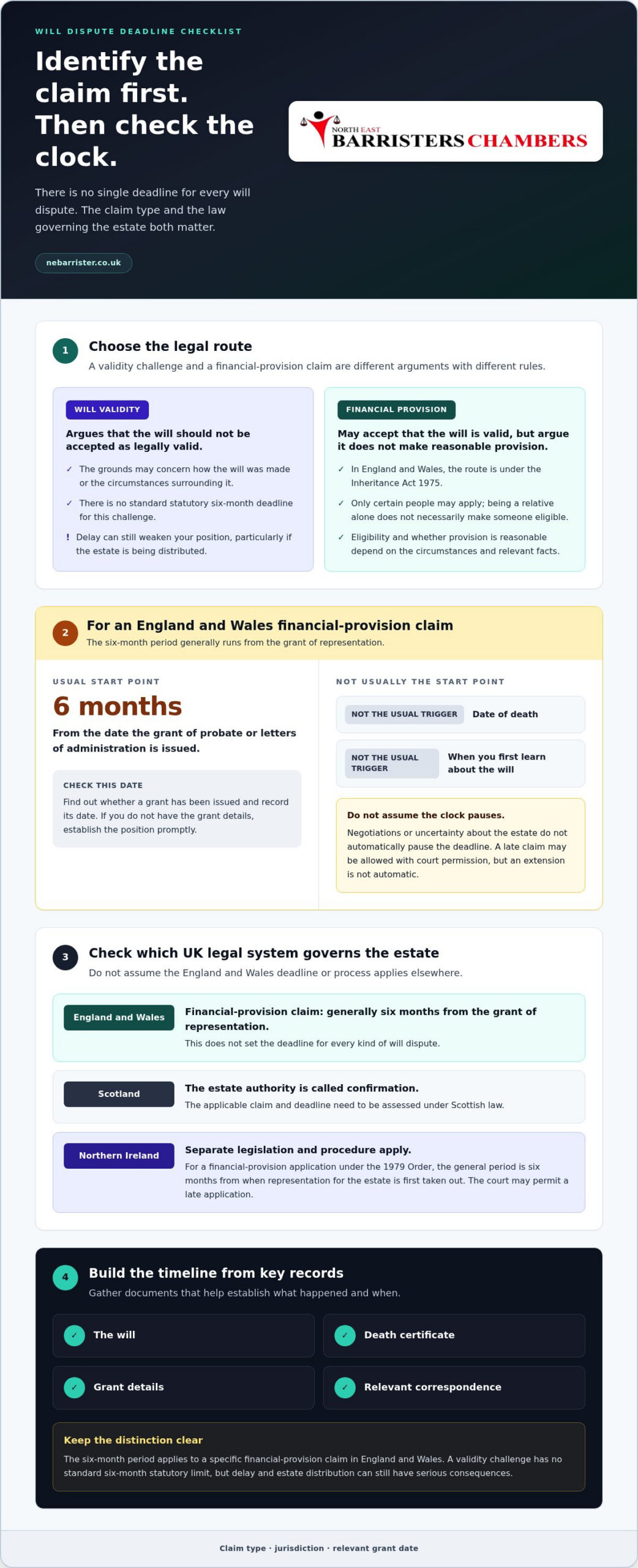
How to check your will-contest deadline and act promptly
Start by pinning down the legal route and the estate’s current position. The relevant deadline can depend on both the jurisdiction and whether you’re challenging the will’s validity or seeking financial provision. Use this checklist to organise the key facts. It can help focus an initial assessment, but it cannot determine the deadline for your particular case.
- Identify the jurisdiction and possible claim. Establish whether the estate is being administered under the law of England and Wales, Scotland or Northern Ireland. Note whether your concern is about validity, financial provision or another issue.
- Check whether a grant has issued. Locate the grant of probate or letters of administration, or the Scottish confirmation. Record the date shown and keep a copy. If you don’t have it, note who may hold the estate information.
- Assemble the core documents. Find the will, death certificate, grant details and correspondence with the executor or administrator. Include letters or messages that refer to the will or estate.
- Gather material linked to your concern. This might include earlier wills, relevant medical information, financial records or names of people with first-hand knowledge. Keep originals safe and make copies where possible.
- Write a dated chronology. Record key events, including when the person died, when you found the will and when you learnt about any grant. Mark what you know directly and what comes from someone else or remains uncertain.
Documents and dates to assemble
A clear timeline helps an adviser distinguish confirmed dates from estimates and identify information that may need checking. Don’t treat the date you discovered the will as the start of every possible deadline. For each document, note when you received it and who sent it. Keep relevant emails, letters and envelopes together, and avoid altering or annotating original records.
You don’t need every document before seeking an initial assessment. A missing grant or earlier will is a useful point to flag, not a reason to postpone having the timeline reviewed.
What to do if you may be close to a deadline
Act promptly. A barrister can assess the potential claim, identify evidence gaps and explain possible procedural steps, including immediate risks to the estate. If the deadline may be near, seek case-specific legal advice now rather than waiting until your file is complete. Whether a late claim or procedural option is available depends on the facts and applicable court rules.
Don’t assume that a caveat or discussions with an executor pause a claim deadline. They may have a role in particular circumstances, but they are not a substitute for identifying the relevant time limit and required steps. Our guide to resolving probate and will disputes directly explains how direct access support can help you assess options and prepare. For advice on the legal issues and potential representation, seek direct access barrister advice.
Getting advice on a will dispute: compare your options and next steps
Once you’ve identified the possible claim and relevant jurisdiction, decide how to move forward. Early legal advice can clarify the issues before positions become entrenched. Depending on the evidence, urgency and progress of the estate, possible routes may include further investigation, negotiation or court proceedings. There is no single route for every dispute, and discussing settlement does not remove the need to protect any applicable deadline.
What a barrister may contribute to a will dispute
A barrister can analyse the legal grounds, review the available evidence and identify gaps or risks. They can advise on the potential merits of a claim and explain practical next steps, including whether court proceedings may need to be considered. If a case proceeds to court, a barrister may also provide advocacy and representation.
This legal work is distinct from administering the estate. A direct access barrister is not a solicitor and does not provide solicitor services. The barrister’s role is to advise and, where instructed, represent a client on legal issues. No advice or representation can guarantee a settlement or a particular court outcome.
Choosing a practical route forward
The right approach depends on the type of claim, the strength and availability of evidence, the urgency of any deadline and whether the estate is still being administered. Negotiation may offer a way to resolve a disagreement without a court decision, but it may not be suitable or successful in every case. Court proceedings may be needed if the dispute cannot be resolved, though they involve formal steps and require careful preparation.
Direct access means you can instruct a barrister for legal advice and representation without instructing a solicitor for those services. The UK direct access barrister guide explains how this arrangement works. If you’re weighing the practical costs of different routes, the guide to managing UK legal costs provides broader context. Time limits for contesting a will in the UK can turn on details that are easy to overlook, so a focused assessment can help identify what needs attention first.
Bring the key dates, documents and a short account of your concerns to an initial discussion. A barrister can use that information to assess the legal issues and explain possible next steps, without assuming that negotiation or litigation is the right answer from the outset. If you’re ready to discuss your situation, discuss your will dispute with a barrister.
Take the next step with clarity
Uncertainty about contesting a will time limits UK can make it tempting to wait until every detail is clear. A more useful next step is to organise what you know for a focused legal assessment: what outcome are you seeking, what evidence supports your concern, and what needs attention first? You don’t need every answer before raising those questions.
Our chambers provides direct access legal advice and court representation in civil law matters for clients across the UK. A barrister can assess the legal issues and explain possible next steps, helping you decide how to proceed. That assessment cannot guarantee a particular result, but it can give you a clearer basis for making an informed decision.
If you’re ready to discuss the legal issues in your will dispute, discuss your will dispute with a barrister. Take the next step by setting out the key dates, documents and questions you need answered.
Frequently Asked Questions
How long do I have to contest a will in England and Wales?
There’s no single deadline for every type of challenge. If you’re researching contesting a will time limits UK, first identify whether you’re seeking reasonable financial provision under the Inheritance (Provision for Family and Dependants) Act 1975 or challenging the will’s validity. A financial-provision claim is generally made within six months of the grant of representation. For either route, get advice promptly, particularly if the estate is being administered or distributed.
Does the six-month deadline apply to every will dispute?
No. The six-month period is generally associated with 1975 Act claims in England and Wales. Challenging whether a will is valid is a different kind of claim and does not automatically share that deadline. Other claims may have their own procedural or limitation rules, and the relevant rules can vary between jurisdictions. Before relying on a date, clarify the legal basis of the dispute and where the estate is being administered.
When does the six-month deadline to contest a will start?
For a 1975 Act claim in England and Wales, the usual starting point is the date the grant of representation is issued. This is not simply the date of death or the day you discovered the will. Check estate correspondence and probate records for the grant date, and keep a copy of the document. If the date is unclear, don’t use an estimate to calculate your position.
Can I contest a will after six months?
Possibly. The six-month period does not apply to every type of will challenge, and a court may allow a late 1975 Act claim in some circumstances. Permission is discretionary, not guaranteed. Learning about a grant late may be relevant, for example, but it does not automatically secure an extension. The claim type, jurisdiction, evidence and reasons for delay all matter, so seek case-specific advice rather than assuming the opportunity has passed.
Is there a time limit to challenge a will’s validity?
There’s no universal six-month deadline for challenging a will’s validity in England and Wales. However, that doesn’t mean there’s unlimited time. Delay may affect the available evidence, the court process or the practical ability to recover assets already distributed. Limitation rules may also depend on the precise claim and circumstances. Keep records of when concerns arose and what has happened to the estate, then have the position assessed promptly.
Do will-contest time limits differ across the UK?
Yes. England and Wales, Scotland and Northern Ireland have distinct legal systems and procedures. A Scottish estate, for instance, uses the term confirmation rather than a grant of representation, so the documents and process may differ. A relative living in one part of the UK should not assume that their location alone determines the rules. Establish which jurisdiction governs the estate before applying a deadline or taking procedural steps.
Does lodging a caveat stop the deadline for contesting a will?
No, don’t assume that lodging a caveat stops a deadline for a separate claim. A caveat relates to the probate process, and its effect depends on the jurisdiction and circumstances. It does not automatically extend a statutory period or prevent every step in estate administration. Before relying on one, clarify what it would achieve in your situation and whether any claim must be issued separately within its own time limit.