
Good preparation is more than putting papers in a folder. A court hearing preparation checklist should help you organise evidence, review the other side’s documents, prepare witnesses and court bundles, and understand how to conduct yourself in court. The right priorities depend on whether your hearing is criminal, civil or family.
It’s understandable to feel unsure about what to bring or how to present your points. A clear plan helps keep relevant facts and documents to hand, meet the court’s directions and address the judge respectfully. In the County Court and Family Court, people are often advised to address the judge as “Sir” or “Madam”.
This guide covers practical checks for each stage, from reviewing your case and organising evidence to preparing for the hearing day. It also explains how preparation can differ across criminal, civil and family proceedings, so you can focus on the steps relevant to your hearing.
Key Takeaways
- Plan how you’ll address the judge and present your points calmly, while following the etiquette used in your court.
- Organise evidence around the facts in dispute and review the other side’s documents so you can identify the points that need a response.
- Prepare witness statements and a clear, properly indexed bundle that makes relevant material easy to find.
- Adjust your preparation to the type of hearing, its directions and deadlines, so you can focus on the requirements that apply to your case.
Court etiquette and addressing judges
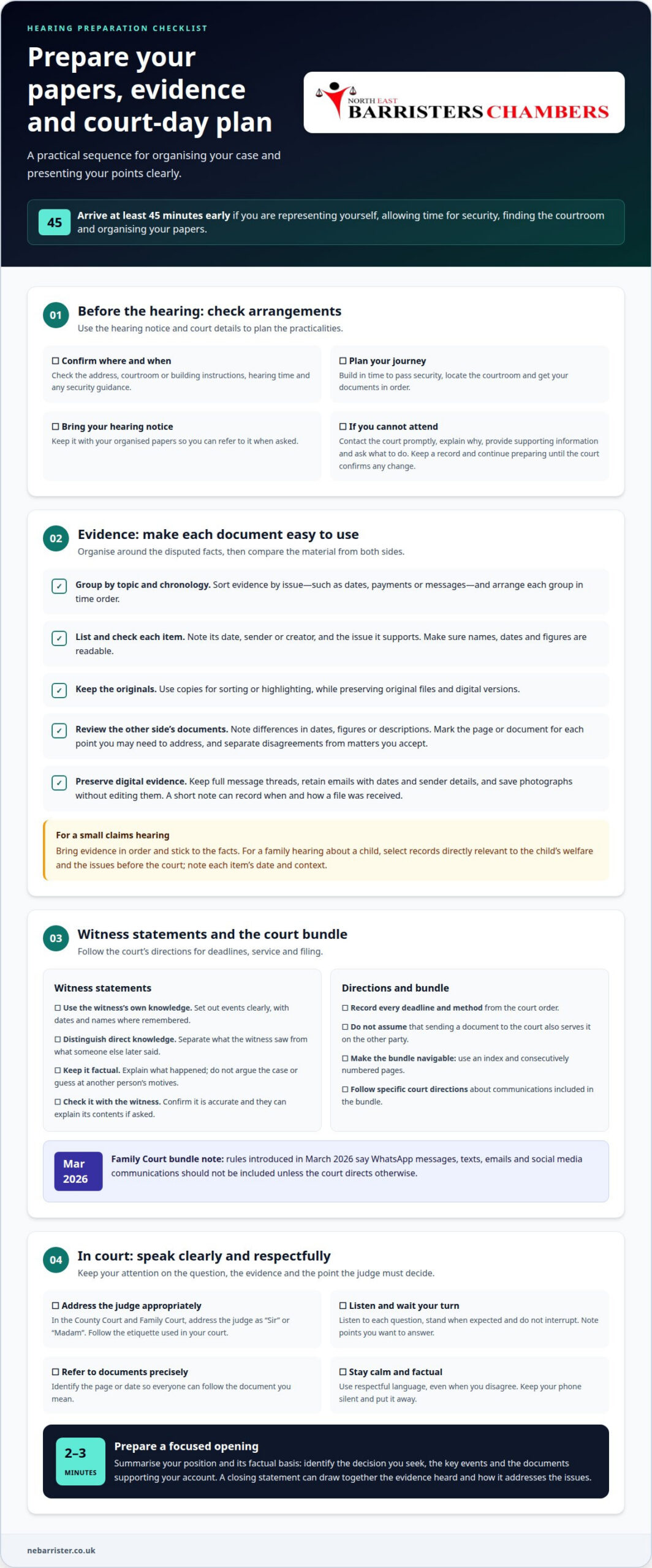
Use the court’s name and hearing notice to prepare for the practical arrangements. Check the address, courtroom or building instructions, hearing time, and any security guidance in your documents. Plan your journey and aim to arrive at least 45 minutes early if you’re representing yourself. That gives you time to pass security, find the courtroom and organise your papers before the case is called.
In the County Court and Family Court, address the judge as “Sir” or “Madam”. Listen to each question, stand when expected, and speak to the judge rather than interrupting another person. When referring to a document, identify its page or date so everyone can follow your point. These steps help keep your submissions clear and the hearing orderly.
- Keep your phone silent and put it away. A ringing phone can interrupt evidence or submissions.
- Bring your hearing notice and organised papers. You can respond promptly when the usher or judge asks for a document.
- Wait for your turn to speak. Make a brief note of points you want to answer, rather than talking over the other party.
- Use calm, respectful language. Focus on facts and evidence, even when you disagree with what has been said.
Legal representation fees depend on the case, hearing length, preparation required and complexity of the issues. Ask for a quote based on the work involved. The fee should make clear what is included and what may cost extra.
If you can’t attend or need an adjournment, contact the court promptly using the details on your hearing notice. Explain why you cannot attend, provide supporting information and ask what steps to take. Don’t assume the hearing has been postponed unless the court confirms this. Keep a record of your communication and continue preparing while you await a response.
Organising evidence and reviewing the other side’s documents
Start by identifying what each document helps prove. Group evidence by topic, such as dates, payments or messages, then arrange each group chronologically. For a small claims hearing, bring the evidence in order and stick to the facts. A clear sequence helps you find relevant material without losing time searching through loose papers.
Review the other side’s documents alongside your own. Note differences in dates, figures or descriptions, and identify what supports your account. For example, compare an invoice with a payment record and the message discussing the work. Mark the page or document for each point you may need to address. Separate factual disagreements from matters you accept to keep your response focused.
- Collect documents linked to the disputed events. This may include letters, invoices, receipts, photographs and records of conversations.
- Keep the original files. Store copies for sorting or highlighting, while preserving the source documents and digital versions.
- Make a document list. Record each item’s date, sender or creator, and the issue it supports.
- Check that each item is readable. Make sure dates, names and figures can be seen clearly on a printed page or screen.
For a family hearing about a child, select records that relate directly to the child’s welfare and the issues before the court. Relevant school communications, appointment records or messages about arrangements may help. Note the date and context of each item. Avoid adding private material just because it is available; explain how each document supports a specific factual point.
Preserve digital evidence in its original form where possible. Keep full message threads rather than isolated screenshots, retain emails with their dates and sender details, and save photographs without editing them. A short note can record when and how a file was received. If you need help presenting documents clearly, organising evidence for court is a useful place to start.
Preparing witness statements and court bundles
Use the court’s directions to plan when and how to serve evidence and witness statements. Deadlines and filing requirements depend on the directions in your case, so record each date and required method from the court order. Don’t assume that sending a document to the court also serves it on the other party.
- Check each witness statement against the witness’s own knowledge. Set out events in a clear sequence, with dates and names where remembered.
- Separate what the witness saw from what someone else said. For example, distinguish seeing a meeting from later hearing about it.
- Use plain, factual language. A witness should explain what happened, not argue the case or guess at another person’s motives.
- Review the final statement with the witness. Confirm it is accurate and that the witness can explain its contents if asked.
For a family court hearing, make the bundle easy to navigate. A paginated bundle should have an index and consecutively numbered pages. Family Court bundle rules introduced in March 2026 say WhatsApp messages, texts, emails and social media communications should not be included unless the court directs otherwise. Follow any direction about specific communications.
Prepare an opening of 2-3 minutes that summarises your position and its factual basis. For example, identify the decision you seek, the key events and the documents supporting your account. A closing statement can then draw together the evidence heard and explain how it addresses the issues. Keep both focused on the points the judge must decide.
To prepare for questions from the judge or the other side, reread your statement and mark the documents supporting important dates or claims. Listen to each question, pause and answer only what was asked. If you don’t understand, ask for the question to be repeated. If you can’t remember a detail, say so rather than guessing. This helps keep your evidence clear and accurate.
Preparation for criminal, civil and family hearings
Before a hearing in England and Wales, check the court’s directions, deadlines and required forms. Organise your case around the issues the judge must decide. A useful court hearing preparation checklist starts with your hearing notice and court orders, not a generic list, because each case has its own steps.
For a civil trial, complete and return the pre-trial checklist by the date set by the court. This helps the court decide whether further directions are needed and whether it can set the trial date and give trial directions. Make sure your answers reflect the current position, including which points remain in dispute.
In family proceedings, pay close attention to the timetable in the court’s directions. It sets dates for disclosure, expert reports, witness statements and hearing bundles. In a children case, the First Hearing Dispute Resolution Appointment is a common early hearing. Prepare a one-page timeline of key events and connect each point to the issue the court must resolve.
For a criminal hearing, organise your preparation around the charge, the evidence and the issues for the court. Identify what is agreed and disputed, then note the questions that remain. In civil and family cases, review the relevant legal rules and statutes alongside the facts. The Civil Procedure Rules, Family Procedure Rules and practice directions are available on the government’s justice website.
Start preparing four weeks or more before the hearing, then aim to finalise key tasks two weeks beforehand. Use the earlier period to review directions, identify missing material and arrange practical needs. Later, check deadlines, organise documents and clarify the points you need to make. This staged approach helps prevent urgent tasks from obscuring important case issues.
If you need help preparing for a criminal or civil hearing, arrange court representation to discuss the issues, evidence and hearing requirements with a barrister.
North East Barristers Chambers: Court Representation
North East Barristers Chambers provides court representation in criminal and civil proceedings. Through Direct Access Barrister Services, individuals and businesses can instruct a barrister directly, without needing a solicitor to arrange the instruction.
Consider representation when issues are contested, evidence needs careful presentation, or you want professional advocacy in court. A barrister can help focus your case on the points the judge must decide and present those points clearly. The work required depends on the hearing, the court’s directions and the documents involved.
If you’re preparing for a criminal or civil hearing and want to discuss representation, contact North East Barristers Chambers.
Turn your preparation into a clear next step
Turn your preparation into a practical plan for the hearing ahead. Choose the points that need attention and note anything you still need to clarify. Keep your court hearing preparation checklist as a working document, updating it if your case develops.
Separate tasks you can organise yourself from questions that depend on court directions or legal advocacy. This helps you use any discussion about the hearing efficiently, with the key issue and relevant papers close to hand.
If you’re unsure how to present your position or what support may help, discuss the hearing and your objectives with a barrister. A focused conversation can help you understand the preparation involved and decide how to proceed. Arrange a discussion with North East Barristers Chambers about your hearing. Take the next step at a pace that feels clear and manageable.
Frequently Asked Questions
What documents should I bring to a court hearing in the UK?
Bring the papers required by your court’s directions, along with the hearing notice and any documents you may need to refer to. Keep the latest court order accessible so you can check a direction if it becomes relevant. If you rely on an electronic document, make sure you can open it at court and have a usable copy if needed.
How do I organise and paginate a court hearing bundle?
Arrange permitted documents in a logical order, create an index identifying each item, then number the pages consecutively. Check that the index references match the finished bundle, especially after inserting or removing a document. For a family hearing, follow the court’s directions on what belongs in the bundle; certain communications may be excluded unless the court directs otherwise.
What should I wear and how should I address the judge in court?
Choose clean, tidy clothing that is comfortable for sitting and speaking in court. There’s no need to dress as a lawyer. In the County Court and Family Court, address the judge as “Sir” or “Madam”. If you’re unsure how to respond, listen to the form of address used in the courtroom and follow the judge’s instructions.
How early should I arrive, and what happens when I get to court?
Aim to arrive at least 45 minutes before the hearing if you’re representing yourself. Allow time for security and finding the correct courtroom. Once inside, follow signs or ask court staff where to wait, then keep your papers ready. The hearing may not start at the listed time, so remain nearby and listen for your case to be called.
Can I take someone with me to a court hearing in the UK?
You can travel to court with someone for support, but that doesn’t automatically mean they can sit in the hearing room. Access depends on the hearing and the court’s arrangements. Agree where to meet after the hearing, and avoid discussing confidential case details in public areas. If your companion is attending as a witness, keep them separate from other witnesses before they give evidence.
How does hearing preparation differ for civil, family and criminal courts in the UK?
Preparation depends on the issues the court must decide. In a civil case, focus on the claim and any points still disputed. In family proceedings, identify the decisions sought and relevant child or family issues. In a criminal case, organise your understanding around the charge and evidence. Court forms, directions and procedures vary across England and Wales, Scotland and Northern Ireland.