
A strong defence starts with the pleaded case, not assumptions about what feels fair. When defending a breach of contract claim, focus first on what the claimant says you agreed to, how they say you breached it and what loss they say followed. An angry reply or a blanket denial won’t answer those questions, and missing a court deadline can make matters worse.
It’s understandable to feel uncertain. The contract may be unclear, performance may be disputed, or the amount claimed may not reflect what happened. Before choosing a response, separate what the documents show from what either party assumes.
This guide explains how to assess the agreement, the alleged breach and the claimed loss; preserve relevant documents; and keep track of deadlines and procedure. It also covers proportionate options, from settlement discussions to defending the claim in court. The right route depends on the facts and the court involved, so use the rules that apply to your jurisdiction. A direct access barrister can help analyse the claim and evidence, advise on strategy, and provide representation where appropriate. We’ll also explain what procedural responsibilities to clarify at the outset.
Key Takeaways
- Assess whether the claimant can show an agreement, a relevant term, a failure to perform and resulting loss.
- When defending a breach of contract claim, match your response to the evidence and allegations, whether you dispute all or part of the claim.
- Identify the document and any deadline, then organise relevant records and build a dated chronology without changing original documents.
- Consider whether admitting part of the claim or exploring settlement could be more proportionate than disputing everything.
- A direct access barrister can provide focused advice on the pleaded case, evidence and possible next steps, with support shaped around the work required.
Defending a breach of contract claim: what the allegation means
Receiving a demand or court document can put you under immediate pressure to respond. First identify what has been sent and what it alleges. A breach of contract claim is an allegation that a party failed to meet an obligation it agreed to. The allegation is not, by itself, proof that the agreement was breached.
The claimant’s case will usually need to identify the agreement and the term said to have been broken. If the claimant seeks damages, they will generally need to explain the loss said to result from the breach. The facts, the remedy sought and the rules of the relevant jurisdiction all matter. A general Breach of Contract Overview can explain common types of breach and remedies, but it isn’t a substitute for assessing the documents and law that apply to your dispute.
When defending a breach of contract claim, distinguish between a demand for payment or action before proceedings and a court claim that has been issued. Court documents may specify a response deadline. Don’t estimate it from memory or rely on a general guide. Read the documents and check the rules for the court and jurisdiction involved.
Is the document a demand, a letter before claim or a court claim?
A demand or letter before claim usually sets out the other party’s position and invites a response before court proceedings. A court claim is different: it will normally include formal documents identifying the court and claim, together with instructions on how to respond. The title alone may not settle the issue, so read the full pack carefully.
Record these details before deciding what to do:
- Who sent or served the document, and on whose behalf?
- Is a court named, and is there a claim or case reference?
- What date appears on the document, and when did you receive it?
- What response does it request, and does it state a deadline?
Keep the envelope and all accompanying pages. If proceedings have been issued, missing a procedural deadline can create serious risks for your position. Treat any stated date as urgent while you establish which rules apply.
Which UK jurisdiction governs the dispute?
Procedure and some contract rules differ across England and Wales, Scotland and Northern Ireland. Check the court named on any claim and review the contract for terms about governing law or where disputes must be heard. The parties’ locations alone may not answer the question. If the documents point in different directions, seek advice before relying on assumptions.
Check UK-wide guidance against the jurisdiction of the case. Establishing this early helps you follow the right procedure, understand the response instructions and avoid applying a deadline from another part of the UK.
Test the breach of contract claim against its evidence
Once you know what the claimant alleges, test each part of the case against the documents and events. A useful starting framework has four parts: an agreement, a relevant contractual term, an alleged failure to perform that term, and loss said to have resulted. For each part, ask what evidence supports it, what evidence points the other way and what remains unclear.
A disagreement about quality, timing or payment doesn’t by itself establish whether a contractual obligation was breached. For example, a customer may say a supplier delivered late, while the supplier says the delivery date changed by agreement. The key questions are what the contract required, whether that requirement changed and what the records show about performance.
Read the claimant’s pleaded case, meaning the formal account of the facts and legal basis of the claim, alongside its supporting documents. Note any facts you accept, such as an order being placed, and distinguish them from facts you dispute, such as a delivery date or the condition of goods. Look for gaps and inconsistencies, but don’t assume one missing document automatically defeats the claim. Evidence is assessed as a whole, including what each party said and did at the time.
What do the contract and communications actually say?
Bring the signed terms, purchase orders, specifications, variations, emails and messages together as one documentary record. Check what each party agreed to do, by when and subject to which conditions. A later email might clarify an earlier term or record an agreed change, but its meaning depends on the surrounding communications and conduct. Keep the original records and note their dates and context.
Separate two issues: what an obligation meant and whether it was performed. If the parties disagree over what “completion” meant, that is a question of interpretation. If they agree on the requirement but disagree over whether the work was completed, focus on performance evidence, such as inspection records, delivery notes or acceptance messages. This distinction helps pinpoint the real dispute rather than responding to broad accusations.
Was there a breach, and can the claimed loss be linked to it?
Compare the alleged failure with practical records: delivery and tracking documents, invoices and payment records, completion reports, inspection notes, complaints and evidence of acceptance. Arrange them by date. This can help establish whether an item was delivered, whether concerns were raised at the time, and whether the claimant later used or accepted the work.
Then examine each claimed loss separately. Does the claimant explain how the alleged breach caused that particular loss, and provide records supporting its amount? An invoice may show that an expense was incurred, but the surrounding evidence still matters when assessing its connection to the alleged breach.
Proof of breach and proof of loss are separate questions: establishing one does not automatically establish the other or the amount claimed. If the documents leave competing interpretations or the loss calculation is unclear, focused direct access barrister advice can help assess the pleaded case and evidence before you decide how to respond.
Choose a proportionate response: defend, admit or seek resolution
After reviewing the allegations and evidence, decide what response fits the actual dispute. You might contest the whole claim, accept some points but dispute others, admit liability or the amount claimed, or explore settlement. The right choice depends on the evidence, the wording of the claim and the practical consequences of continuing. Don’t let anger, pressure to respond quickly or a wish to “fight everything” make the decision for you. Any court response deadline still needs attention while you consider your options.
When might a full or partial defence be appropriate?
A full defence may be appropriate where there’s a material dispute about whether an agreement existed, what it required, whether it was performed or whether you’re liable for the alleged breach. A partial dispute may be more accurate if you accept some facts or liability but challenge a particular allegation, sum or component of loss. For example, you might agree that payment is outstanding but dispute additional charges or claimed losses.
Be precise about any admission. Its wording can affect what remains in dispute, so don’t concede a point simply to sound reasonable or end an uncomfortable conversation. Equally, denying facts that the documents clearly support can undermine a measured response. Get advice if you’re unsure what an admission means for the rest of the claim.
Compare the available routes
| Route | When it may fit | Key trade-off |
|---|---|---|
| Defend the whole claim | There’s a substantial dispute about the agreement, obligation, performance or liability. | Preserves your position, but proceedings can take time and require continued attention. |
| Dispute part | You accept some elements but contest specific allegations or amounts. | Focuses the dispute, but any admission should be clearly and carefully framed. |
| Admit all or part | The evidence supports liability or a particular amount. | May narrow the issues, but an admission can affect your legal position. |
| Seek settlement or mediation | A negotiated outcome could be preferable after weighing the evidence and practicalities. | May avoid further dispute, but there’s no guarantee the parties will agree. |
When should settlement or mediation be considered?
Compare the evidence with the likely time and effort of continued proceedings. Consider the value of the dispute, the commercial relationship, the effect of delay and the risks each side faces. Mediation gives the parties a structured opportunity to discuss resolution with an independent mediator, but it doesn’t force agreement. Negotiations can also take place directly or through representatives.
Handle settlement discussions carefully. Set out what is being proposed, identify which parts of the claim it would resolve, and keep a clear record of any offer and response. Don’t assume an informal conversation has changed a court deadline or concluded the claim. A barrister can help assess the options and frame a response. A guide to reducing UK legal costs with direct access explains how focused legal input may fit into a proportionate approach.
For help weighing the evidence and possible routes, discuss your options with a barrister.
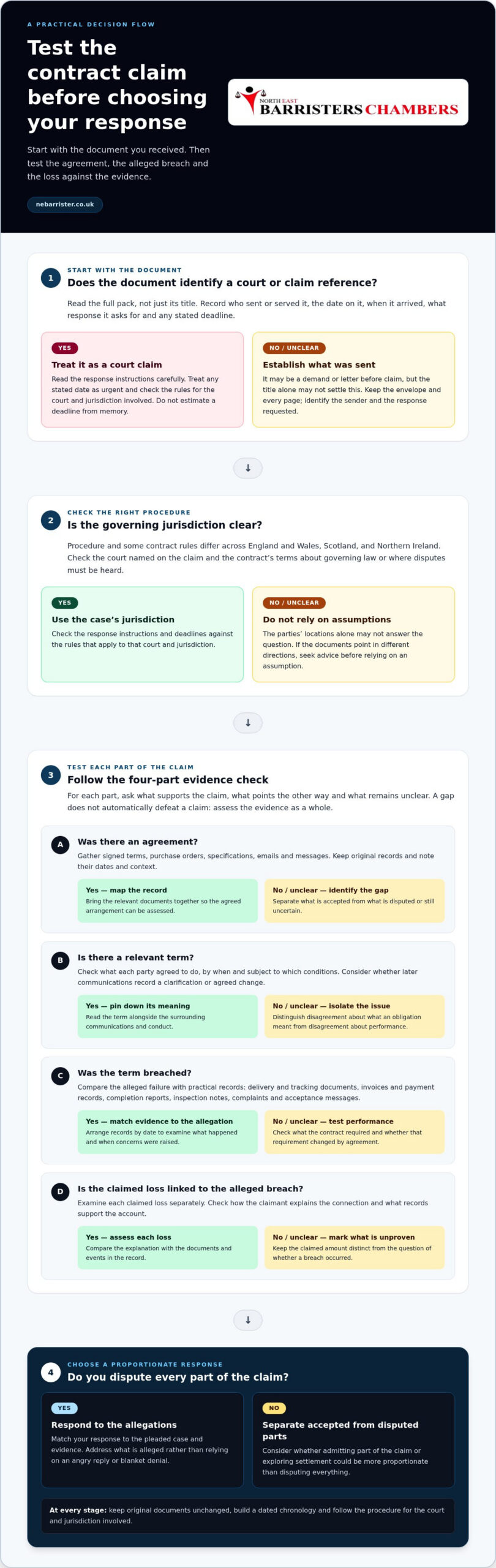
How to respond to a breach of contract claim step by step
A calm, organised response starts with the documents, not a rushed argument. Use these steps to protect your position and prepare for decisions about defending a breach of contract claim. The correct form, response and filing route depend on the court and jurisdiction, so don’t rely on a form or deadline from a different type of case.
- Identify the document and any deadline. Establish whether you have a pre-action letter or formal court claim. Read every page, note the date received, court, claim reference and response instructions. If a deadline is stated, treat it as urgent while checking the applicable procedure.
- Confirm the jurisdiction and court process. Identify whether the claim is in England and Wales, Scotland or Northern Ireland, and check the court named on the documents. Procedures and forms differ. Use current guidance and forms that apply to that court, rather than assuming a process used elsewhere in the UK is suitable.
- Preserve relevant records. Keep the contract and original documents unchanged. Save relevant emails, messages, invoices, payment records, delivery notes and work records. Avoid deleting, editing or annotating originals. If a document is missing, record that fact instead of trying to fill the gap from memory.
- Build a dated chronology and evidence file. Put the agreement, amendments and key communications in date order. Note what happened, who was involved and which facts you accept or dispute. Link each disputed point to the documents that support your account, and keep a separate list of unanswered questions.
- Compare the allegations with your records. For each point in the claim, note the claimant’s allegation, your response and the evidence on both sides. This makes it easier to see whether the dispute concerns the agreed obligation, what happened in practice or the loss claimed.
- Get advice on the response and responsibilities. A barrister can help assess the case and advise on strategy or representation. Agree at the outset what work is covered and who will handle each procedural task. Instructing a barrister doesn’t necessarily mean they will take every step in the litigation, so understand what you must do and by when.
Prepare a clear chronology and evidence file
Keep the chronology factual and concise. For example, record the date an order was placed, any agreed change to the specification, when delivery took place and when a complaint was first made. Distinguish a dated document from your recollection, and label uncertainty clearly. This helps you and your barrister identify where evidence supports your account, where it conflicts with the claimant’s version, and what further information may matter.
Check the response requirements before taking action
Read the claim documents and any court directions carefully. Check the current forms, filing method and procedural requirements for the relevant court in England and Wales, Scotland or Northern Ireland. Don’t assume that settlement discussions pause a court timetable. If a barrister is instructed, clarify which litigation steps remain your responsibility and make sure each is completed in time.
This is general information, not a substitute for advice on the actual claim and its documents. For focused help assessing your evidence, response and procedural responsibilities, discuss your claim with a barrister.
How a direct access barrister can help defend a contract claim
A direct access barrister can give focused advice on the claimant’s pleaded case, the evidence supporting it and the points that may need a response. When defending a breach of contract claim, this can help separate the legal issues from the pressure of receiving an allegation. A barrister may assess the contract, identify strengths and weaknesses in each side’s account, explain potential risks and advise whether to defend, admit part of the claim or explore resolution.
The work can be tailored to the stage of the dispute. Depending on the case and agreed scope, support may include advice on strategy, help with drafting a response or representation at court. Direct access means you can instruct a barrister without first instructing a solicitor. It doesn’t mean the barrister automatically undertakes every administrative or procedural task connected with litigation.
What to prepare before seeking barrister advice
Make the first discussion more useful by gathering the key documents and setting out what you need help with. Include the demand or claim form, the contract and any amendments, relevant correspondence, and any court directions or stated response deadline. Prepare a short chronology of important events and note which facts you accept, dispute or can’t yet verify. Keep original records unchanged.
Be clear about the outcome you want, such as disputing liability, challenging part of the amount claimed or resolving the matter commercially. List any urgent decisions or procedural steps first. If a deadline is close, flag it at the start so the advice can focus on the immediate position as well as the wider strategy.
Agree the scope of advice and representation
At the outset, clarify what work the barrister will undertake and what remains your responsibility. This might include whether the instruction covers advice only, drafting particular documents or court representation. Confirm who will handle procedural steps, filing and correspondence, and how you should manage any directions or deadlines. Clear arrangements help prevent important tasks from being overlooked.
Some cases may need a solicitor for litigation tasks, depending on their complexity and what must be done. Assess that for the particular dispute rather than assuming either way. Clarify the practical division of responsibilities and any further support the case may require. Understanding the UK direct access barrister guide can also help explain how direct instruction works.
Focused advice can help you make an informed choice, but no barrister can promise a particular result. The right next step is to have the claim, evidence and timetable considered together. Discuss your contract claim with a barrister to consider the advice or representation that may suit your circumstances.
Take the next step with a clear plan
A contract dispute can feel all-consuming, but your next move doesn’t need to be decided in haste. A focused review of the claim can help you understand your options and what needs attention first. That clarity matters when you’re defending a breach of contract claim, especially if a court deadline is approaching or the other party is pressing for an answer.
We provide direct access advice and representation in civil law matters for individuals and businesses across the UK. You can discuss the documents, the immediate decisions and the level of support that may suit your case. The aim is to help you approach the dispute with a reasoned plan, without promising a particular outcome.
Discuss your breach of contract claim with a barrister and take a practical next step. With clear advice, you can move forward with greater confidence.
Frequently Asked Questions
Do contract claim rules differ across the UK?
Yes. England and Wales, Scotland and Northern Ireland have distinct court systems and procedural rules, and contract law may also differ. The relevant rules depend on factors such as where proceedings are brought and any governing-law or jurisdiction clause in the contract. For example, a form or court process used in England and Wales may not apply in Scotland. Check the rules for the court handling your case before acting.
Can a company director be personally liable for a company’s breach of contract?
Usually, a director isn’t personally liable just because their company has allegedly broken a contract. The company is generally a separate legal person. Personal liability may arise, however, if the director gave a personal guarantee, contracted in their own name, or is separately alleged to have committed a wrongful act. If a claim names you personally as well as the company, get advice on the pleaded basis for each claim before responding.
Can an email or message change the terms of a contract?
It can, depending on what was agreed and the circumstances. A clear exchange between people with authority may record a variation, such as a revised delivery date or specification. But an email proposing a change isn’t necessarily proof that both parties accepted it. Check the wording, surrounding communications, conduct and any clause setting out how variations must be made. Keep the full conversation, not just a selected message.
Can a claimant add interest to a breach of contract claim?
Possibly. The claimant may rely on an interest clause in the contract or a statutory basis, depending on the type of debt and the applicable law. For qualifying commercial debts, statutory late-payment interest may be relevant; other claims can have different rules. Check the rate, dates and amount claimed, and ask how the calculation was made. Don’t assume interest is due simply because it appears in a demand.
What does “without prejudice” mean in settlement discussions?
“Without prejudice” can protect genuine settlement communications from being shown to the court as evidence of admissions, but the label alone doesn’t make a conversation privileged. The communication must generally be part of a genuine attempt to settle an existing dispute, and exceptions can apply. Use the label carefully and avoid treating it as a way to hide ordinary business communications. If the exchange could affect your position, take advice before sending it.
Should I disclose documents that weaken my position?
Don’t destroy, conceal or alter relevant documents. Whether you must disclose a particular document depends on the court process and directions, which vary across UK jurisdictions. In England and Wales, disclosure obligations in many civil claims can include documents that harm your case as well as those that support it. Preserve the material and get advice on what must be provided, when and how. Selective disclosure can damage credibility and create procedural problems.