
A court notice can turn a motoring allegation into an urgent question: could you face penalty points, disqualification or another consequence, and who can help? A direct access barrister for motoring offences can provide legal advice and court representation. Whether this route fits depends on the allegation, the stage your case has reached and the work you need.
It’s understandable to be unsure about instructing a barrister directly. This route gives you direct access to legal advice and advocacy, but you may also need to manage practical steps yourself. This guide explains what a barrister can do, where the limits of direct access may apply and how to prepare for an initial discussion.
Gather the paperwork you have, such as a charge sheet or court notice, and note any hearing date, licence details and your account of events. These details help you explain the case clearly and discuss what support may be useful.
Key Takeaways
- Assess whether direct access suits your case by considering the alleged offence, its procedural stage and the help you need.
- A direct access barrister for motoring offences can provide legal advice and advocacy, while some case-management tasks may remain your responsibility.
- Identify whether you need case analysis, preparation or representation at a hearing before making an enquiry.
- Organise your paperwork and a clear timeline of events to support a focused discussion about your case.
- Explain the allegation, share relevant documents and clarify the next steps with North East Barristers Chambers.
When a direct access barrister for motoring offences may help
A motoring allegation can create immediate worry, particularly if you rely on your driving licence for work, family commitments or daily travel. Depending on the allegation, possible consequences may include penalty points, a driving ban or a financial penalty. An allegation is not a finding of guilt, and no outcome can be promised.
Direct access means instructing a barrister yourself for legal advice or advocacy, rather than having another legal representative instruct them on your behalf. A Barrister is a specialist legal advocate. With direct access, you approach them directly for advice or representation. Whether it is appropriate depends on your case and the work you need.
Which motoring allegations might need legal advice?
Advice may help you understand the allegation, the evidence and the decisions ahead. Motoring allegations include:
- Speeding or driving without insurance
- Drink or drug driving
- Dangerous or careless driving
- Failing to provide a specimen
This is a selection, not a complete list of offences. The offence label alone does not determine the right approach. The evidence, circumstances of the incident, your driving record and the possible effect on your licence may all matter. For example, an allegation that could put your licence at risk may call for different advice from a case where your main concern is understanding a notice and responding correctly.
Why the stage of the case matters
Your paperwork can indicate where matters stand. An initial notice raises different questions from a charge, a plea decision or a court hearing. At the notice stage, identify what the document asks you to do and any deadline it gives. After a charge, you may need advice on the case and plea decision. Before a hearing, preparation and advocacy may become central.
The advice you need can change as evidence and procedural steps develop. Your case may involve reviewing documents, identifying points that need clarification or preparing for a hearing. Timing matters: seeking advice shortly before a hearing can leave less time to consider the material and prepare. If you’re unsure what a notice means, keep it and note any dates so the position can be assessed.
The case stage, the alleged offence and the work you need together shape what legal advice is appropriate.
North East Barristers Chambers provides direct access criminal law advice and court representation. Explain the allegation and the stage your case has reached to discuss what guidance or advocacy may be relevant. The consequences depend on the charge, evidence, your record and the court’s decision.
What a direct access barrister can do, and where the role has limits
Instructing a barrister directly gives you access to legal advice and advocacy without another representative instructing them for you. The work can be tailored to your motoring case, for example, understanding the allegation, assessing the available material or preparing for a hearing. Direct access does not automatically cover every case-management task, so practical responsibilities may remain with you.
Advice, preparation and court advocacy
A barrister may analyse the allegation and available evidence, explain relevant legal issues and advise on possible next steps. This can help you understand which points matter and what questions to raise. Advice depends on the documents and circumstances, not simply the offence label.
If you need help preparing for a hearing, the barrister may review the case material, explain the hearing process and prepare legal submissions. When instructed to appear, a barrister can represent you in court and make arguments on your behalf. This is advocacy, not a promise that a particular argument will be available or that the court will reach a particular decision.
Understanding possible licence consequences can also help you frame your questions. GOV.UK explains how penalty points and endorsements work, but the effect in an individual case depends on the circumstances and the court’s decision. A direct access barrister for motoring offences can provide case-specific advice within the agreed scope of work, not a guaranteed outcome.
What direct access does not automatically include
Direct access does not automatically mean the barrister will manage every step of the case. Under the Public Access scheme, barristers generally provide advice, drafting and advocacy, while conducting litigation is a separate function that is not usually included. You may therefore need to take responsibility for administration yourself.
- Sending documents to the court or another party when required
- Managing correspondence and keeping track of deadlines
- Organising paperwork and taking procedural steps in your case
This list is practical, not exhaustive. Responsibilities depend on the work agreed and the case. Some barristers have separate authorisation to conduct litigation, but it is not a standard part of direct access. Before proceeding, establish who will handle each task rather than assuming it is included.
Suitability may need to be reviewed as the case develops. If its complexity or circumstances mean another form of representation is in your best interests, the barrister should advise you accordingly. The applicable rules and your particular needs determine whether the arrangement can continue.
North East Barristers Chambers provides direct access criminal law advice and court representation, with work tailored to case requirements. To discuss the role and responsibilities involved in your circumstances, make an enquiry about direct access advice.
How to assess representation for your motoring offence
The right representation depends on more than the name of the allegation. Consider the case stage, the help you want and the practical tasks you can manage. This gives you a clearer basis for an enquiry and helps define the work you’re asking a barrister to do.
| Case situation | Work you may need | Responsibilities to clarify |
|---|---|---|
| Speeding allegation and an initial notice | Advice on the notice, the information available and possible next steps | Any response or action required by the date stated on the notice |
| Drink-driving charge before a plea decision | Case-specific advice on the allegation and material, to inform your decision | Providing relevant documents and understanding the agreed scope of advice |
| Dangerous-driving case with a hearing listed | Preparation for the hearing and, if instructed, court advocacy | Supplying paperwork, tracking deadlines and completing any agreed tasks yourself |
Match the service to the case stage
Advice before a plea decision differs from preparation for a listed hearing. Before a plea, you may need help understanding the allegation and evidence before deciding how to respond. For a hearing, the focus may shift to reviewing the case material, preparing submissions and arranging advocacy. Describe the stage you’ve reached rather than assuming one type of instruction fits every case.
Use the dates in your notice or court document to explain the timing. A response deadline or hearing date can affect how quickly preparation is needed. Share the document and its dates so the discussion can focus on the actual timetable. The criminal law court representation guide explains how direct access can relate to advice and advocacy in a criminal case.
Compare the scope and responsibilities
Before instructing a barrister, establish what the work covers and what remains for you to handle. Ask for the scope to be explained in practical terms: which documents will be reviewed, whether hearing preparation or an appearance is included, and what correspondence or procedural steps you must manage. Clear communication helps prevent different assumptions about who is doing what.
Direct access is a route to barrister services, not a guarantee that the overall cost will be lower. The value depends on the work your case needs and the responsibilities you take on. If you’re considering this route, the direct access barrister guide offers further context on how the arrangement works. A focused enquiry should set out the allegation, case stage, key dates and the help you’re seeking.
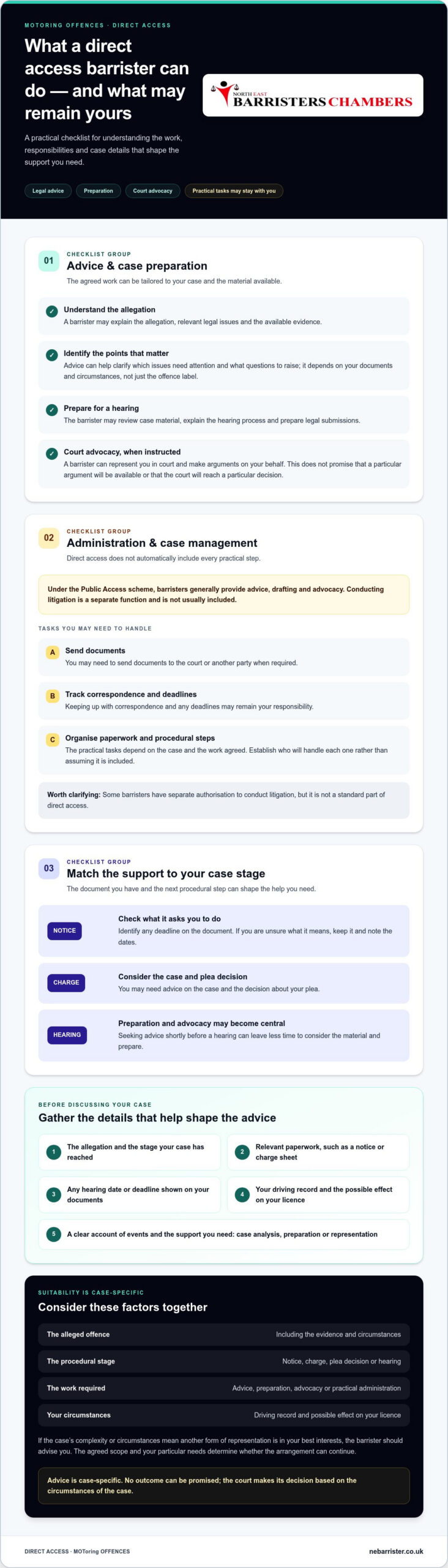
What to gather before seeking motoring-offence advice
Organising your papers before an initial discussion makes it easier to explain what has happened and identify the help you need. You don’t need to solve the case or decide which details matter before speaking to a barrister. Bring together the paperwork you have, note key dates and separate what you know from what you’re unsure about.
Documents and information to organise
Use this checklist to prepare a clear, factual overview for a direct access barrister for motoring offences:
- Collect the official paperwork. Include any notice, charge paperwork, court documents and correspondence about the allegation. Keep envelopes where postmarks or delivery dates may help explain when something arrived.
- Record the timetable. Note response dates, any stated deadlines and the hearing date, if one has been set. Follow the instructions and dates shown on each notice or court document. If you’re uncertain what a document requires, flag the question rather than guessing.
- Make a short timeline. Set out the date and approximate time of the incident, what happened before and afterwards, and when you received or sent relevant communications. Mark uncertain details as estimates.
- Gather related records. Identify material that may be relevant, such as correspondence, photographs or other records connected with the allegation. Keep original documents and files unchanged. Don’t write on, highlight or alter potential evidence.
- List potential witnesses. Note who may have seen or heard something and how they can be identified. Don’t coach them or contact them to discuss or shape their evidence.
- Note your driving position. Write down your licence details and any current penalty points you know about. This helps the barrister understand why the allegation may matter to your licence.
Complete, chronological documents help a barrister understand what has happened, identify gaps and focus advice on the right stage of your case.
Questions to clarify the advice or representation sought
Alongside your documents, prepare a few questions to keep the discussion focused on your priorities. Be clear about whether you need advice on the allegation, help preparing for a hearing, court advocacy or a combination. If a hearing or response date is approaching, mention it early.
- What work would the barrister’s instruction cover, and what would remain my responsibility?
- How should I provide further documents or updates, and how will deadlines be addressed?
- What preparation is involved if the barrister is instructed to represent me at a hearing?
- How might the allegation affect my work, caring responsibilities or ability to travel?
Explain the practical impact without overstating or minimising it. If driving is essential for your job, say why and provide relevant context. That helps the barrister understand your priorities, although it doesn’t determine the court’s decision.
Once your papers and questions are organised, make an enquiry about motoring-offence advice and explain the case stage and dates shown in your documents.
Instructing a direct access barrister for motoring offences
Make an enquiry by explaining the essentials: what you’re accused of, what has happened so far and what help you’re looking for. You don’t need to work out the legal issues in advance. North East Barristers Chambers provides direct access criminal law advice and representation, with the work shaped around the requirements of the case.
Make a clear, useful first enquiry
A concise summary brings the key points into focus. Include the allegation as it appears on the official paperwork, the current stage of the case and any response or hearing dates stated in notices or court documents. If a date is close, say so. Distinguish facts you know from details you’re uncertain about instead of filling gaps with assumptions.
Then explain the immediate question you need help with. You may be seeking advice to understand the allegation, preparation for a hearing, court advocacy or a combination. Mention any important practical effect, such as needing a licence to travel for work, without assuming that this determines the legal outcome.
Share relevant paperwork when requested, keeping original documents and evidence unchanged. Avoid sending unnecessary personal information, and don’t post details of the allegation publicly. A direct access barrister for motoring offences can give more focused advice when your initial account is clear, factual and supported by relevant documents.
Understand the next steps before proceeding
Before proceeding with an instruction, make sure you understand the proposed work and what it covers. It may relate to a specific task, such as advice on the case material or representation at a hearing. Clarify what preparation is involved and what documents or information you’ll need to provide. Establish how responsibilities for correspondence, deadlines and other case administration will be handled.
It’s reasonable to raise questions before deciding whether to proceed. For example, make sure you understand:
- What advice or representation the proposed work includes
- Which tasks you’ll need to complete yourself
- What paperwork is needed and how it should be provided
- How the stated court or response dates affect the next steps
Clear expectations help you make an informed decision and avoid assuming that every part of a case is included in the instruction. If the case changes or new information emerges, raise it promptly so the work and responsibilities can be considered in light of the updated position.
To discuss your circumstances and direct access criminal law advice or representation, make an enquiry about motoring-offence representation.
Take the next step with a clearer view
You don’t need every legal question answered before seeking advice. Start by identifying the decision or concern that feels most pressing, whether you need to understand what happens next or decide what support you need. This gives an initial discussion a practical focus and helps you explain what matters most in your circumstances.
Choosing a direct access barrister for motoring offences is about finding a suitable way to address your case, not predicting the result. Clear communication about your priorities and the work you’re seeking helps establish a useful way forward. North East Barristers Chambers provides case-specific criminal law advice and court representation for individuals and businesses across the UK.
To discuss your circumstances, make an enquiry about direct access representation.
Frequently Asked Questions
Can I instruct a direct access barrister for a motoring offence?
In many cases, you can instruct an authorised barrister directly for advice or representation. Whether this route is suitable depends on the case, the work needed and the barrister’s authorisation. You may, for example, need advice on a specific legal issue or advocacy at a hearing. Before an instruction proceeds, ask for a clear explanation of the proposed work and any steps you’ll be responsible for completing.
What motoring offences can a direct access barrister advise on?
A barrister may advise on allegations such as speeding, drink or drug driving, driving without insurance, dangerous or careless driving, and failing to provide a specimen. These are examples, not a complete list. The wording on your notice or court paperwork is a useful starting point, as similar-sounding allegations can involve different facts. Share the document and explain what happened to get guidance focused on your circumstances.
Can a direct access barrister represent me in the Magistrates’ Court?
A barrister may represent you in the Magistrates’ Court if the case and instruction are suitable and the barrister is authorised to undertake the work. The hearing type and procedural requirements also matter. Before the hearing, clarify what advocacy is included, what preparation is required and which practical tasks remain yours. For example, you may need to provide documents or take steps in response to court directions.
What should I do after receiving a Notice of Intended Prosecution?
Read the notice carefully and note every response requirement and date it gives. Don’t ignore it, and don’t assume that seeking legal advice pauses a deadline. Keep the notice with related correspondence, including any documents that arrived later. If you’re unsure what a request means or how to respond, seek advice promptly and refer to the exact wording rather than relying on memory.
Do I need a solicitor as well as a direct access barrister for a driving offence?
Not automatically. For suitable work, a member of the public can instruct an authorised barrister directly. However, the barrister’s instruction may not cover every litigation task. For example, you may need to send documents or manage correspondence yourself. The appropriate arrangement depends on the case and its procedural needs, so clarify who will handle each step before the work begins.
Can a barrister help me avoid a driving ban or penalty points?
A barrister can review the case, advise on relevant legal issues and present appropriate arguments. The court decides the outcome after considering the evidence, law and circumstances. No barrister can guarantee that penalty points, a driving ban or another penalty will be avoided. If your licence is important for work or caring responsibilities, explain the practical impact so it can be considered as part of the case advice.
What happens if I have already received a court summons for a motoring offence?
Check the court paperwork for the hearing date, response instructions and any deadlines, then keep the documents together. Don’t assume the hearing will be postponed because you’re seeking advice. Share the paperwork and explain whether you’ve already responded or taken any steps. A direct access barrister can assess the case stage and discuss what preparation or representation may be appropriate, subject to the case and the barrister’s authorisation.