
A director’s decisions can have personal consequences if they breach their legal duties. The director duties and responsibilities in the UK include seven statutory duties under the Companies Act 2006, owed by each director to the company itself. A breach can lead to repaying profits, compensating the company for losses or returning company property.
A company director helps direct the company’s affairs, whether by managing daily operations or serving on the board in a non-executive role. The rules can seem complex, but the core principles are practical: act within the company’s constitution, make decisions in its interests, use reasonable care and disclose conflicts.
This guide explains directors’ duties, how they apply to different roles and what to consider when a conflict arises. It also outlines possible consequences of a breach, helping you understand your responsibilities and recognise when legal advice may be useful.
Key Takeaways
- Understand how a director’s role and the company’s constitution shape the decisions they can make.
- Recognise potential conflicts early and learn why disclosure matters before a company decision is made.
- See how the standard of care, skill and diligence applies to directors in different roles.
- Know the possible consequences of a breach, including financial remedies and disqualification.
Acting within the company’s constitution
Under the Companies Act 2006, section 171 requires directors to act within the company’s constitution and use their powers only for proper purposes. The constitution includes the articles of association and certain resolutions and agreements covered by Part 10. A director considering a major commitment should first establish whether the articles authorise it and whether any approval is required.
That means a director cannot treat board authority as unlimited. For example, if the articles set a maximum number of directors, appointing someone beyond that limit may exceed the company’s powers. A decision outside a director’s authority may be reversed, and the director may have to compensate the company for resulting financial loss. Section 173 also requires directors to exercise independent judgement.
Section 172 requires a director to act in good faith to promote the company’s success for the benefit of its members as a whole. In making a decision, directors should consider its likely effect on the company’s long-term success, reputation, stakeholders and the environment. They should also consider shareholders as a whole, including minority shareholders, rather than favouring one member’s interests.
Directors must not use company property, information or opportunities for personal benefit where that conflicts, or could conflict, with the company’s interests. For example, a business opportunity learned about through the role should not be diverted for private gain. Disclose the situation and follow the company’s process for managing the conflict.
Directors remain responsible for company records, annual accounts, required filings and tax obligations, even if an accountant handles the day-to-day work. They must prepare annual accounts, file the Company Tax Return, pay Corporation Tax and meet Companies House filing requirements. For businesses expanding internationally or operating overseas subsidiaries, using specialist cloud accounting services Singapore can similarly assist directors in maintaining clear oversight of bookkeeping and local compliance obligations.
To become a director, a person must be at least 16 years old, according to Companies House, and must not be disqualified. Before accepting an appointment, understand the company’s articles and appointment process; Companies House states that a UK company must have at least one director.
How does a director avoid a conflict of interest?
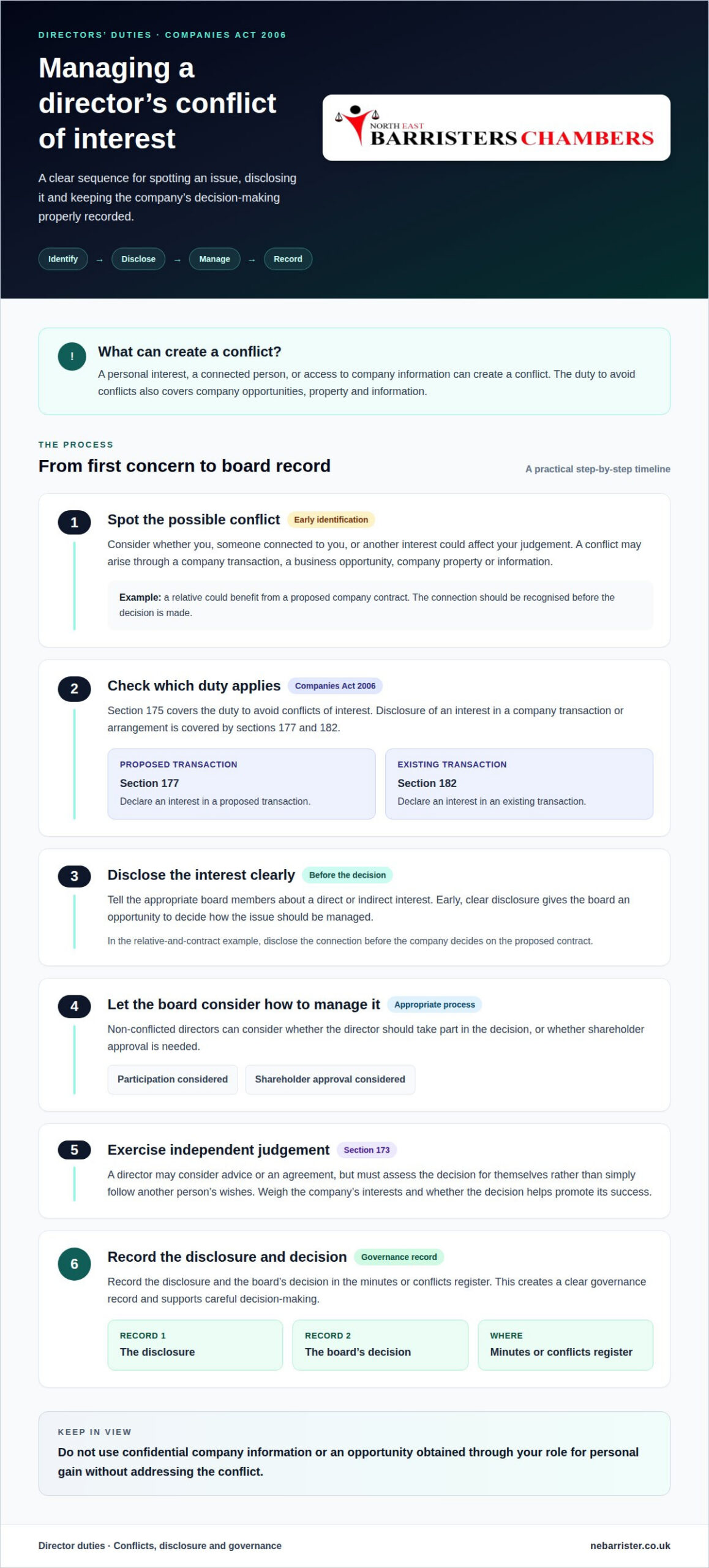
Conflicts can arise through a personal interest, a connected person or access to company information. The Companies Act 2006 requires directors to identify these situations, disclose relevant interests and follow a proper process.
Maintaining Independent Judgement
Section 173 of the Companies Act 2006 requires a director to exercise independent judgement rather than simply follow another person’s wishes. A director may consider advice or an agreement, but must still assess the decision for themselves. This matters when a shareholder, colleague or business associate has a competing interest. Good governance means weighing the company’s interests and whether the decision helps promote its success.
Disclosing and Managing Conflicts
Disclosure means telling the appropriate board members about a direct or indirect interest in a company transaction or arrangement. Under section 177, a director must declare an interest in a proposed transaction; section 182 covers an interest in an existing one. Early, clear disclosure gives the board a chance to decide how to manage the issue.
For example, a director whose relative could benefit from a proposed company contract should disclose that connection before the decision. The non-conflicted directors can then consider whether the director should take part or whether shareholder approval is needed. Record the disclosure and the board’s decision in the minutes or conflicts register. This creates a clear governance record and supports careful decision-making.
The duty to avoid conflicts under section 175 also covers opportunities, property and information belonging to the company. A director should not use confidential information for personal gain or pursue a business opportunity obtained through their role without addressing the conflict. If the right approach is unclear, Direct Access Barrister Services can provide legal advice on the issue and its implications.
Reasonable care, skill and diligence
Section 174 of the Companies Act 2006 requires each director to meet a standard of reasonable care, skill and diligence. It combines the care expected of someone performing that role with the director’s own knowledge and experience.
The Expected Standard of Care
The legal test considers what a reasonably diligent person would do in the same role, as well as the director’s actual skills and experience. A director with specialist financial knowledge, for instance, may be expected to apply it when reviewing company accounts. The standard reflects both the responsibilities of the position and the individual’s abilities.
Executive and non-executive directors have the same legal duties, despite their different day-to-day roles. Limited involvement does not excuse a non-executive director from questioning unclear figures in a proposed budget. They should ask relevant questions and assess the answers before supporting the decision.
Applying Care, Skill and Diligence
Directors meet this duty by approaching decisions attentively and checking that the available information supports the proposed action. Before approving a major contract, for example, the board can review its terms, risks and expected effect on the company. This helps directors exercise their judgement instead of approving papers without scrutiny.
Good corporate governance means preparing for meetings, following up unanswered questions and recording the reasons for significant decisions. If sales figures conflict with a forecast, directors should seek an explanation before relying on it. They can delegate tasks such as preparing accounts—often working with professional advisers such as Coombs Chartered Accountants—but delegation does not remove their responsibility to oversee the work.
The appropriate level of care depends on the decision’s importance and the director’s role, expertise and experience. A routine operational choice may need less scrutiny than a major financial commitment. Directors should give decisions attention proportionate to the risks, question gaps in the evidence and consider the company’s circumstances.
Consequences of breaching directors’ duties
A breach may result in financial remedies, prosecution or disqualification, depending on the conduct and its consequences. Duties apply to executive and non-executive directors alike, even though their roles in carrying out company decisions differ.
A director who breaches a duty may have to repay profits, compensate the company for a loss or return company property. Using a company opportunity for personal gain, for example, could require the director to account for that profit. These remedies address harm to the company; they do not automatically make a director liable for every company debt.
A director may also face a personal claim for breaching a duty. They are not automatically liable for company debts because a company is a separate legal entity. However, if a company becomes insolvent and a director has failed to meet their duties, insolvency office holders have a legal duty to pursue certain claims for creditors.
Insolvency changes the focus of decisions: directors must consider creditors’ interests, and their duties continue during the insolvency process. Resigning shortly before or during that process does not remove those responsibilities. Directors may still face scrutiny for earlier actions, including failures to act within their powers or promote the company’s success.
Other consequences may include a fine, prosecution or disqualification from acting as a director. A disqualified person cannot be appointed as a director. The outcome depends on the alleged breach, its impact and the evidence. Preserve relevant board records and seek advice promptly if a claim or investigation arises.
If you face a directors’ duties dispute or need advice about potential liability, seek Direct Access Barrister advice on the issues and your options.
North East Barristers Chambers: Direct Access Barrister Services
North East Barristers Chambers provides direct access barrister services for individuals and businesses seeking advice on legal issues involving director duties. A barrister can explain the relevant principles, assess the issues and advise on possible next steps. If a dispute reaches court, court representation may also be relevant.
This support may be useful if you face a claim alleging breach of duty, need to understand potential personal liability or are dealing with a conflict involving company decisions. The chambers handles civil and criminal law matters. The appropriate support depends on the nature of your case and the help you need.
For advice about a directors’ duties issue, contact North East Barristers Chambers.
Make your next decision with clarity
Understanding director duties and responsibilities in the UK is not only about knowing the rules. It also means recognising when a decision, dispute or potential claim calls for specific legal advice. Early guidance can help you understand the issues and make informed choices about what to do next.
North East Barristers Chambers provides direct access barrister services and court representation. Its criminal law work may be relevant if a director faces a criminal allegation connected with their role. The right support depends on the legal issue and the outcome you need to address.
You don’t have to work through a complex legal concern without guidance. Contact North East Barristers Chambers to discuss your situation and take a considered next step.
Frequently Asked Questions
What is a director in a company?
A company director is appointed to help direct the company’s affairs and take part in its governance. Executive directors usually manage daily operations, whilst non-executive directors generally do not. Companies House states that a UK company must have at least one director, and an appointee must be 16 or over. A person’s actual role can also matter, not only their job title.
Consequences of Breaching My Duties?
A breach may lead to a claim for financial remedies or other action. If concerns arise, preserve board papers, emails and records showing what information informed the decision. Do not alter or delete documents. A clear record can help explain your actions and reasoning. Prompt legal advice can help you understand the specific allegation and respond appropriately.
What are the Directors’ Duties in the UK?
Directors’ duties and responsibilities in the UK include acting within their powers, promoting the company’s success and exercising independent judgement. Directors must also use reasonable care, skill and diligence, avoid conflicts, refuse improper benefits from third parties and declare interests in company transactions. These duties apply across director roles, so a non-executive position does not remove them.
What happens if a director breaches a duty?
The company may pursue a remedy, and a director may face disqualification, a fine or prosecution, depending on the circumstances. If insolvency occurs, office holders have a legal duty to pursue certain claims to help pay creditors. A disqualified person cannot be appointed as a director. The appropriate response depends on the alleged conduct, the evidence and whether the company is insolvent.
What is the difference between a de facto director and a shadow director?
A de facto director performs director functions without formal appointment. A shadow director is someone whose directions or instructions the board is accustomed to follow. The distinction lies in how each person relates to the company’s management and board. Both categories are subject to directors’ general duties, so the absence of a formal appointment does not automatically remove those responsibilities.
What are the statutory duties of company directors under the UK Companies Act 2006?
The Companies Act 2006 sets out seven general duties owed by each director to the company. They cover acting within powers, promoting success, independent judgement, reasonable care, skill and diligence, avoiding conflicts, refusing benefits from third parties and declaring interests in proposed or existing transactions. Together, these duties guide how directors use their authority and make decisions for the company.