
An unfavourable family court decision can be appealed, but disagreement with the outcome alone isn’t enough. The grounds for appealing a family court order include a legal error or an unjust decision caused by a serious procedural or other irregularity. In most cases, you’ll also need permission to appeal, and deadlines are strict: appeals are usually lodged within 21 days in England and Wales, and within 14 calendar days in Northern Ireland.
If you believe the judge overlooked important evidence or applied the law incorrectly, it is understandable to want the decision reviewed. An appeal is not a chance to rehear the whole case, so identifying a valid ground and acting within the applicable time limit matters.
This guide explains the main grounds for appeal, when permission is needed, how deadlines differ and what to consider before challenging a financial order. It also explains how a barrister can assess the decision and represent you through the appeal process.
Key Takeaways
- Separate genuine legal or procedural errors from simply disagreeing with the judge’s decision.
- Find out whether permission to appeal is required and what the court will consider before granting it.
- Identify the deadline that applies to your type of order and act promptly, as some appeals have shorter time limits.
- For a financial order after divorce, consider whether an appeal is the right route or whether a different application may be more appropriate.
Permission to appeal
In England and Wales, the appeal is heard by an appeal court. Permission may be granted by the judge who made the decision or by the appeal court. Ask for permission at the hearing. If it is refused, act promptly to follow the review process and meet its deadline.
Apply for permission to appeal
- Ask for permission at the hearing. Permission is required for most family court appeals. Request it orally when the judge gives the decision, and identify the legal or procedural error you believe affected the outcome.
- Explain why the appeal should proceed. Permission may be granted if the appeal has a real prospect of success or there is another compelling reason for it to be heard. Refer to relevant evidence and explain how the alleged error mattered, particularly where the decision affects children.
- Check whether an exception applies. Permission is generally required to appeal Family Court judgments and orders, except for committal orders, secure accommodation orders and refusals to grant habeas corpus for a minor’s release. Check the order rather than assuming an exception applies.
Respond to a refusal of permission
- Read the refusal notice and act within 7 days. If permission is refused on paper, apply for an oral hearing within 7 days of the refusal. If permission is refused, a review request in an England and Wales case must be made within 7 days of receiving notice.
- Address the reason for refusal. Explain why the appeal has a real prospect of success or raises another compelling reason to be heard. Permission may be refused if neither test is met, so focus on the stated legal or procedural issue, not simply your disagreement with the outcome.
- Protect the next step. In England and Wales, a refusal becomes final if you do not apply for a review within the stated period. Check the notice carefully and ensure your request reaches the correct appeal court in time. Delay can prevent you from pursuing that route.
Can You Appeal a Family Court Decision?
According to the Ministry of Justice, family court appeals in England and Wales are governed by Part 30 of the Family Procedure Rules and Practice Direction 30A. An appeal doesn’t automatically pause or stay the order, so it remains in effect unless the court suspends it.
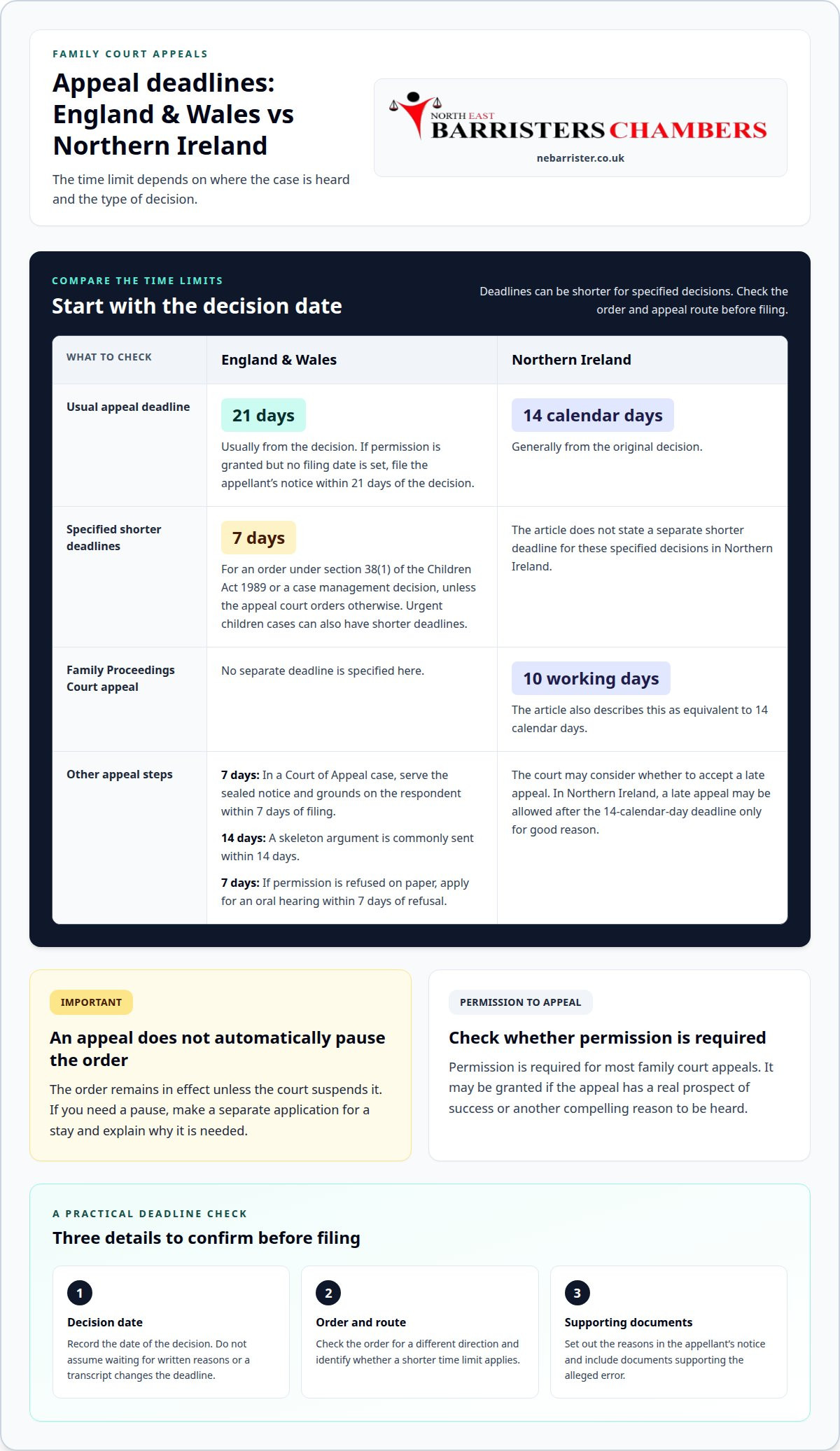
- Identify the deadline and appeal route. In England and Wales, appeals are usually lodged within 21 days of the decision. If permission is granted but no filing date is set, file the appellant’s notice within 21 days of the decision. Check the order for any different direction before preparing documents.
- Act faster for specified decisions. The Ministry of Justice says an appellant must file an appeal notice within 7 days when appealing an order under section 38(1) of the Children Act 1989 or a case management decision, unless the appeal court orders otherwise. Urgent children cases can also have shorter deadlines, such as seven days.
- Use the correct process for your jurisdiction. In Northern Ireland, a family court appeal must generally be lodged within 14 calendar days of the original decision. For an appeal from a Family Proceedings Court, the deadline is 10 working days. The court may consider whether to accept a late appeal.
- Prepare and serve the supporting documents. Set out your reasons in the appellant’s notice and include documents supporting the alleged error. In a Court of Appeal case in England and Wales, serve the sealed notice and grounds on the respondent within 7 days of filing. A skeleton argument is commonly sent within 14 days.
- Keep following the order while the appeal is pending. Filing an appeal alone doesn’t suspend its requirements. If you need a pause, make a separate application for a stay and explain why it’s needed. Legal advice can help you present the reasons clearly; family court representation may assist with preparing your case.
Appeal time limits and late applications
In England and Wales, the usual deadline is 21 days from the decision being appealed. The deadline can be shorter for certain decisions, so identify the order and appeal route before filing.
- Start by recording the decision date. Use the date of the decision as your starting point, then check whether the order sets a different filing date. Do not assume that waiting for written reasons or a transcript changes the deadline. Seek advice promptly if you are unsure which decision to appeal.
- Apply the shorter deadline where it fits. According to the Ministry of Justice, an appellant must file an appeal notice within 7 days of the decision when appealing an order under section 38(1) of the Children Act 1989 or a case management decision, unless the appeal court orders otherwise.
- Check whether permission affects the filing date. If permission to appeal is granted and the court sets a filing date, follow that direction. If no date is set in an England and Wales case, file the appellant’s notice within 21 days of the decision. Keep the permission decision with your appeal papers.
- Use the Northern Ireland time limit. A family court appeal there must generally be lodged within 14 calendar days of the original decision. For an appeal from a Family Proceedings Court, the period is 10 working days, equivalent to 14 calendar days.
- Deal with a late filing directly. In Northern Ireland, the court may allow an appeal after the 14-calendar-day deadline only for good reason. Set out the reason for delay and provide supporting information, rather than relying on the merits of the appeal alone.
- Check special statutory appeals separately. Under section 111A of the Magistrates’ Courts Act 1980, an appeal in Child Support Act 1991 proceedings must be filed within 21 days after the decision. That deadline cannot be extended under rule 4.1(3)(a), so a solicitor’s advice should address whether this route applies.
Appeals against financial orders after divorce
- Identify the error you are challenging. An appeal against a financial order is not justified simply because you consider the outcome unfair. Explain the legal error, overlooked evidence or serious procedural irregularity, and show how it affected the decision. The appeal court reviews the decision made; it does not rehear the divorce case from the beginning.
- Consider whether setting aside is the appropriate route. In England and Wales, an appeal should not ordinarily be used where the complaint is better addressed by applying to set aside a financial remedy order under rule 9.9A. For example, distinguish an alleged error by the judge from a problem that calls for a set-aside application.
- Check the deadline for a case management challenge. An appeal against a case management decision must be filed within 7 days. Treat that limit as strict unless the appeal court orders otherwise. Explain the specific direction you challenge and prepare the documents needed to support your grounds.
- Weigh the possible outcomes and costs. The appeal court can dismiss the appeal, vary or discharge the order, set it aside, make a fresh order or send the case back for a rehearing. If you lose, you may be ordered to pay the other party’s legal costs. Even a successful appellant is unlikely to recover 100% of their costs.
- Clarify the likely expense before proceeding. The total cost depends on the case, the documents required and the representation involved. Help with fees depends on eligibility and the relevant court fee. For an assessment of the appeal and court representation, discuss your family court appeal.
North East Barristers Chambers: Direct Access Barrister Services
North East Barristers Chambers provides direct access barrister services and court representation for people considering a family court appeal. A barrister can assess the decision, identify potential legal or procedural errors, and explain the appeal process.
Consider seeking advice before filing if you are unsure whether your concerns amount to valid grounds, which documents support your case, or how to present your arguments. You can instruct a barrister directly for professional advocacy without a solicitor. This can help you make an informed decision about the next step and prepare for court representation if your appeal proceeds.
If you’d like to discuss your family court appeal, contact North East Barristers Chambers.
Prepare your next step with care
Before taking action, turn your concern into a clear account of what the court may have got wrong. Set out the decision you challenge, why it may be legally or procedurally flawed, and which documents support your position. This helps you assess whether the grounds for appealing a family court order concern an appealable issue, rather than simply dissatisfaction with the result.
A careful review can also help you decide what to ask a barrister and what practical steps to take next. North East Barristers Chambers offers direct access to barrister advice and court representation, providing a route to discuss your appeal and the advocacy it may require.
Ask North East Barristers Chambers about appeal representation and take your next step with a clearer understanding of your options.
Frequently Asked Questions
Do I need legal advice to make an appeal?
You can take steps without a solicitor and instruct a direct access barrister without a solicitor intermediary. Advice can help distinguish an appealable error from dissatisfaction with the result. Before deciding, organise the order, any written reasons and the evidence you say the judge missed. This gives a barrister a clearer basis for assessing your proposed grounds.
How do I start the appeal process?
Start by obtaining the sealed order and written reasons, then identify the precise decision you want the appeal court to review. Note the alleged error and the evidence or hearing document that supports it. Next, check the appeal route, permission requirement and deadline for that order. Your appellant’s notice should set out the decision challenged and the grounds, not retell the entire family dispute.
What are the grounds for appeal?
A family court appeal requires a recognised error, not simply a different view of what would have been fair. Examples include a judge applying the law incorrectly, overlooking important evidence or making a decision affected by a serious procedural irregularity. Explain how the error could have affected the order. Disagreement with the weight given to evidence, by itself, may not establish an appealable flaw.
What happens if my appeal is successful?
The appeal court chooses a remedy suited to the error it finds. It may set aside the original decision, substitute a fresh order, vary the existing order or send the case back for a rehearing, potentially before a different judge. Read the appeal judgment carefully: it explains what happens next and whether further steps are needed in the lower court or in connected proceedings. Where court outcomes affect the distribution of family property or beneficial interests, estate planning specialists such as Aiker Wills and Trusts can assist with updating relevant trusts and wills.
When can you submit an appeal?
In England and Wales, the usual deadline is 21 days from the decision, but specified decisions can have a shorter limit. For an order under section 38(1) of the Children Act 1989 or a case management decision, the notice is due within 7 days unless the appeal court orders otherwise. Check the order and calculate the relevant deadline immediately, rather than waiting for further correspondence.
What are the grounds for appealing a family court order in England and Wales?
The grounds for appealing a family court order include a decision that was wrong, or unjust because of a serious procedural or other irregularity. For example, the judge may have misapplied the law or failed to consider key evidence. The appeal court reviews the alleged flaw in the original decision; it does not normally rehear the whole case or simply replace the judge’s view with yours.