
You don’t have to use a solicitor to divorce in England and Wales. The choice in DIY divorce vs using a barrister comes down to whether you can manage the process yourself and whether you need legal advice or representation on a related issue.
Keeping costs down matters, and an agreed divorce may feel manageable on your own. But divorce can also involve financial arrangements, children or disagreements. A procedural mistake or unresolved claim may cause problems later.
This guide explains the main costs, the risks of proceeding without legal advice and what a barrister can help with. It also explains how Direct Access works and how a barrister’s role differs from a solicitor’s, so you can decide what support suits your circumstances.
Key Takeaways
- Consider handling the divorce application yourself if matters are straightforward and you and your former partner agree.
- Separate the divorce process from financial arrangements; an agreement may need a financial order to record it and dismiss future claims.
- Compare DIY, fixed-fee and solicitor support by what each covers, including any extra work if complications arise.
- Consider Direct Access barrister support for legal advice or court representation, particularly when financial issues or disputes need specialist attention.
Risks of proceeding without legal advice
- Separate the divorce from financial arrangements.
Ending a marriage does not itself settle every financial claim. In England and Wales, a financial order can record an agreement and dismiss financial claims between you. A solicitor can prepare a financial consent order in the format required by the court. Without advice, you may accept wording that fails to reflect the agreement or leaves claims unresolved.
- Review documents before you sign or submit them.
Check that every form gives a complete, consistent account of your circumstances. For example, figures in financial disclosure should match the information supporting them. Errors or missing details can complicate discussions and court proceedings. Legal advice can help explain documents, identify gaps and assess whether the terms reflect what you intend.
- Get advice on the decisions that affect your position.
A solicitor can explain options based on your circumstances, including financial arrangements and proposals involving children. This can be especially useful if you and your former partner disagree or an offer is difficult to assess. Before accepting a settlement, understand what it covers, what it leaves open and how it may affect future financial claims. It is also important to consider how divorce alters broader estate arrangements, such as wills and succession; for guidance on family law and inheritance, specialist practices such as rgs-law.com highlight the value of protecting your estate alongside any divorce agreement.
- Understand what mediation can and cannot do.
Mediation can help couples discuss an agreement, but a mediator cannot give legal advice during mediation. If you need to weigh a proposal, get independent legal advice separately. A mediator may help you discuss a financial figure, for example, while a legal adviser can explain its implications before you accept it.
- Identify the procedure that applies where you live.
Divorce procedures differ across the UK. In Scotland, the simplified divorce procedure may be available after one year of separation when both spouses consent, according to the Scottish Courts and Tribunals Service. If you do not meet the conditions, or there are disputes about finances or children, legal advice can help clarify the relevant steps and documents.
Can You Finalise a Divorce Without Legal Representation?
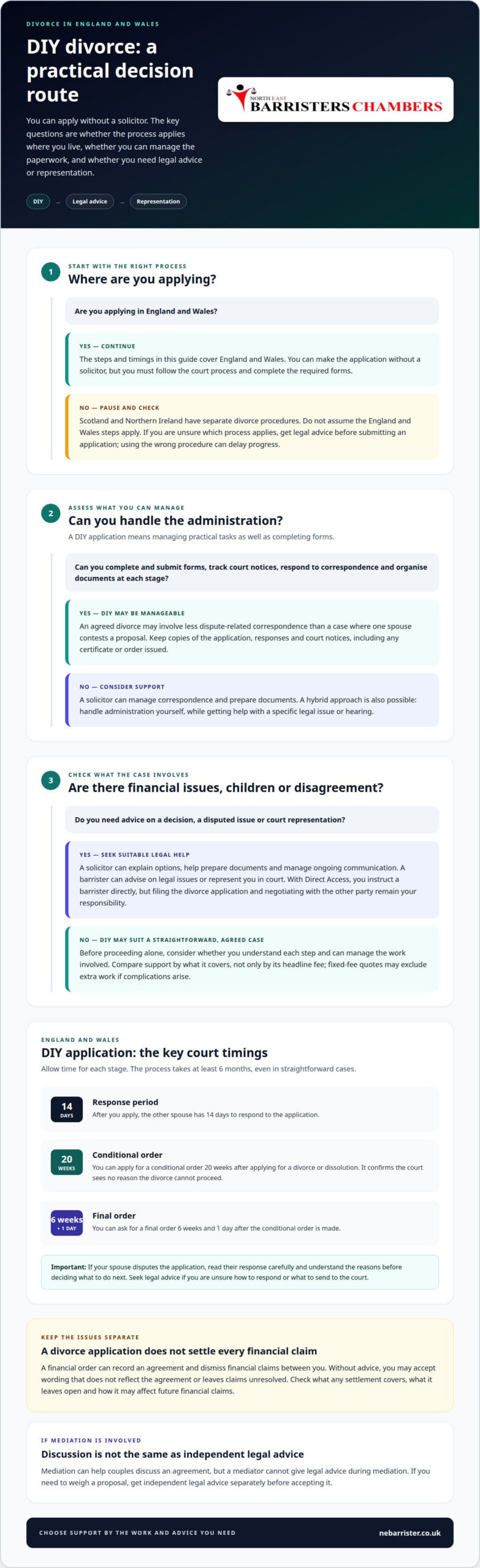
Yes. In England and Wales, you can apply without a solicitor, but you must follow the court process and complete the required forms.
-
Check the relevant divorce process
First, identify where you are applying. England and Wales, Scotland and Northern Ireland have separate divorce procedures. The steps below cover England and Wales, so don’t assume they apply elsewhere. If you are unsure which process applies, get legal advice before submitting an application. Using the wrong procedure can delay progress.
-
Follow the DIY application steps
You don’t have to hire a solicitor in England and Wales. If a form or question is unclear, legal advice can help you understand what information to provide and how to complete it accurately. After applying, the other spouse has 14 days to respond to the application.
For help with an unclear legal issue, a barrister’s perspective can help you understand the process before you proceed.
-
Proceed through the court process
Allow time for each stage. An applicant can apply for a conditional order 20 weeks after applying for a divorce or dissolution, according to HM Courts & Tribunals Service. The conditional order confirms the court sees no reason the divorce cannot proceed. You can ask for a final order 6 weeks and 1 day after it is made. The process takes at least 6 months, even in straightforward cases.
If your spouse disputes the application, read their response carefully and understand the reasons before deciding what to do next. A dispute can affect how the case progresses, so seek legal advice if you are unsure how to respond or what to send to the court. Keep copies of the application, responses and court notices, including any certificate or order issued.
DIY, fixed-fee support and solicitor representation costs
A solicitor can manage correspondence and prepare documents, while a barrister advises on legal issues and represents you in court. With Direct Access, you instruct a barrister directly. However, administrative tasks such as filing the divorce application and negotiating with the other party remain your responsibility.
-
Compare support costs
Compare what each option covers, not just its headline fee. A fixed-fee quote may exclude additional work if something unexpected happens, so check which tasks and stages are included.
A barrister’s fee depends on the case and is given after a quote request. The work required, preparation and court hearing needs shape the cost. There is no single figure for every divorce. A solicitor can advise on options suited to your circumstances, including whether limited help or full representation makes sense.
-
Manage a case without a solicitor
Before proceeding alone, assess the practical work you will need to manage. You may have to complete and submit forms, track court notices, respond to correspondence and organise documents at each stage. An agreed divorce, for example, may involve less dispute-related correspondence than a case where one spouse contests a proposal.
A hybrid approach may suit you if you want to handle administration but need help with a specific legal issue or hearing. A solicitor may manage correspondence and paperwork, while a barrister can advise on legal arguments or represent you in court. This can be useful if you need advocacy but not full solicitor representation.
Consider a solicitor when your situation involves disputed finances, complex documents or ongoing communication. A solicitor can explain your options and help prepare documents in the required court format. Their guidance can also help you understand how a proposed agreement relates to a conditional order and final order, rather than treating the divorce application as the only issue to resolve.
Direct Access barrister services
Direct Access lets you instruct a barrister directly for focused legal advice or court advocacy, without appointing a solicitor. The choice between DIY divorce vs using a barrister often depends on which legal issues you need help resolving.
- Identify the decision you need help with.
A barrister can advise on financial settlements and child arrangements in divorce cases. For example, they can help you assess a proposed agreement about finances or arrangements for children. The advice may focus on the consequences of ending the marriage rather than completing the divorce application itself. Before seeking advice, set out the decision you need to make and the relevant facts.
- Prepare the relevant financial information.
For a financial remedy case, a barrister can review or help complete financial disclosure, including Form E, and consider proposals. A barrister can also draft Form E. Organise supporting documents so the advice can address your financial position and the proposals involved. This can help you understand the material before deciding how to respond or what position to take.
- Understand what direct instruction does not cover.
A Direct Access barrister does not handle administrative tasks such as filing the divorce application or negotiating with the other party on your behalf. You remain responsible for those steps, including applying for the relevant court order. The court fee is separate from barrister fees. Direct Access may suit you if you can manage administration but need legal advice or advocacy.
- Match the arrangement to the case.
When weighing DIY divorce vs using a barrister, consider whether your case involves complex valuations, multiple expert reports, high conflict or substantial ongoing correspondence. These cases may be less suitable for Direct Access alone because they can require extensive case management. A barrister can represent you in court, while solicitor support may be better suited to ongoing correspondence and administration.
For focused advice or advocacy on a family law issue, explore Direct Access barrister support.
North East Barristers Chambers: Direct Access Barrister Services
North East Barristers Chambers provides Direct Access Barrister Services for people who need legal advice or advocacy without instructing a solicitor. This may suit you if you are managing the divorce administration yourself but need help understanding a legal issue or preparing for a hearing.
North East Barristers Chambers also provides Court Representation. Direct Access does not include filing the divorce application or negotiating with the other party on your behalf, so you remain responsible for those tasks. If your case involves complex valuations, multiple expert reports, high conflict or substantial ongoing correspondence, Direct Access alone may be less suitable.
Consider the support you need: focused advice, representation at court, or both. Contact North East Barristers Chambers to discuss your situation.
Choose the support that fits your next step
Choosing between a DIY divorce and using a barrister is not an all-or-nothing decision. You can manage routine administration yourself while seeking legal input on a specific issue that could shape your next decision. Write down what remains unresolved, such as a financial proposal, a document you do not understand or hearing preparation. This gives any discussion a clear focus.
North East Barristers Chambers provides Direct Access Barrister Services and Court Representation in family law, alongside criminal law. If you need advice or advocacy, consider whether direct instruction fits the work you want handled and the parts of the case you can manage yourself.
Contact North East Barristers Chambers to discuss the legal support you’re considering. A clear next step can make a difficult process easier to approach.
Frequently Asked Questions
How Much Does Divorce Cost Without a Solicitor?
A DIY divorce in England and Wales involves a court application fee, with further costs depending on whether you need legal help or additional court documents. You may also incur costs for expert assessments or legal support, so the application fee alone may not cover related financial matters.
What kind of divorce cases might be less suitable?
Cases involving very complex valuations, multiple expert reports, high conflict or substantial ongoing correspondence may be less suitable for Direct Access alone. For example, a dispute involving several assets and repeated negotiations can require continuing case management, not just advice for a hearing. If you cannot organise documents, deadlines and communications yourself, consider whether you need more continuous legal support.
Can I use the simplified/do it yourself procedure?
In Scotland, a simplified procedure may be available if you have been separated for one year and both spouses consent, according to the Scottish Courts and Tribunals Service. That route has specific eligibility conditions. In England and Wales, you can apply without a solicitor, but the process is different. Northern Ireland also has its own divorce procedure, so do not use forms for another jurisdiction.
How long will it take?
In England and Wales, a divorce takes at least 6 months in straightforward circumstances. The applicant may apply for a conditional order 20 weeks after filing, then request the final order 6 weeks and 1 day after the conditional order is made. Court processing, a delayed response or a contested issue can extend the timetable, so completing forms promptly does not determine the whole duration.
How much does it cost to lodge the application in court?
This is the application fee, not the total cost of resolving finances or obtaining legal help. A financial consent order carries a separate £62 court fee. When budgeting, distinguish the application from any additional order or professional work.
Is it safe to proceed without a solicitor?
Yes, you can apply for a divorce without a solicitor in England and Wales, but consider the issues involved. An agreed application with no disputed financial or child arrangements is generally more manageable than a contested case. Get advice before accepting financial terms you do not understand. Ending the marriage does not settle every related financial claim, so consider those separately.