
What belongs in a witness statement: what you know, what someone told you, or what you believe? When drafting a witness statement in the UK, the account should usually use the witness’s own words, focus on facts within their knowledge, and make clear when information came from someone else. Opinions should generally be left out.
It’s understandable to want every important detail included, but a clear, well-organised account is more useful than a long one that blurs events, assumptions and evidence. The layout matters too: numbered paragraphs and pages help readers follow the evidence, while supporting documents should be clearly identified.
This article explains what information a barrister needs from you, how your account can be checked against case documents, and what affects the quality of the final statement. It also explains why careful formatting and a precise statement of truth matter, so you know what to provide and what the finished document needs to do.
Key Takeaways
- Separate what you witnessed yourself from information someone else gave you, and make the source clear.
- A barrister can compare your account with case documents to identify gaps, inconsistencies and details that need clarification.
- Clear paragraph numbering, labelled exhibits and a properly completed statement of truth help make the evidence easier to follow.
- Learn what to provide to support a careful draft and when barrister-led advice or court representation may help.
Statement of truth and signature
End the evidence with a statement of truth, then sign and date the witness statement. These steps identify the account the witness confirms and must be completed carefully.
How a barrister sets out the statement of truth
- Use the required wording and understand its effect before approving the final draft. The statement should end: ‘I believe that the facts stated in this witness statement are true.’ It must also confirm that the witness understands the risk of contempt of court proceedings for making a false statement. “Believe” does not remove the need for accuracy. Every assertion still needs a proper basis.
- Raise any uncertainty before the statement is finalised. An inaccurate date, overstated recollection or claim presented as personal knowledge when it came from someone else can undermine the evidence. False statements may expose the witness to contempt of court proceedings. A barrister can clarify the wording, but the witness must be able to stand behind the account.
How a barrister handles signing the witness statement
- Sign and date the final version only after checking that it reflects your evidence. The signature should follow the statement of truth, making clear which account you confirm. If changes are made after signing, the revised version needs attention before use. A barrister can identify whether an amendment affects the evidence and prepare a clean version for approval.
- Allow time for filing and service if a hearing is approaching. In England and Wales housing possession cases, witness statements must be filed at court and served on the other party at least 2 days before the hearing unless the court directs otherwise, according to the Ministry of Justice. Court directions matter, so the applicable timetable should be followed.
- For fax service, distinguish the transmission deadline from the time the fax is started. The Ministry of Justice gives this wording: “If the transmission of the fax is completed on a business day before 4.30p.m., on that day; or.” This is an extract from a longer provision, not a complete sentence standing alone. A barrister considers the relevant service method and deadline when arranging delivery.
What is a witness statement?
A witness statement records a person’s evidence about the factual issues in a case. The details below help identify the witness, the dispute and the basis for each part of the account.
- Identify the case and the witness before describing events. In civil proceedings, the heading should give the case name and claim number. The statement should also include the witness’s full name and address. For a company witness, include their position or status and the company name. These details distinguish the witness from the parties and other people mentioned.
- Explain how the witness knows each fact. Use first-person wording for events they saw, heard or experienced. If a fact came from another person, identify that person and explain how the information was received. For example, distinguish “I saw the delivery arrive” from “The site manager told me it arrived”. This makes the source clear and prevents second-hand information from appearing to be direct observation.
- Keep the account focused on factual issues the witness can address. A statement should give that person’s version of relevant events, rather than argue what the court should decide. A barrister can organise the evidence around disputed events and explain which details support each point.
- Apply the rules for the court hearing the case. England and Wales civil proceedings use the Civil Procedure Rules, and the Ministry of Justice’s standard witness statement document is designed to support compliance with Practice Direction 32. Scotland and Northern Ireland have separate legal systems and procedural rules, so the relevant court’s requirements differ.
- Use the court’s directions to establish when statements must be exchanged. There is no single deadline for every UK civil case; the timetable depends on the proceedings and any directions made. If a statement has already been filed, don’t alter it informally. Explain the proposed correction or additional evidence to a barrister, who can advise on the appropriate process under the court’s directions.
- You don’t need a solicitor to instruct a barrister directly for civil law work. The cost depends on the case, its complexity and the work required, and is given after a quote request. For help with evidence or court representation, explore civil law barrister support.
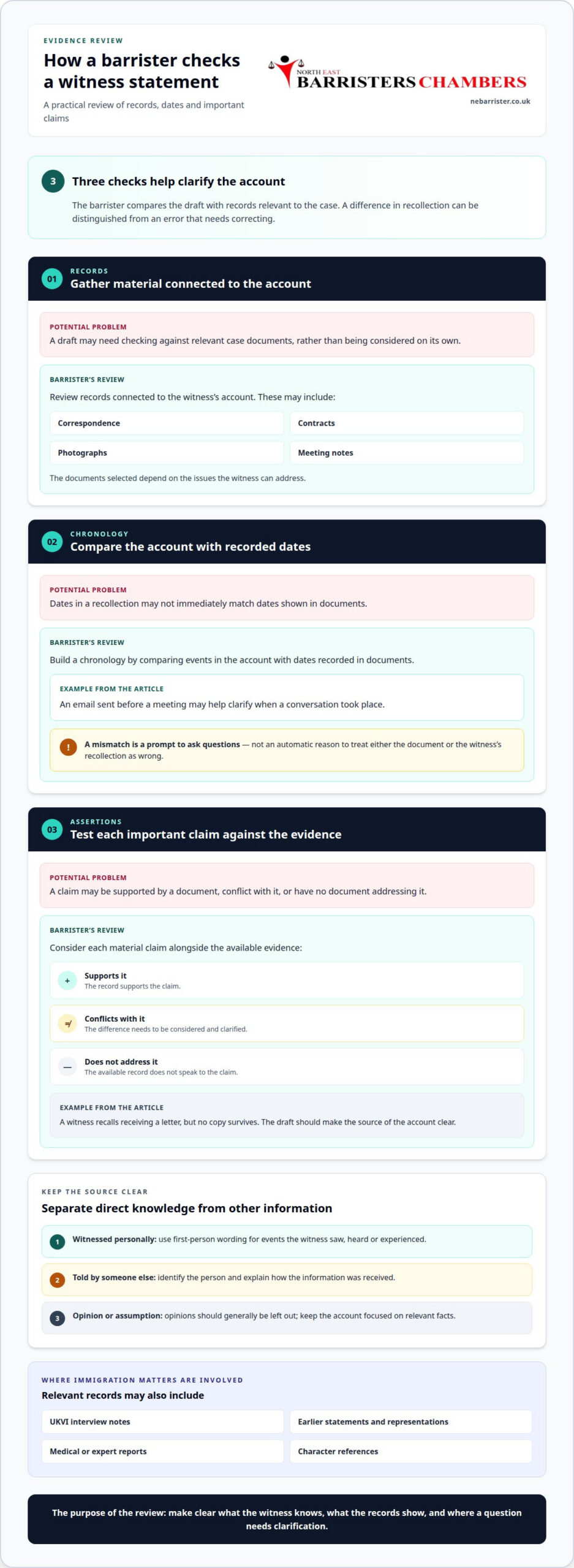
How a barrister checks a witness statement against case documents
A barrister compares the draft with records relevant to the case. When drafting a witness statement in the UK, this review helps distinguish a difference in recollection from an error that needs correcting.
- Gather relevant records. The barrister reviews material connected to the witness’s account, such as correspondence, contracts, photographs and meeting notes. In immigration matters, relevant records may include UKVI interview notes, earlier statements and representations, medical or expert reports, and character references. The documents selected depend on the issues the witness can address.
- Build a chronology. The barrister compares events in the account with dates recorded in documents. An email sent before a meeting, for example, may help clarify when a conversation took place. A date mismatch is a prompt to ask questions, not an automatic reason to treat either the document or the witness’s recollection as wrong.
- Test important assertions. Each material claim is considered alongside the available evidence. The barrister identifies whether a document supports it, conflicts with it or does not address it. If a witness recalls receiving a letter but no copy survives, the draft should distinguish their recollection from documentary proof.
- Explore apparent inconsistencies. If an earlier account gives a different date, the barrister asks the witness to explain the difference. It may reflect an estimate, a misunderstanding or a later correction. The account should not be altered merely to match another record; any explanation must accurately reflect what the witness remembers.
- Consider context and source. The barrister checks who created a document, when it was created and whether surrounding material changes its meaning. One message in an email chain may read differently alongside the response. This contextual review helps prevent a statement from relying on a document in a way its full contents do not support.
- Resolve points before approval. The barrister discusses unclear details with the witness and revises the draft where needed. Careful drafting of a witness statement in the UK means preserving the witness’s honest account, including any remaining difference between it and a document. The witness should approve only wording they can explain and confirm as accurate.
Witness statement layout and formatting by a barrister
A barrister formats the statement so its evidence is easy to navigate. In England and Wales, the Ministry of Justice says the standard witness statement document is designed to ensure compliance with Practice Direction 32 (PD 32) in civil proceedings.
- Set out the case heading. The barrister places the case name and claim number at the start. This identifies the proceedings before the witness’s evidence begins. A standard document also includes the main body, exhibits and statement of truth.
- Number each paragraph and page. Numbered paragraphs let readers refer to a specific fact without ambiguity. Numbered pages help keep the evidence in order if the document is printed or handled separately. For a lengthy account, the barrister can add headings to distinguish topics or periods.
- Apply the page and number conventions. In England and Wales, the statement should use A4 paper with a 3.5 cm margin. Dates and other numbers should appear in figures under paragraph 19.1(6). The barrister applies these details consistently, including dates in the chronology.
- Make exhibits easy to identify. The barrister labels each supporting document clearly and refers to it in the relevant paragraph. For example, a paragraph about a letter can point to the labelled exhibit containing it. This helps readers connect the facts stated with the evidence relied upon.
- Keep the document legible. A typed statement is preferable where possible; clear handwriting may be used if typing is not possible. Printing on one side of each page can make the evidence easier to review. The barrister checks that paragraph numbers, exhibit labels and page numbers remain readable.
- Review the final layout before approval. The barrister checks that the statement of truth and signature appear with the completed evidence, and that no page or exhibit is missing. Arrange direct access barrister support for help preparing a clear, properly organised statement.
North East Barristers Chambers
North East Barristers Chambers provides Direct Access Barrister Services for people who need advice on evidence and court proceedings. A barrister can help you understand what your account needs to address, identify documents relevant to your case and explain how the statement fits into your wider legal position. This support can be useful when the facts are disputed, your documents appear inconsistent, or you need to prepare for a hearing. The appropriate next step depends on your case and the help you need, including advice or Court Representation in civil or criminal matters. If you would like to discuss your situation, contact North East Barristers Chambers.
Take the next step with a clear account
A statement can shape how the court understands your evidence, so treat its preparation as part of your wider case strategy. If events have changed, a document has come to light, or you have concerns about a draft, raise those points before relying on the final version. Clear instructions help a barrister focus on the issues that matter and explain options for progressing your case.
Professional support with drafting a witness statement in the UK can be useful when the account is detailed, disputed or closely tied to other evidence. North East Barristers Chambers provides Direct Access Barrister Services and Court Representation, including in criminal law matters. You can discuss what assistance fits your circumstances and what information will help move the work forward.
Contact North East Barristers Chambers to discuss your witness statement and next steps. A careful conversation can help you approach the process with greater clarity.
Frequently Asked Questions
Personal knowledge, information or belief?
Separate what you witnessed from what you learnt through another person or document. For example, “I attended the meeting” describes personal knowledge; “My colleague told me the meeting was cancelled” identifies information from someone else. If you include information or belief, explain its source and basis. This distinction helps readers assess the evidence without mistaking something you heard for something you saw yourself.
What is a witness statement in UK civil proceedings?
A witness statement is a written account of a witness’s evidence about relevant factual issues in a civil case. It gives the court that person’s version of events and may support a party’s position on questions such as what happened, when it happened and who was involved. It is not a substitute for legal argument: the witness describes evidence, while submissions explain what the court should decide.
What format will a barrister use for a witness statement in the UK?
The format depends on the court and type of proceedings. In civil cases in England and Wales, the standard witness statement document is designed to support compliance with Practice Direction 32. A barrister adapts the document to the case, including its heading, evidence and exhibits. For instance, a statement relying on several letters needs references that let the reader identify each document clearly.
How does a barrister write and structure a witness statement?
A barrister develops the account from the witness’s instructions and relevant evidence, then organises events so the factual issues are easy to follow. The statement is generally written in the first person and in the witness’s own words. A dismissal claim involving financial loss, for example, may need evidence about pay and steps taken to find other work, where relevant to the issues.
What statement of truth wording must a UK witness statement include?
The statement should end with: “I believe that the facts stated in this witness statement are true.” The witness must also confirm they understand the risk of contempt of court proceedings for making a false statement. This is a serious confirmation, not a formality. Before approving the document, the witness should raise any wording they cannot honestly confirm or any detail they believe needs correcting.
How does a barrister handle the signing, dating and service of a witness statement?
The witness signs and dates the final statement after approving its contents. The barrister checks the relevant court directions for how and when it must be served, because deadlines depend on the proceedings. For example, a housing possession case may have a different timetable from another civil claim. If the court changes its directions, the applicable service arrangements may change too.