
What if instructing a barrister directly gives you specialist advice and advocacy, but leaves some case-management tasks in your hands? That’s the key point to understand when researching how to instruct a barrister directly. Direct access can be a practical route, but it doesn’t automatically cover every part of a case.
It’s understandable to be unsure what to prepare, who will manage correspondence and deadlines, or whether your case is suitable. The work a barrister can take on depends on the case and the rules that apply. Before work begins, clarify the barrister’s role and who is responsible for practical tasks such as filing documents and managing ongoing correspondence.
This guide takes you through the process, from preparing a clear case summary and organising relevant documents to making an enquiry and agreeing responsibilities, communication and next steps. North East Barristers Chambers provides direct access advice and court representation in criminal, civil and family matters. You’ll learn what to discuss before instructing a barrister, so you can make an informed next move without treating general information as advice on your specific case.
Key Takeaways
- Understand how to instruct a barrister directly and why the work involved depends on your case and the applicable rules.
- Prepare a short chronology and identify the decision, hearing or practical outcome you need help with.
- Agree the barrister’s role, deliverables, communication route and deadlines before work begins.
- Keep papers complete and in date order so the key events and current stage of your case are clear.
- North East Barristers Chambers provides direct access advice and court representation in criminal, civil and family matters.
How to instruct a barrister directly: what the process involves
Direct instruction means you engage a barrister without first instructing a solicitor. You give your instructions and case information to the barrister yourself, rather than communicating through a solicitor who has instructed counsel on your behalf. This gives you direct access to specialist advice or advocacy, but it doesn’t mean every task in a case is included.
The process usually starts with an enquiry explaining the issue and the case’s current stage. You then provide an initial outline, agree the work to be done and send the papers needed for that work. The barrister’s role depends on the agreed scope and the professional rules that apply. Rules can differ across UK jurisdictions, so guidance about one jurisdiction shouldn’t be assumed to apply throughout the UK.
What does instructing a barrister directly mean?
In a solicitor-led case, a solicitor usually manages the client relationship and instructs a barrister when specialist advice or advocacy is needed. With direct access, you communicate your instructions and relevant case information to the barrister yourself. A barrister’s work may include advice, drafting or court representation, but the agreed role must reflect the case and applicable rules. For background on the profession, see What is a Barrister?
For example, you might seek advice on a dispute or representation at a hearing. Neither request automatically includes managing every administrative step. Before work starts, clarify who will handle tasks such as filing documents or dealing with ongoing correspondence.
Which legal matters might involve direct access?
Direct access may be relevant to criminal, civil and family matters, depending on the issues and work required. Someone facing a hearing might need advocacy; a person involved in a civil dispute might need advice on their position; and a family matter may call for guidance or representation. These examples illustrate different needs, not a guarantee that every case or procedural task is suitable.
The rules also depend on where the case is taking place. In England and Wales, the Bar Standards Board regulates the Public Access Scheme. Barristers generally cannot conduct litigation under this route unless they hold separate authorisation to do so. For more context on how direct access works, the direct access barrister guide explains the route in broader terms.
In your initial enquiry, describe the issue, the outcome you’re seeking and any important dates. A clear outline gives the barrister a practical starting point to discuss the proposed work and its scope. Whether direct access is suitable depends on the facts of your case and the work required, so a general guide can’t decide this for you.
Before instructing a barrister directly, define your case and objectives
A useful first enquiry starts with the essentials, not a long account of every detail. A short, factual summary helps the barrister understand what has happened, where the matter stands and what you need help with. It also helps identify the key documents and questions for the next stage.
What information should your first enquiry include?
Explain who is involved, what the matter concerns and what has happened so far. You don’t need to decide the legal issues yourself. Focus on the facts you know, and distinguish them from points that are disputed or unclear.
Write a brief chronology in date order. Include the current stage of the case and highlight any upcoming hearing, filing date or response deadline. If you don’t know an exact date, say so rather than guessing. Deadlines can affect which issue needs attention first.
Then state your objective in plain language. You may want advice before a hearing, representation at a hearing or help understanding a decision. Naming the task you’re seeking makes it easier to discuss the likely scope of the work. This practical preparation is central to how to instruct a barrister directly.
How to organise case documents before sending them
Gather documents that relate to the issue, but avoid sending a large, unexplained bundle. Make a simple index and use consistent labels so each item is easy to identify. Keep original documents safe and send copies unless you’re specifically asked for an original.
- Chronology: record key events and dates, with a short note of what happened.
- Document index: list each item, its date and a brief description, such as “letter about the decision”.
- Case papers: group relevant correspondence, court documents, decisions and supporting records together.
- Outstanding questions: note anything you’re unsure about and any document you’re still trying to locate.
Keep your summary measured. If you disagree with an account or decision, explain what you dispute and why, then point to any relevant document. Avoid presenting assumptions as established facts or leaving out information simply because it feels unhelpful. A balanced account gives the barrister a clearer starting point.
Use the method provided for sending papers and follow any instructions about confidentiality and personal data. If you’re unsure which documents are relevant, explain what you have rather than trying to make a legal judgement about each item. A focused set of papers is easier to review and discuss.
North East Barristers Chambers provides direct access advice and court representation in criminal, civil and family matters. Preparing your chronology and papers can make an initial discussion more focused. You can make an enquiry with North East Barristers Chambers.
Agree the barrister’s role, scope and responsibilities before work begins
Before work starts, make sure you understand exactly what you’re asking the barrister to do. The agreed scope should identify the work, what you’ll receive, how you’ll communicate and any relevant deadlines. For example, a request for advice about a hearing doesn’t automatically include preparing documents, attending court or managing the case through to its conclusion.
Be especially clear about procedural administration. In England and Wales, the Bar Standards Board’s Public Access rules generally prevent barristers from conducting litigation unless they hold separate authorisation. Conducting litigation can include steps such as filing documents with the court and managing certain case correspondence. Rules differ across UK jurisdictions, so don’t assume that terminology or limits applying in one jurisdiction apply identically elsewhere.
Advice, preparation and advocacy are different tasks
Advice involves analysing the information and papers provided, then explaining relevant legal issues and possible options. Preparation may include reviewing documents or drafting specified material, if that work is agreed and permitted. Advocacy means presenting your case at an agreed hearing when representation is agreed and the barrister is able to undertake it. Each is a distinct task, and an instruction for one doesn’t automatically include the others.
The table below gives a general guide to task boundaries. It isn’t a promise that any particular task is included. Your responsibilities depend on the agreed work and applicable rules.
| Task category | What it may involve | What to clarify |
|---|---|---|
| Advice | Considering the case information and explaining legal issues or options. | Which questions the advice will address and whether it will be oral, written or both. |
| Preparation | Reviewing specified papers or drafting agreed documents. | Which documents or drafts are included and what you must provide. |
| Advocacy | Representing you at an agreed hearing, where permitted. | Which hearing is covered and what preparation is included. |
| Case administration | Filing, routine correspondence or ongoing case management. | Who is responsible for each task, as these may remain with you. |
What to clarify in the agreed scope of work
Ask for the boundaries to be set out clearly before relying on the arrangement. Confirm which papers will be reviewed, what advice or documents you’ll receive, whether a hearing is included and when each part is due. Establish who will send correspondence, file documents and communicate with the court or other parties. Unless the agreed service provides otherwise, you may need to handle administrative steps yourself.
Agree how to pass on urgent changes, new documents or a change to a hearing date. Use the stated communication route, identify deadlines clearly and keep copies of important messages. These details are central to how to instruct a barrister directly: a precise scope helps you understand what the barrister will do, what remains your responsibility and when to raise a new request.
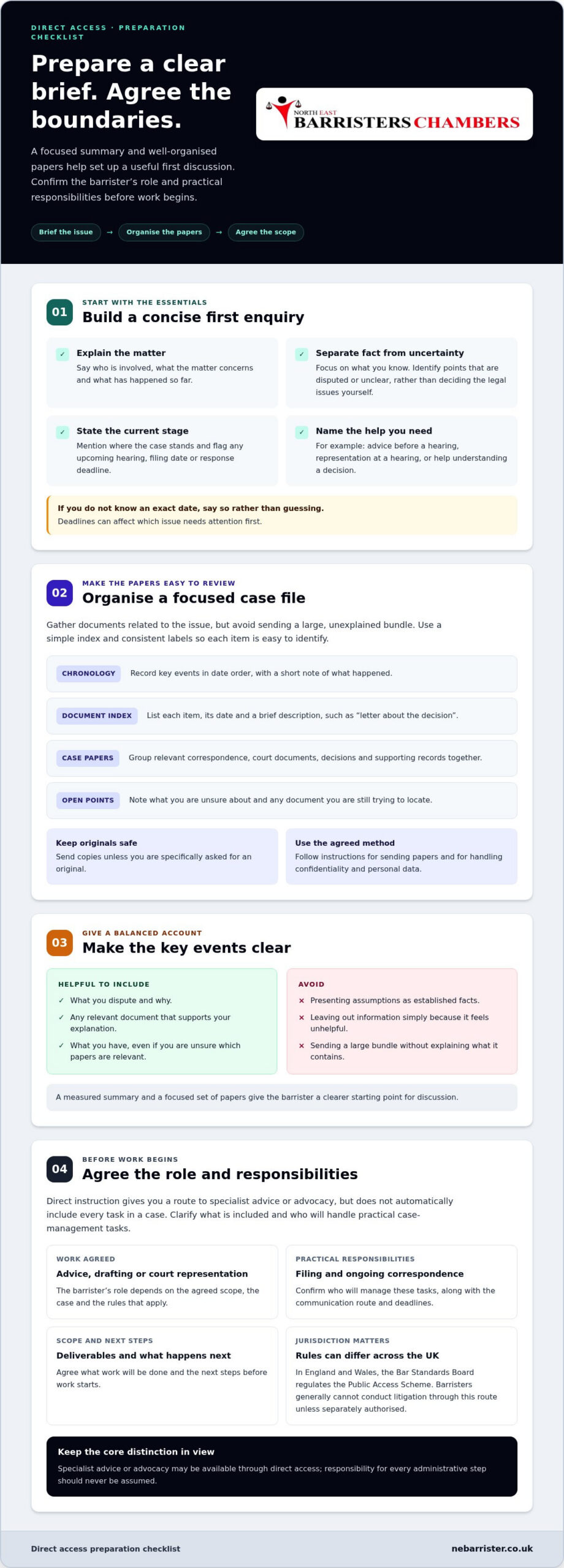
Follow these steps to give clear instructions and keep the case organised
A clear workflow helps you move from an initial enquiry to focused legal work. Keep each stage organised and provide the information needed for the task you’ve agreed.
A practical sequence from enquiry to agreed instructions
- Send a concise enquiry. Give a short account of the matter, identify its current stage and state what help you’re seeking, such as advice on a specific issue or representation at a hearing. Highlight upcoming dates straight away.
- Provide relevant papers and answer questions. Send the requested documents in an orderly format. Answer clarification questions accurately and distinguish what you know from what you’re unsure about. If a document is missing, say so rather than implying the file is complete.
- Agree the work and arrangements. Before work begins, make sure you understand what the barrister will do, what you’ll receive, how to communicate and which practical steps remain your responsibility. Keep a record of the agreed scope and deadlines.
- Prepare for the agreed work. Check that the papers relate to the task, are legible and are labelled consistently. Note the questions you want addressed so important points aren’t buried in a large bundle.
Complete, chronological papers help counsel follow events and see how documents relate to the issues in dispute. For example, arranging a decision, related correspondence and any response in date order makes the history easier to follow than sending the same items in an unexplained batch. An index gives each document a reference, so you can both refer to the same material during a discussion.
A clear instruction identifies the issue or task, points to relevant evidence and flags any deadline that affects the work. This keeps the discussion focused on what you need help with and reduces the risk of different interpretations of your request.
How to communicate changes and urgent developments
Tell the barrister promptly if new evidence arrives, circumstances change or a hearing or response date is altered. A change may affect the agreed work or timetable, so explain what happened, when you learned of it and what deadline now applies. Don’t assume a new document has been received or reviewed until its receipt is acknowledged.
Use a clear subject line and identify the case in each message. Keep one dated case folder, digital or paper, with copies of instructions, documents sent, replies and key dates. A simple communication log can record when you sent an item, what it contained and any response. This gives you a useful reference if you need to check what was shared or agreed.
If you’re ready to set out your matter and the assistance you’re seeking, make a direct access enquiry.
Instruct a barrister directly with North East Barristers Chambers
North East Barristers Chambers provides direct access legal advice and court representation for individuals and businesses across the UK in criminal, civil and family matters. A clear account of your situation can give the first conversation a useful focus. You don’t need to know the legal answer before making an enquiry. Explain what has happened, what stage the matter has reached and what assistance you’re seeking.
What happens when you approach the chambers?
Outline the matter and describe the help you’re looking for, such as advice on a particular issue or representation at a hearing. Share significant dates at the outset, especially a hearing or response deadline. This helps focus the discussion on the case, the work you have in mind and the practical arrangements involved.
The discussion gives you an opportunity to explain the information you have and the work you’re seeking. Describe the outcome or decision you need help with, identify unresolved questions and outline any steps already taken. The scope should be clear before work begins, including what is covered and which responsibilities remain with you. Each case is different, so a general guide cannot determine whether direct access is suitable for your circumstances or predict an outcome.
Prepare to take the next step
Bring your key information together before making contact. Your file doesn’t have to be perfect. A concise, accurate outline is a practical place to start, and you can explain if something is missing or uncertain.
- Chronology: note key events in date order, including the current stage of the matter.
- Documents: gather relevant correspondence, decisions, court papers and other records, with clear labels.
- Important dates: write down any upcoming hearing, filing date or response deadline and flag it clearly.
- Questions: list the points you most need help understanding or resolving.
Keep confirmed facts, disputed points and your own questions distinct. If there are gaps in the papers, say what is missing rather than filling them with assumptions. This helps clarify what information may be needed and what work you’re asking the barrister to consider.
Organising your summary and papers can make your enquiry more focused, but you don’t have to resolve every legal issue before raising your case. If you’re ready to discuss your circumstances and the assistance you’re seeking, discuss your case with North East Barristers Chambers.
Take the next step with a clear starting point
You don’t need to have every detail resolved before exploring direct access. Start by explaining what decision or hearing is ahead, what you hope to understand and which practical point feels most pressing. That gives the discussion a purpose without asking you to predict the legal answer.
Understanding how to instruct a barrister directly also means treating the first conversation as a chance to define the work, not assuming it covers every task or stage. Be open about what you can manage and where you need help. If the proposed scope leaves questions, raise them before work begins. Clarity at this point can help you decide how to proceed.
To discuss your circumstances and the assistance you’re seeking, Discuss your case with North East Barristers Chambers. A clear starting point is enough to begin the conversation.
Frequently Asked Questions
Can I instruct a barrister directly without a solicitor?
Yes. In England and Wales, the Public Access scheme can allow you to instruct an appropriately authorised barrister directly. Whether it’s suitable depends on the case and the work required. The phrase how to instruct a barrister directly describes a route, not a guarantee that a barrister can take on every task. Clarify what the barrister will do and which practical responsibilities will remain yours before proceeding.
What information should I send when instructing a barrister?
Send a concise account of the issue, who is involved, the current stage and what help you’re seeking. Include important dates and flag any upcoming hearing or deadline. For a business matter, identify the organisation and your role in it; for a criminal matter, include the charge details shown on relevant paperwork. An index can help the barrister locate each document quickly. Use the secure method provided for sharing case information.
Can a direct access barrister conduct litigation for me?
Not automatically. Direct access doesn’t itself authorise a barrister to conduct litigation, which can include procedural steps such as filing documents or managing case correspondence. The permitted work depends on the barrister’s authorisation, the applicable rules and the circumstances. Clarify who will handle each administrative task, including court communications. Check current Bar Standards Board guidance for England and Wales before relying on general information.
Can I instruct a barrister directly for a criminal case?
Yes, direct access may be an option for some criminal law advice or representation, depending on the case, its stage and the work needed. If you’ve received a charge document or hearing notice, include the relevant details and date in your enquiry. Don’t assume one instruction covers every hearing or procedural step. If a hearing or deadline is approaching, make that clear and seek advice specific to your circumstances.
Does the same direct access process apply throughout the UK?
No. Public Access guidance commonly refers to barristers regulated in England and Wales. Scotland and Northern Ireland have separate legal systems and professional arrangements, so terminology and procedures may differ. Identify where your case is being heard and make sure any guidance you rely on applies there. A general article can explain broad concepts, but it can’t determine which rules apply to a particular case or replace advice based on its circumstances.
Can I instruct a barrister after already using a solicitor?
Yes, you may seek barrister advice or representation after working with a solicitor. Explain what has already been done and share relevant advice, correspondence and court documents, subject to any confidentiality arrangements. Be clear about who is currently handling each task and whether any instructions remain active. For example, if a hearing has been arranged, identify who is preparing for it and who will communicate with the court to avoid confusion or duplicated work.
How long does it take to instruct a barrister directly?
There’s no single timetable. The time needed can depend on the information available, the complexity of the case, the work requested and any approaching hearing or deadline. A clear chronology and complete papers can make an initial discussion more focused, but they don’t set a response time. Sending an enquiry alone doesn’t meet a court deadline or other formal requirement, so keep track of those dates and act on them separately.