
What if the most effective way to defend your brand’s future didn’t involve the eye-watering hourly rates of a traditional law firm? It’s a common anxiety for many UK business owners. You’ve spent years building a reputation, only to find it threatened by a competitor’s infringement or a groundless legal challenge. You likely agree that the complexity of intellectual property law is daunting, and the prospect of dual-layer legal fees can make seeking justice feel like a financial risk you simply cannot afford to take.
I’m here to tell you there’s a more pragmatic path. By instructing a specialist barrister for intellectual property disputes directly, you gain access to expert advocacy and strategic advice without the unnecessary overheads. This 2026 buying guide will show you how to protect your innovations whilst maintaining total control over your legal budget. We’ll explore the latest UKIPO fee updates, the current £60,000 IPEC cost caps, and how the Direct Access scheme puts you in the driving seat. You’ll learn how to secure successful resolutions through a transparent, modern approach to legal representation that prioritises your commercial interests.
Key Takeaways
- Understand how the Direct Access scheme allows you to bypass traditional intermediaries, significantly reducing your legal expenditure whilst maintaining expert courtroom representation.
- Learn the specific criteria for selecting a barrister for intellectual property disputes, focusing on sector-specific technical knowledge and proven advocacy skills.
- Discover the streamlined process for preparing your evidence and documents to ensure your barrister can provide a clear and efficient merit assessment of your case.
- Gain insights into the 2026 legal landscape, including how IPEC cost caps and revised UKIPO statutory fees affect your strategy for protecting brand assets.
- Identify the practical steps required to manage your own litigation administration while benefiting from the strategic guidance of a specialist advocate.
Understanding Intellectual Property Disputes and the Need for Advocacy
An IP dispute is a legal conflict over the ownership or infringement of intangible assets. When you’ve poured resources into a unique brand or a technical invention, seeing a competitor replicate your work is incredibly frustrating. These conflicts aren’t just about “copying”; they’re about protecting the commercial value you’ve built. Instructing a specialist barrister for intellectual property disputes ensures that your case is framed with the necessary precision from the outset. I provide a direct link to expert advocacy, ensuring your innovations remain legally secure.
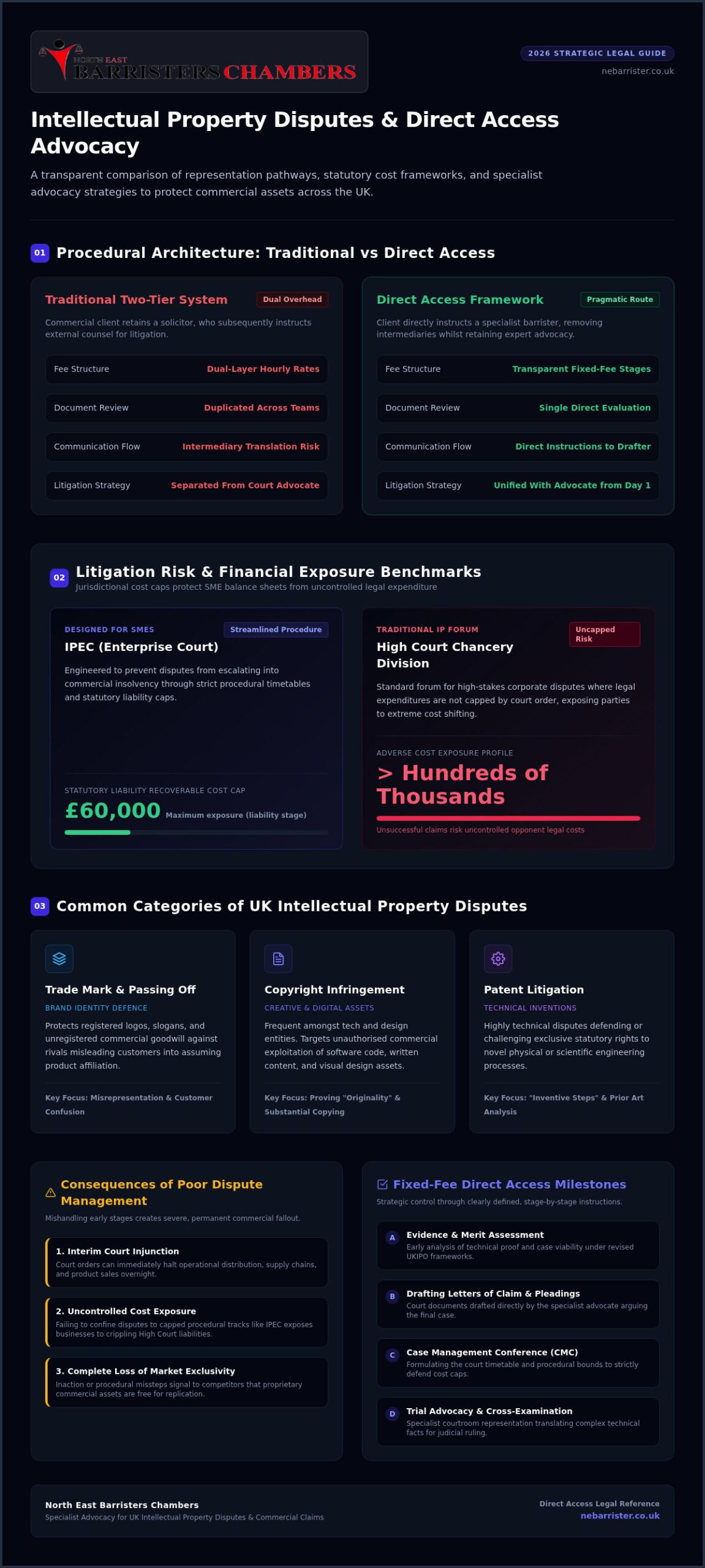
IP litigation is notoriously technical. A generalist might understand the basics of civil procedure, but they often lack the depth required to argue the nuances of “originality” in copyright or “inventive steps” in patent law. I focus on the advocacy stage, translating complex technical evidence into persuasive legal arguments that a judge can act upon. This specialist focus is particularly vital in the Intellectual Property Enterprise Court (IPEC). This court is designed to be more accessible for SMEs, offering a streamlined procedure and capped costs to prevent litigation from becoming a financial black hole.
Common Types of IP Conflict in the UK
Most disputes I handle fall into three distinct categories, each requiring a different strategic approach:
- Trademark infringement and passing off: This involves protecting your brand identity. It’s not just about registered logos; it’s about preventing competitors from misleading customers into thinking their products are yours.
- Copyright disputes: These are frequent amongst creative professionals and tech firms. They often involve the unauthorised use of software code, written content, or visual designs.
- Patent litigation: These cases are highly technical. They involve defending or challenging the exclusive rights to a specific invention or process, often requiring a deep dive into engineering or scientific data.
The Consequences of Poorly Managed IP Litigation
Handling a dispute incorrectly can be more damaging than the infringement itself. If you don’t act decisively, you risk an injunction that could halt your business operations overnight. Financial exposure is another major concern. While IPEC caps recoverable costs at £60,000 for liability, an unsuccessful claim in the High Court Chancery Division could lead to costs exceeding hundreds of thousands of pounds. Beyond the money, there’s the loss of brand reputation. If you don’t protect your assets, you signal to the market that your innovations are free for the taking.
The Strategic Advantage of Direct Access for IP Law
Direct Access is a regulatory framework that permits you to hire a barrister for intellectual property disputes directly. Historically, you would have been required to hire a solicitor first, who would then “instruct” counsel. By bypassing this traditional two-tier system, you gain a more streamlined and cost-effective route to specialist advocacy. This is particularly beneficial for IP law, where the strategy often hinges on the specific nuances of the technical evidence that the advocate will eventually present in court. I work directly with you to ensure that every legal document reflects the commercial reality of your business.
When you work with me, the person drafting your pleadings and cross-examining witnesses is the same person who hears your initial instructions. This ensures there is no “lost in translation” effect between different legal teams. You can reduce UK legal costs significantly by eliminating the duplication of work that occurs when both a solicitor and a barrister are reading the same documents and attending the same meetings. This model allows for better strategic alignment from the very first consultation.
Cost Efficiency and Transparency
I provide a clear, transparent billing model that is often out of reach when dealing with large corporate firms. By removing solicitor overheads, your budget is spent entirely on the expert advocacy that actually wins cases. I often work on a fixed-fee basis for specific stages of litigation, such as drafting a Letter of Claim or representing you at a Case Management Conference. This predictability is essential for SMEs and individual creators who need to manage their cash flow whilst defending their rights. You pay for the expertise you need, when you need it, without the burden of a large firm’s monthly retainers.
Speed and Agility in Response
Intellectual property disputes move fast. If a competitor is selling infringing goods, you might need an urgent injunction. Direct communication allows us to act with agility. Instead of waiting for a solicitor to relay messages, we can refine our strategy in real-time. This efficiency is supported by the HMCTS guide to IP dispute procedures, which emphasises the need for concise, focused statements of case. This agile approach is equally effective in the High Court or the IPEC. If you want to discuss how this model fits your specific case, feel free to explore my direct access services.
Key Criteria: How to Choose a Barrister for Intellectual Property Disputes
Selecting the right advocate is a decision that dictates the trajectory of your case. It isn’t enough to find someone who is simply “good in court”; you need a professional who understands the specific commercial environment in which you operate. When you are looking for a barrister for intellectual property disputes, you should evaluate their track record in the Intellectual Property Enterprise Court (IPEC) and their ability to handle the 2026 cost caps effectively. A great advocate doesn’t just argue the law; they navigate the procedural landscape to ensure your brand assets are protected without unnecessary financial exposure.
I believe the best results come from a balance of professional authority and approachable pragmatism. You need an advocate who is authoritative in the courtroom but remains a straightforward, helpful guide for you throughout the process. For a clear understanding of your rights when instructing an advocate directly, you can refer to the Bar Standards Board Public Access guidance. This document outlines the regulatory framework that ensures you receive the same high standard of service as you would through traditional routes.
Technical Proficiency and Sector Knowledge
Does the barrister understand the underlying technology or the creative process behind your work? In IP law, the advocate acts as a bridge between the creator and the judge. If I am representing a tech firm in an AI copyright dispute, I must be able to explain training datasets or model weights with total clarity. This technical proficiency is vital when dealing with Intellectual Property Office (IPO) procedures or complex patent litigation. Without it, the “inventive step” or the “originality” of your work can be lost in translation.
Experience in your specific sector, whether it’s fashion, retail, or manufacturing, is invaluable. A barrister who knows industry norms can spot weaknesses in an opponent’s evidence that a generalist might miss. This sector-specific insight allows for a more robust defence of your intangible assets, especially when dealing with “lookalike” packaging or trade mark infringement. Ultimately, choosing a barrister for intellectual property disputes is about finding a partner who understands both the courtroom and your business.
Courtroom Presence and Advocacy Style
The “theatre” of the courtroom still matters. Whilst many disputes are settled through negotiation, your advocate’s reputation for powerful courtroom presence often dictates the terms of that settlement. I focus on a methodical advocacy style that prioritises clarity over complexity. One of my favourite strategies involves the rigorous cross-examination of expert witnesses. In IP cases, expert evidence is often the pivot point. A barrister must be able to dismantle a technical report piece by piece, exposing inconsistencies that favour your position. This requires a high degree of reliability and a reputation amongst the judiciary for being thoroughly prepared.
Step-by-Step: Instructing Your Barrister for an IP Claim
Instructing a barrister for intellectual property disputes is a logical next step once you’ve identified a threat to your brand. It’s a straightforward process, but preparation is key. I’ve found that clients who arrive with a well-organised bundle often save themselves significant time and stress. By being proactive, you allow me to focus immediately on the strategic legal arguments rather than sorting through unorganised files. This initial preparation is the foundation of a successful claim or defence.
Preparing Your IP Evidence Bundle
You need proof of ownership. For copyright, this might be dated drafts, original sketches, or digital metadata; for trademarks, it’s your registration details and proof of use in the market. Documenting the infringement is equally vital. Take screenshots, save URLs, and record any evidence of customer confusion or financial loss. If you’ve already sent a “cease and desist” letter or received a response, keep that correspondence in a chronological file. Having this information ready allows for a more accurate assessment of your claim’s strength during our first meeting.
The Direct Instruction Process
When you make your initial enquiry, I need a clear summary of the conflict. What happened? Who is the opposing party? What is your ideal outcome? This helps me assess the merits of your case quickly. Under the framework for direct access barrister services, we will then agree on a “Letter of Instruction.” This document formalises our relationship, defining whether I am providing initial advice, drafting a statement of case, or representing you at a hearing.
I will also provide a client care letter that clearly outlines the fee structure and the specific scope of my work. It’s a transparent way to ensure we are aligned before any significant costs are incurred. As a barrister for intellectual property disputes, I help you manage critical dates whilst ensuring your legal position is robustly defended. Remember that IP law is governed by strict deadlines. For example, if you’re facing a trademark opposition at the UKIPO, you usually have a limited, non-extendable period to file your counter-statement. Missing these windows can be fatal to your claim. If you’re ready to protect your assets, you can enquire about my direct access services today.
Securing Expert Advocacy with North East Barristers Chambers
I am committed to providing straightforward, results-driven advocacy for every client I represent. Intellectual property is the lifeblood of many modern businesses, and when it’s threatened, you need more than just a legal opinion; you need a strategy that prioritises your commercial survival. I combine professional authority with an approachable, modern service designed to strip away the intimidation often associated with the Bar. Whilst I am an independent practitioner, my reach is national. I regularly represent clients in all major IP forums across the UK, including the IPEC and the High Court. My goal is to provide a sense of clarity and relief, acting as a straightforward solution-provider in a field that is often unnecessarily complex.
Why Our Direct Access Model Works for You
I offer a level of personal accountability that is often missing in larger, more traditional legal structures. When you instruct me as your barrister for intellectual property disputes, you aren’t dealing with a faceless corporate entity or a revolving door of junior staff. You’re dealing with me. This direct connection ensures that your instructions are never diluted or misinterpreted as they move between different layers of a firm. My approach to case management is flexible and helpful, adapting to the specific needs of your dispute whether you are an individual creator or a growing SME.
Sometimes, intellectual property theft escalates beyond civil litigation. In instances involving large-scale piracy, counterfeit goods, or the theft of trade secrets, the boundaries between civil and criminal law can blur. Because of my broader expertise, I can provide criminal law court representation if your IP dispute takes a more serious turn. This breadth of expertise ensures that you have a consistent, highly capable advocate by your side, regardless of the legal forum or the nature of the allegations.
Taking the Next Step in Your IP Dispute
Taking the first step toward resolving a dispute is often the hardest part. I aim to provide a pragmatic path forward from the moment you make contact. Choosing an agile, independent chambers means you benefit from a more responsive and cost-effective service than a large firm can typically provide. I am not weighed down by corporate bureaucracy, which allows me to focus entirely on the specifics of your case and your desired outcomes. If you’re looking for a barrister for intellectual property disputes who understands the value of clear communication, I am ready to assist.
You can contact me today for a preliminary assessment of your IP case. During this initial enquiry, we can discuss the nature of the conflict and the potential routes to resolution. I provide transparent, fixed-fee quotes for direct instruction, ensuring you have a clear understanding of the legal costs involved from the outset. Whether you need a robust defence against an infringement claim or you need to protect your own brand assets, I provide the expert courtroom advocacy you need to secure a successful result.
Defending Your Innovation in 2026 and Beyond
Protecting your brand doesn’t have to be a financial burden or a source of constant anxiety. By choosing to work directly with a barrister for intellectual property disputes, you’re opting for a modern, agile approach that prioritises both expert advocacy and cost-effectiveness. We’ve explored how this model removes unnecessary solicitor overheads whilst ensuring you receive specialist advocacy in civil and commercial law across the UK.
Success in these complex conflicts relies on early preparation and a clear strategic alignment between you and your advocate. I focus on delivering clarity and relief through a straightforward service that puts your commercial interests first. You don’t have to face these legal challenges through a faceless corporate entity. My practice provides expert court representation across the UK, ensuring your brand assets remain secure for years to come.
Instruct a Direct Access Barrister for your IP dispute today to begin protecting your innovations with confidence through a cost-effective direct access model for businesses.
Frequently Asked Questions
Can I really hire a barrister for intellectual property disputes without a solicitor?
Yes, you can. The Direct Access scheme allows businesses and individuals to instruct a barrister for intellectual property disputes directly. This bypasses the traditional requirement to hire a solicitor first. It’s a pragmatic choice for those who can manage their own administrative tasks, such as filing court papers. By working directly with your advocate, you maintain a clear line of communication and ensure your strategic goals are understood from the very first consultation.
How much does a barrister cost for an IP dispute under the direct access scheme?
Fees for IP disputes are typically structured around the specific stages of work required. I provide transparent, fixed-fee quotes for tasks like drafting a statement of case or attending a court hearing. This approach offers much-needed budget certainty. Unlike traditional models where you pay for both a solicitor and a barrister, direct instruction removes the middle-man. This significantly reduces your overall legal expenditure whilst ensuring you still receive expert advocacy and specialist advice.
What is the difference between the High Court and the IPEC for IP cases?
The primary differences involve the complexity of the case and the financial risks involved. The Intellectual Property Enterprise Court (IPEC) is designed for SMEs, featuring a streamlined procedure and a £60,000 cap on recoverable legal costs for the liability stage. The High Court handles larger, more complex disputes where damages might exceed £500,000. Choosing the right forum is a critical strategic decision that I will help you navigate based on your specific commercial goals.
Can a barrister help me with a trademark opposition at the IPO?
Yes, I can provide specialist representation for proceedings before the UK Intellectual Property Office (UKIPO). This includes drafting notices of opposition, counter-statements, and evidence of use. I also provide oral advocacy at hearings before the Comptroller. Having an expert advocate involved in trademark oppositions ensures your brand is defended with technical precision. This is particularly important given the 25% increase in statutory UKIPO fees implemented in April 2026.
What happens if my IP dispute is too complex for direct access?
If a dispute involves extremely heavy disclosure, intensive investigatory work, or complex multi-party litigation, it may exceed the scope of the Direct Access scheme. As a barrister, I have a professional duty to tell you if your case requires the involvement of a solicitor to manage the day-to-day conduct of litigation. In such instances, I will provide a clear assessment of why additional support is necessary to protect your legal position effectively and ensure the best outcome.
Will a barrister draft my legal documents for an IP claim?
I will draft all the essential legal documents required for your IP claim or defence. This includes the Particulars of Claim, Defences, and witness statements. I also prepare skeleton arguments for court hearings and formal letters of claim. By drafting these documents myself, I ensure that the legal theory we present in court is consistent with the written evidence. This creates a cohesive and more persuasive case for the judge to consider during the trial.
How long does a typical intellectual property dispute take to resolve?
Resolution timelines depend heavily on the court track and the willingness of parties to negotiate. A small claim in the IPEC might be resolved in a few months. More complex multi-track cases often take between 12 and 18 months to reach a final trial. However, many disputes are settled much earlier through robust pre-action correspondence or mediation. My focus is always on achieving a successful resolution as efficiently as possible to minimise business disruption and costs.
Can a barrister represent me in mediation for an IP conflict?
I can certainly represent you during mediation or any other form of Alternative Dispute Resolution (ADR). Mediation is often a highly effective way to resolve IP conflicts without the cost and stress of a full court trial. I act as your advocate during these sessions, helping you negotiate from a position of strength. My role is to ensure that any settlement reached is legally sound and protects your long-term commercial interests and brand reputation.