
Why are you still paying for a middleman when the person actually arguing your case in court is just a phone call away? With the Renters’ Rights Act 2025 now fully implemented as of May 2026, navigating the end of “no-fault” evictions and the move to rolling tenancies has become a complex, high-stakes challenge. I understand how frustrating it is to watch legal fees escalate whilst communication from a traditional firm moves at a snail’s pace. You’re likely worried about protecting your property or rental income in a landscape where court possession claim fees have recently risen to £415.
The good news is that you don’t have to hire a full legal team to get results. Instructing a landlord tenant dispute barrister through the Direct Access scheme allows you to bypass solicitors entirely, significantly reducing your legal expenditure. In this article, I’ll show you how this modern, agile approach provides the expert representation you need at a tribunal or court. We will explore how to secure clear, authoritative advice on your rights and find a more cost-effective route to a resolution that protects your interests without the unnecessary overheads.
Key Takeaways
- Learn how a landlord tenant dispute barrister provides specialist advocacy and representation without the need for a solicitor.
- Understand how the Direct Access model eliminates dual-fee structures and offers fixed-fee certainty to lower your total legal spend.
- Discover how to navigate complex possession proceedings and disrepair claims under the latest UK property regulations.
- Gain clarity on what to expect when attending the First-tier Tribunal or County Court for your hearing.
- Follow a simple, step-by-step guide to instructing your advocate directly for a more agile and efficient resolution.
What is a Landlord Tenant Dispute Barrister?
A landlord tenant dispute barrister is a specialist advocate who focuses on the high-stakes world of property litigation. My role is to provide you with the expert legal advice and courtroom representation that generalist firms often lack. While solicitors are excellent at managing the administrative burden of a case, I specialise in the complex interpretation of statutes and the art of oral advocacy. This distinction is vital. You don’t want a generalist when you’re facing a tribunal judge; you want a specialist who lives and breathes property law.
The implementation of the Renters’ Rights Act in May 2026 has made the legal landscape more technical than ever. Whether you’re a landlord dealing with new Section 8 grounds or a tenant fighting for repairs, the stakes are high. Getting a landlord tenant dispute barrister involved early means I can assess the merits of your position before you commit to expensive court fees. This proactive approach often leads to quicker settlements and prevents you from pursuing a losing battle. It’s about finding the most direct path to a resolution.
The Role of a Property Barrister in 2026
My work goes beyond just standing up in court. I provide detailed written legal opinions on complex leasehold issues or Assured Shorthold Tenancy (AST) disputes. If your case proceeds to litigation, I draft the formal “Statements of Case” and other court documents to ensure your arguments are framed correctly from the start. This expertise extends to the County Court and specialist bodies like the First-tier Tribunal (Property Chamber), where precision is everything. I focus on the legal strategy that wins cases, ensuring every document serves a specific purpose.
Direct Public Access: No Solicitor Required
Historically, you had to hire a solicitor just to speak to a barrister. That changed with the Public Access Scheme, which allows you to instruct me directly. This model gives you total control over your legal strategy and, crucially, your budget. You no longer have to pay for two sets of lawyers when one specialist advocate can handle the core of the work. Direct Access is a cost-effective alternative to the traditional solicitor-led route. It puts you in the driving seat of your own case. As a landlord tenant dispute barrister, I work as your independent partner, offering a modern and agile way to handle litigation that prioritises your specific needs and financial constraints.
Common Disputes Where Expert Advocacy is Essential
Property law is a technical minefield where even a minor procedural error can lead to months of delays and wasted costs. As a landlord tenant dispute barrister, I see first-hand how disputes escalate when parties rely on guesswork rather than specialist advocacy. Whether you are facing a disagreement over a residential flat or a commercial warehouse, the rules of engagement are strict. I provide the clarity needed to navigate these conflicts, ensuring your legal position is robust from the outset.
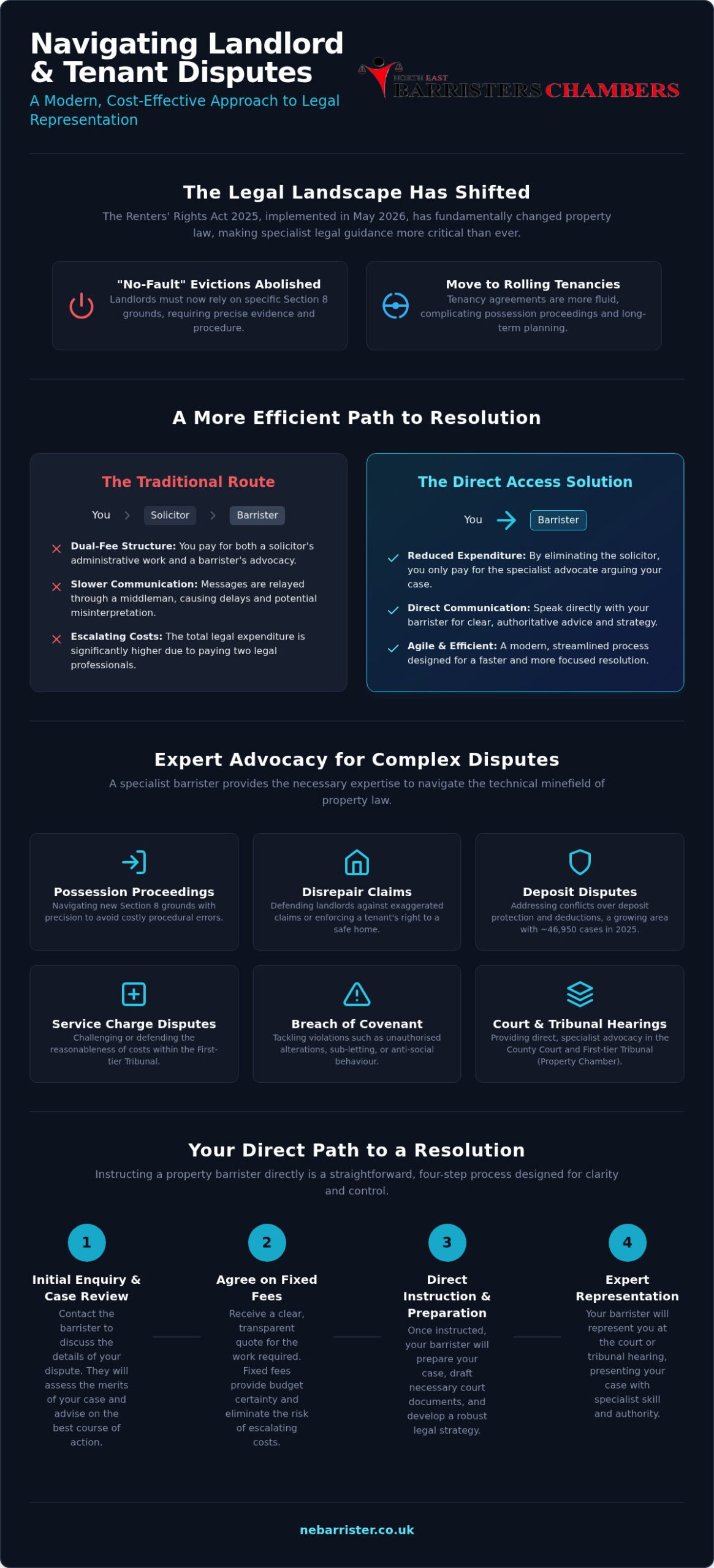
Possession proceedings have become significantly more complex following the implementation of the Renters’ Rights Act 2025 in May 2026. The abolition of Section 21 “no-fault” evictions means landlords must now rely on specific Section 8 grounds. I help you navigate these new requirements with precision. With the court possession claim fee now at £415, you cannot afford to have your application struck out due to a technicality. I ensure your notices are served correctly and your evidence is trial-ready.
Disrepair claims are another area where expert advocacy is vital. I often represent landlords defending themselves against exaggerated claims for damages, or tenants seeking to enforce their right to a safe home. These cases frequently intersect with deposit disputes, which reached an estimated 46,950 cases in 2025. I also specialise in service charge disputes within the First-tier Tribunal (Property Chamber), where we challenge or defend the reasonableness of costs. From unauthorised alterations to sub-letting violations, I address breaches of covenant with a focus on protecting the underlying value of the property.
Residential Tenancy Conflicts
In the residential sector, I handle the intricacies of Assured Shorthold Tenancies (AST) and the often-misunderstood rules surrounding deposit protection. My role involves ensuring that the correct legal procedures are followed during evictions to prevent “unlawful eviction” claims, which can be financially devastating. I also provide direct advocacy in cases involving persistent non-payment of rent or anti-social behaviour, where a swift and professional courtroom presence is required to regain control of a situation.
Commercial Lease Disputes
Commercial property disputes carry unique risks, particularly regarding forfeiture and peaceable re-entry. A single mistake in the forfeiture process can lead to a claim for wrongful eviction and significant damages. I advise on terminal and interim schedules of dilapidations and represent clients in contested lease renewals under the Landlord and Tenant Act 1954. If you are struggling with a complex rent review or a breach of a commercial covenant, you can speak with a specialist barrister to assess your options before formal proceedings begin. This agile approach ensures your business interests remain protected throughout the litigation process.
Barrister vs Solicitor: Reducing Your Legal Costs
Many clients are surprised to learn that the traditional legal model often involves paying for two lawyers when only one is strictly necessary. In a standard setup, a solicitor manages the file and then instructs a barrister to provide specialist advice or represent you in court. This creates a dual-fee structure where you’re billed for the solicitor’s time spent communicating with the barrister, on top of the barrister’s actual fee. By hiring a landlord tenant dispute barrister directly, you’re able to eliminate this layer of expense entirely.
One of the most significant benefits of this approach is the shift from hourly billing to fixed-fee arrangements. Solicitors typically charge by the hour, which can lead to fee creep as a case drags on. In contrast, I provide clear, upfront quotes for specific pieces of work, such as drafting a defence or attending a hearing. This provides you with financial certainty and ensures that your legal budget is spent on expert advocacy rather than administrative overheads. It’s a straightforward way to cut out the middleman and keep your costs under control. For a comprehensive breakdown of what you can expect to pay across different stages of a dispute, my guide on civil litigation costs UK explains the Fixed Recoverable Costs regime and how to budget effectively in 2026.
Direct communication also ensures that your instructions don’t get lost in translation. When you work with me, there are no multiple legal layers to navigate. You speak directly to the person who will be standing in front of the judge. This efficiency leads to faster resolutions because we can refine your strategy in real-time without waiting for a third party to relay messages. It’s about having a direct line to the expert who actually decides the direction of your case.
The Direct Access Financial Advantage
The financial impact of the Direct Access model is substantial. When you handle the basic administrative tasks yourself, such as filing forms or organising your evidence, you can save thousands of pounds in solicitor fees. I focus my time where it adds the most value: on the complex legal arguments that win cases. If you want to understand more about how this works, you can read my guide on how to reduce legal costs UK through the Direct Access scheme. It’s about being agile and spending your money where it actually matters.
When is Direct Access Most Suitable?
Direct Access is ideal for cases where the facts are relatively clear but the legal application is technical. This includes straightforward possession claims based on rent arrears or defending against disrepair allegations. If you’re comfortable managing your own correspondence and keeping your documents in order, you’re the perfect candidate for this model. For a landlord tenant dispute barrister, this collaborative approach is the most efficient way to achieve a result. However, if a case involves dozens of parties or thousands of pages of evidence, I’ll always be honest about whether a hybrid approach with a solicitor might be more practical for you. This same direct access principle applies beyond property law — if a professional such as a surveyor or solicitor has given you negligent advice that contributed to your dispute, a civil negligence claim barrister in the North East can help you pursue accountability without the overhead of a traditional law firm.
Navigating the Court and Tribunal Process
Entering a courtroom or tribunal can feel intimidating without a specialist by your side. Most residential disputes, such as those involving service charges or rent increases, are heard in the First-tier Tribunal (Property Chamber). If your case involves a possession claim or debt recovery, it will typically proceed through the County Court. Before either venue will hear your case, you must follow the Pre-Action Protocol. This set of rules requires both parties to exchange information and attempt a resolution before starting formal proceedings. Ignoring these steps can lead to the court penalising you on costs, even if you eventually win the case.
On the day of the hearing, my role as your landlord tenant dispute barrister is to provide a calm and authoritative presence. Courtroom etiquette is strict. I ensure that your case is presented using the correct terminology and that we adhere to all procedural rules. This professional advocacy is often the difference between securing a final order and facing a costly adjournment. With the fee for an application on notice (Form N244) rising to £321 in July 2026, getting the procedure right the first time is a financial necessity.
Preparation: The Key to Success
Success in property litigation is built long before we reach the courtroom. I work with you to organise your evidence into a clear, persuasive format. This includes:
- Detailed rent ledgers showing the exact breakdown of any arrears.
- Original signed tenancy agreements and any subsequent renewals.
- A chronological file of all relevant correspondence and notices served.
I use this evidence to draft a skeleton argument. This document provides the Judge with a roadmap of our legal position, citing the specific statutes and case law that support your claim. I also recommend a pre-hearing “conference” or meeting. This allows us to review the final strategy and ensures you know exactly what to expect when the hearing begins.
What Happens During the Hearing?
During the hearing, I act as your voice. I handle the cross-examination, which is the process of testing the evidence provided by the opposing party. This is a technical skill that requires identifying inconsistencies in their story. I then make formal legal submissions, applying the law to the facts of your case. Once the Judge or Tribunal panel makes a decision, I help you understand the judgement and the specific terms of the order. If you’re facing an upcoming hearing, you can instruct me for court representation to ensure your case is handled with expert precision from start to finish.
How to Instruct a Property Barrister Directly
Instructing a landlord tenant dispute barrister is a straightforward process designed to save you time and money. Unlike the traditional solicitor-led route, you can initiate the process yourself by following a few clear steps. I prioritise transparency and efficiency, ensuring that you always know where your case stands and what your legal costs will be from the very first day. The process moves quickly from our initial contact to formal representation.
The first step is your initial enquiry. I ask for a brief summary of the dispute along with any key documents, such as the tenancy agreement or recent correspondence. Once I have this, I perform a conflict check to ensure I haven’t previously acted for the opposing party. I also conduct a suitability assessment. As discussed earlier, whilst Direct Access is ideal for most property matters, I will always tell you if a case is too complex for this model and requires a solicitor’s involvement. This honesty protects your interests and ensures your case is handled correctly.
If the case is suitable, I will provide a clear, fixed-fee quote for the specific work required. You will then receive a Client Care Letter, which acts as our formal contract. This document outlines the scope of the work and the agreed price, providing you with total financial certainty. Finally, once you formally engage me, you provide the full “bundle” of documents. This is the collection of evidence we will use to build your case, ensuring we are fully prepared for any upcoming deadlines or hearings.
Getting Started with Your Instruction
To make the process as fast as possible, your initial email should be concise. Please include the tenancy type, key notice dates, and a short description of the core issue. I value clarity, which is why I avoid the dense jargon often found in legal firms. My goal is to get straight to the heart of your problem. For more information on how this model works across the country, you can view my direct access barrister pillar page. It explains the national service model in detail.
Your Direct Access Journey
I act as a friendly guide through what can often feel like a legal maze. My service is agile and modern, designed to adapt to your specific needs regardless of where your property is located in the UK. You get the benefit of a seasoned professional who is both an expert in the courtroom and a practical businessperson. I understand that you want results, not endless paperwork. If you are ready to resolve your dispute with expert advocacy and reduced legal spend, contact us today for a Direct Access quote. Let’s work together to protect your property and your peace of mind.
Secure Your Property Interests with Expert Advocacy
Protecting your rental income or property rights shouldn’t be a source of constant stress. You now understand how the Direct Access model removes unnecessary legal layers, allowing you to work directly with a specialist advocate. By choosing to instruct a landlord tenant dispute barrister, you’re opting for a more agile and cost-effective way to navigate the court and tribunal system. This approach ensures your case is trial-ready without the escalating fees often associated with traditional firms.
I offer fixed-fee transparency and expert advocacy in all UK courts and tribunals, providing a modern and pragmatic alternative for today’s property owners and tenants. My goal is to act as your straightforward guide, ensuring you have the clarity and relief that comes from professional representation. Whether you’re facing a complex possession hearing or a service charge dispute, I’m here to provide the authority and expertise you need to succeed.
Instruct a Direct Access Barrister Today to start your journey towards a resolution. You don’t have to face the legal maze alone; let’s work together to protect your interests and get your property matters back on track.
Frequently Asked Questions
Can I hire a barrister without a solicitor for a landlord-tenant dispute?
Yes, you can instruct a landlord tenant dispute barrister directly through the Public Access Scheme. This allows you to bypass the need for a solicitor entirely for many property-related matters. I handle the core legal strategy and advocacy, whilst you manage the basic administrative tasks. It’s a modern, agile way to access high-level expertise without the traditional dual-fee structure of hiring two separate legal professionals.
How much does a landlord-tenant barrister cost?
I operate on a fixed-fee basis for Direct Access work, providing you with total financial certainty from the start. The total cost depends on the complexity of your dispute, the volume of evidence, and whether you require a written opinion or full court representation. Unlike solicitors who often bill by the hour, my clear quotes ensure there are no hidden surprises as your case progresses through the legal system.
What is the difference between a solicitor and a barrister in property law?
Solicitors typically manage the day-to-day administration of a file and handle general correspondence. As a barrister, I specialise in courtroom advocacy and providing high-level legal advice on complex technical issues. While solicitors are generalists in the litigation process, I am the specialist who presents your case to the Judge. Direct Access allows you to bring that specialist expertise into your case much earlier and more affordably.
Can a barrister help me with a Section 21 eviction notice?
I provide expert advice on the validity of eviction notices and help you navigate the transition following the Renters’ Rights Act 2025. Although “no-fault” Section 21 notices have been phased out for new rolling tenancies, I can assess whether a notice served during the transitional period is legally sound. As a landlord tenant dispute barrister, I also assist landlords in moving to revised Section 8 grounds to ensure possession claims aren’t struck out.
Will a barrister represent me at a Property Tribunal hearing?
Yes, I provide expert representation at the First-tier Tribunal (Property Chamber) for a wide range of residential disputes. This includes cases involving service charge reasonableness, rent increases, and leasehold management issues. Having a specialist advocate at a tribunal is vital because these panels focus heavily on technical legal points. I ensure your arguments are framed correctly and that your evidence is presented persuasively to the tribunal members.
How long does it take to resolve a property dispute with a barrister?
The timeline for resolution depends largely on the court or tribunal’s current backlog, which can vary by region. However, instructing a barrister directly can often speed up the process. I provide fast, focused legal opinions that help you identify the strongest path to a settlement early on. By avoiding the back-and-forth communication inherent in traditional legal firms, we can move your case forward with greater efficiency.
What documents do I need to provide to my barrister?
You should provide a complete “bundle” of documents related to your property. This includes the original tenancy agreement, any renewal documents, and a clear rent ledger if the dispute involves arrears. I also need to see any formal notices served, such as a Section 8 or Section 21 notice, and a chronological file of your correspondence with the other party. Clear documentation is the foundation of a winning legal strategy.
Can I recover my barrister fees from the other party if I win?
Whether you can recover your legal costs depends on the type of claim and the track it is assigned to in court. In the County Court, the “loser pays” principle often applies to multi-track or fast-track cases, but cost recovery is more limited in the small claims track. In the First-tier Tribunal, costs are usually only awarded if a party has acted unreasonably. I will always assess the likelihood of cost recovery during our initial consultation.
