
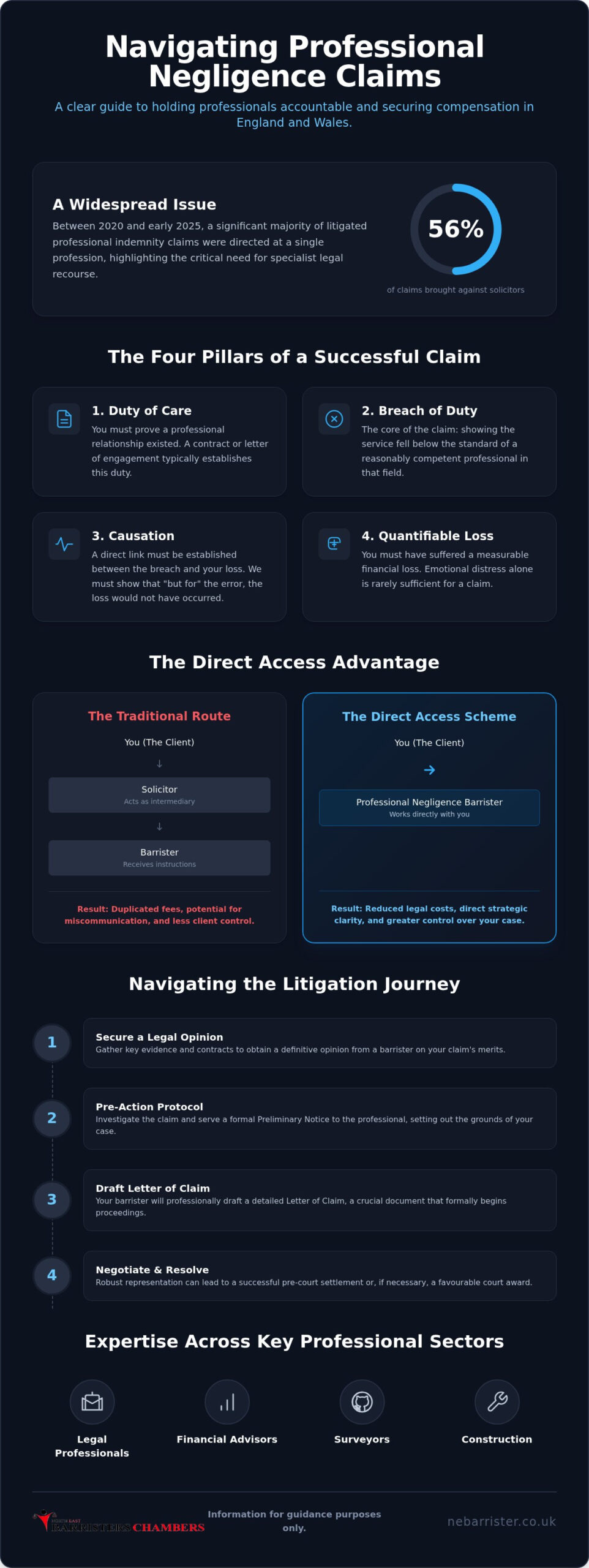
Did you know that between 2020 and early 2025, over 56% of litigated professional indemnity claims in England and Wales were brought against solicitors? It is a bitter pill to swallow when a specialist you trusted provides substandard advice that leaves you facing a significant financial loss. I understand the frustration of feeling let down, especially when the fear of mounting legal fees makes you hesitant to seek justice. You may feel overwhelmed by the technicalities of the “Duty of Care” threshold, yet you cannot afford to let a negligent mistake go unchallenged. Instructing a professional negligence barrister through the Direct Access scheme offers a pragmatic way to secure expert advice without the intermediary costs of a solicitor.
I am here to help you hold these professionals accountable and secure the compensation you deserve. This article provides a clear roadmap for your claim, from obtaining a definitive legal opinion on its merits to the professional drafting of your Letter of Claim. I will also explain how robust representation can lead to a successful settlement or court award, ensuring you have the strongest possible advocate by your side throughout the litigation process.
Key Takeaways
- Understand the legal criteria for a claim, specifically how to prove a professional’s breach of duty led to your financial loss.
- Explore the cost-saving advantages of the Direct Access scheme, which allows you to work directly with a professional negligence barrister rather than paying for a solicitor’s intermediary services.
- Learn how to hold various specialists accountable, including legal and financial advisors, for errors that have impacted your business or personal finances.
- Navigate the pre-action protocol with confidence by understanding the steps required to investigate a claim and serve a formal Preliminary Notice.
- Prepare a robust brief for your case by identifying the key evidence and contracts needed to secure a clear legal opinion on your claim’s merits.
What is Professional Negligence and When Can You Claim?
I often meet people who are reeling from a professional’s mistake. Professional negligence is a breach of the duty of care that causes a quantifiable loss. It happens when a specialist fails to perform their duties to the required standard, leaving you to pick up the pieces. Standards matter. This isn’t limited to just one industry; I handle cases across law, finance, construction, and surveying. For example, a surveyor might miss a major structural defect, or an accountant could provide incorrect tax advice that leads to a heavy penalty. Financial loss is the primary driver for these claims, and proving that loss requires meticulous documentation of every pound lost due to the error. If you’re unsure where you stand, a What is Professional Negligence in English Law? overview can clarify the basics. However, you’ll likely need a professional negligence barrister to apply these rules to your specific situation and determine if you have a viable claim for damages.
The Four Pillars of a Negligence Claim
To succeed in a claim, I must help you establish four specific criteria. Without all four, a case is unlikely to succeed in court.
- Duty of Care: We must prove a professional relationship existed. Usually, a signed contract or a letter of engagement is enough to satisfy this requirement.
- Breach of Duty: This is the core of the claim. We have to show the advice or service fell below the standard of a reasonably competent professional in that field.
- Causation: I need to link the breach directly to your misfortune. You must show that “but for” the professional’s error, you wouldn’t have suffered.
- Loss: You must have suffered a quantifiable financial loss. Evidence is key here. Emotional distress alone rarely justifies a professional negligence claim in English law.
Common Misconceptions About Negligence
It’s vital to distinguish between a service you’re unhappy with and one that is legally negligent. A “bad result” doesn’t always equal negligence. Professionals are allowed to exercise reasonable judgement. As long as that judgement was reasonable at the time, it might not be a breach. Mistakes happen, but not every mistake is actionable. Expert witnesses are frequently the deciding factor in these cases, as they define what a “reasonably competent” peer would have done in the same circumstances.
A formal claim is also very different from a consumer complaint. While an ombudsman might look at poor service, a professional negligence barrister focuses on recovering financial damages through the legal system. I often recommend obtaining expert evidence from another professional in the same field. This provides the court with an objective view on whether the standards were truly missed. Proving a breach requires more than just a feeling of being let down; it requires a clear, evidence-based strategy.
The Advantages of a Direct Access Professional Negligence Barrister
I’ve found that the traditional model of legal instruction often creates unnecessary distance between you and the expert who actually argues your case. By choosing the Direct Access route, you bypass the traditional solicitor layer. This isn’t just about saving money; it’s about making sure your voice is heard without being filtered through an intermediary. You work directly with a professional negligence barrister from the outset. This streamlined approach reduces the risk of strategic instructions being misinterpreted during the long journey toward a settlement or court award. It puts you in direct contact with the person who will ultimately stand up for you in court.
How Direct Access Helps You Reduce Legal Costs
Legal fees can quickly spiral, especially when you are already facing a financial loss. Direct Access allows you to avoid the duplication of fees that occurs when both a solicitor and a barrister are involved. Instead, you pay for the specific expertise you need. One of the best ways to reduce legal costs UK claimants face is through unbundled services. This means you only hire me for high-value tasks, such as providing a formal legal opinion or drafting the Particulars of Claim. You manage the administrative side of the case yourself, whilst I provide the heavy-hitting legal firepower. This targeted approach ensures your budget is spent on the elements that actually win cases.
Direct Strategic Clarity
Control is a vital part of the litigation process. When you instruct a professional negligence barrister directly, you receive a merits of claim assessment straight from a courtroom expert. I don’t sugarcoat the reality of your situation. You get a clear, authoritative view on whether your case is worth pursuing before you commit to significant expenditure. This early clarity is invaluable. It helps you maintain control over your litigation strategy and settlement negotiations from day one.
Modern chambers prioritise transparent, jargon-free communication. I believe in being an approachable guide through a complex system. If you want to discuss your options, you can contact me to explore Direct Access and see if it fits your needs. According to a 2025 survey by the Bar Standards Board, 28% of individuals who instructed a barrister did so through the public access scheme. This reflects a growing trend towards more efficient, direct legal services that put the client in the driving seat.
Expertise Across Key Professional Sectors
I see negligence claims across a broad spectrum of industries, but the core issue remains the same: a professional failed to meet the expected standard. Statistics from CMS.law in February 2025 indicate that 56% of litigated professional indemnity claims in England and Wales were against solicitors. However, the scope of my work extends far beyond the legal sector. I frequently handle disputes involving accountants, financial advisors, and surveyors. Each sector has its own specific standards, but the requirement for a professional negligence barrister to prove a breach remains constant. Accuracy is non-negotiable in these fields.
- Solicitors and Barristers: Handling cases where missed limitation dates or poor litigation advice led to a lost case.
- Accountants and Tax Advisors: Addressing errors in tax returns or negligent business valuations that caused financial penalties.
- Financial Advisors: Investigating the mis-selling of products or a failure to assess risk profiles correctly.
- Surveyors and Architects: Pursuing claims for a failure to identify structural defects or critical planning errors.
Legal Professional Negligence
One of the most common reasons clients contact a professional negligence barrister is to address ‘lost’ chances in litigation. If a previous solicitor missed a limitation date or gave poor advice that led to a case being struck out, you’ve lost the opportunity to seek justice. This is a serious failure. I provide a tactical advantage by reviewing the original solicitor’s file with a fresh, courtroom-ready perspective. I can determine if the original case had a realistic prospect of success and quantify the value of that lost chance. It’s about turning a previous legal failure into a successful claim for compensation.
Financial and Valuation Disputes
Claims against accountants and tax advisors often involve complex figures and intricate regulatory frameworks. Whether it’s a negligent audit or a missed error in a tax return, the financial impact on a business can be devastating. I also represent clients against surveyors who have over-valued a property or missed ‘red flag’ structural issues. These cases often hinge on the Financial Ombudsman Service (FOS) award limits. For actions occurring after 1 April 2019, the FOS can order a firm to pay up to £455,000. If your loss exceeds this limit, or if the case is too complex for the ombudsman, formal litigation becomes necessary.
Preparing evidence for financial claims requires a methodical approach. I work to collate expert reports and financial data into a cohesive argument that proves exactly how the professional’s breach caused your loss. My role is to translate these complex financial discrepancies into a robust legal case that a judge can clearly understand. You don’t have to navigate these technical disputes alone. I’ll help you hold these professionals to account.
Navigating the Professional Negligence Litigation Journey
I believe that clarity is the best antidote to the stress of litigation. The journey to securing compensation follows a specific, regulated path. I start by helping you issue a Preliminary Notice. This is a concise letter that alerts the professional to your intent to claim. It’s a vital first step that starts the clock on their response time. We then move into the investigation phase. This is where we gather the evidence needed to prove your case. Once we have a solid foundation, I draft the Letter of Claim. This document is the heart of your grievance. It sets out the facts, the breach, and the financial loss in detail. The final stage involves the Letter of Response and the settlement phase, where we negotiate for a fair award.
The Pre-Action Protocol for Professional Negligence
Following the Professional Negligence Pre-Action Protocol is not optional; it’s a mandatory requirement under the Civil Procedure Rules. If you jump straight to court without following these steps, you risk being penalised on costs. I ensure your Letter of Claim is legally robust and persuasive from the outset. A well-drafted letter often forces the other side’s insurers to take your claim seriously. We also look at Alternative Dispute Resolution (ADR), such as mediation. ADR is a powerful tool to avoid a full trial, saving you time and money. If you’re ready to start this process, you can instruct a barrister directly to manage these critical documents and protect your position.
Proving Loss and Causation
Proving that a professional made a mistake is only half the battle. We also have to prove that the mistake actually caused your financial loss. I use the “But For” test. We must show that but for the professional’s negligence, your financial situation would be significantly better. I work with you to organise financial records and expert reports to quantify your damage precisely. This data is then used to draft the Particulars of Claim. This is the formal legal document used if your case proceeds to the County Court or High Court.
As a professional negligence barrister, I specialise in making sure these arguments are airtight. I focus on the facts that matter to the court, ensuring your claim is presented with the authority it deserves. It’s not just about what happened; it’s about what you can prove. By meticulously linking the breach to the financial damage, I build a case that is difficult for the defendant to dismiss. This methodical approach is what leads to successful settlements and court awards.
How to Instruct a Professional Negligence Barrister Directly
I believe the process of instructing a barrister should be as transparent as the advice I provide. It starts with an initial assessment to determine if your case is suitable for the Direct Access scheme. I’ll need to review your brief. This should include all relevant contracts, advice letters, and correspondence from the professional in question. This preparation is critical. By collating these documents early, you allow me to provide a definitive merits assessment during our first consultation. We will discuss the potential outcomes and the strategic path forward with total honesty. I prioritise fixed-fee arrangements for initial advice and opinions. This ensures you have total cost certainty from the very beginning, preventing any unexpected surprises as the case develops.
Is Your Case Suitable for Public Access?
Most negligence claims are eligible for this route if you can manage basic case administration. I find that direct access barrister services are ideal for focused negligence litigation where the core dispute is clearly defined. You act as the administrator, whilst I act as the legal architect and courtroom advocate. However, some cases involve massive volumes of disclosure or require complex witness management across multiple parties. If a case is too burdensome for a Litigant in Person, I’ll be honest with you. My goal is to ensure you have the right level of support. I act as an agile practitioner, adapting to your specific needs whilst maintaining the highest professional standards of the Bar.
Taking Action Today
If you’re ready to hold a professional accountable, the next step is simple. Submit your enquiry via the website for a national review. I provide representation across the UK, acting as a mobile and modern expert who travels to meet the needs of my clients. Please provide a brief summary of the professional error and the financial loss you’ve suffered. This helps me hit the ground running. You don’t have to navigate this complex field alone. I’m here to act as your straightforward solution-provider in a challenging landscape. Contact us to discuss your professional negligence claim today to secure the expert legal recourse you deserve. Working with a professional negligence barrister directly is the most efficient way to challenge substandard advice and regain control of your financial future.
Take Control of Your Professional Negligence Claim
Holding a professional accountable for substandard advice doesn’t have to be a confusing or financially draining process. By instructing a professional negligence barrister directly, you gain immediate access to the strategic clarity required to challenge errors in law, finance, or construction. You’ve seen how the Direct Access scheme allows you to manage your own administration whilst benefiting from an expert’s courtroom perspective and robust drafting skills. I provide national representation across all UK courts, ensuring you have authoritative support regardless of where your case arises. I prioritise transparent fixed-fee structures for my advice. You’re never left in the dark about the cost of seeking justice. My expertise in complex professional liability litigation is focused on one goal: securing the compensation you deserve.
Don’t let a professional’s mistake dictate your financial future. You can secure expert advocacy for your professional negligence claim today and begin the journey toward a fair resolution. I am here to help you navigate the complexities of the legal system with confidence and ease.
Frequently Asked Questions
Can I sue my solicitor for negligence without hiring another solicitor?
Yes, you can instruct a barrister directly through the Public Access scheme. This allows you to bypass the need for a second solicitor. You will act as a Litigant in Person, managing your own correspondence and administrative tasks. I provide the expert legal analysis and court representation required to challenge the negligent firm. It’s a pragmatic way to reduce legal costs whilst ensuring you have high-level advocacy for your professional negligence claim.
What is the time limit for starting a professional negligence claim in the UK?
The primary limitation period is six years from the date of the negligent act or breach of contract. If you only discovered the negligence later, you may have three years from the date of knowledge to bring a claim. However, there is an absolute long-stop deadline of 15 years from the original event. It’s vital to act quickly, as missing these statutory deadlines usually means your claim is barred forever under the Limitation Act 1980.
How much does it cost to hire a professional negligence barrister directly?
Fees depend on the complexity of your case and the specific tasks required. I prioritise transparency by offering fixed-fee options for initial advice and formal legal opinions. This prevents the uncertainty often associated with traditional hourly billing. By instructing a professional negligence barrister directly, you only pay for the expert work you need, such as drafting a Letter of Claim or providing court representation, rather than paying for a solicitor’s overheads and administrative time.
What kind of compensation can I get in a professional negligence claim?
Compensation is designed to put you back in the financial position you would have been in if the negligence had not occurred. This covers quantifiable financial losses, such as lost investment value, overpaid taxes, or the lost chance of a successful lawsuit. For smaller claims, the Legal Ombudsman can order up to £50,000. For larger financial disputes, the Financial Ombudsman Service award limit is £455,000 for actions occurring on or after 1 April 2019.
Do I have to go to court to win a negligence case?
Most professional negligence claims are settled before they ever reach a courtroom. The Pre-Action Protocol encourages parties to exchange information and engage in Alternative Dispute Resolution, such as mediation. A barrister can draft a robust and persuasive Letter of Claim that highlights the strengths of your case. This often leads the professional’s indemnity insurers to offer a settlement, saving you the time and stress of a full trial whilst securing the award you deserve.
What happens if the professional I am suing has gone out of business?
You can often still pursue a claim if the professional had indemnity insurance. Most regulated professionals, including solicitors and accountants, are required to maintain insurance that covers their liabilities. If the firm has dissolved, the claim is usually handled by the insurer. In specific cases involving financial advisors or solicitors, you might also have recourse to the Financial Services Compensation Scheme or the Solicitors Regulation Authority Compensation Fund to recover your losses.
Can a barrister help me if I have already started my claim as a Litigant in Person?
Yes, I can be instructed at any stage of your litigation. If you have already started the process as a Litigant in Person, you might find that the case has become more complex than expected. A barrister can review your existing papers, provide a definitive opinion on the merits, and draft formal court documents like the Particulars of Claim. This ensures your case is legally sound and professionally presented before you head to a hearing.
How do I prove that a professional’s advice was actually negligent?
Proving negligence requires showing that the professional’s work fell below the standard of a reasonably competent peer. This is often achieved through expert evidence from another professional in the same field. I use the “But For” test to prove causation. We must demonstrate that your loss would not have happened but for their error. Documenting every piece of advice, contract, and financial record is essential to building a successful case that the court will accept.
