
The £10,000 threshold is not an automatic dividing line. According to the Ministry of Justice, in England and Wales the small claims track is normally for claims worth no more than £10,000, subject to special provisions for personal injury and housing disrepair. This guide to the small claims track explains why the court can also consider what the claim involves.
It’s understandable to focus on the amount in dispute: that figure can affect which court track a claim follows. But the threshold is only part of the picture. A claim worth more than £10,000 may still be allocated to the small claims track, while a more complicated case may be placed on a different track.
This guide to the small claims track explains which disputes it covers, how the monetary limit works, which costs may be recoverable and what happens after the court sends directions questionnaires. It sets out what each stage means and when legal representation may help.
Key Takeaways
- Look beyond the amount claimed: the type and complexity of the dispute can affect which court track is appropriate.
- A directions questionnaire helps the court decide how a defended claim should proceed, so its instructions matter.
- Small-claims costs are restricted, but some court fees and expenses may be recoverable.
- Direct Access Barrister Services and Court Representation can help you prepare your position and present your case.
Directions Questionnaires
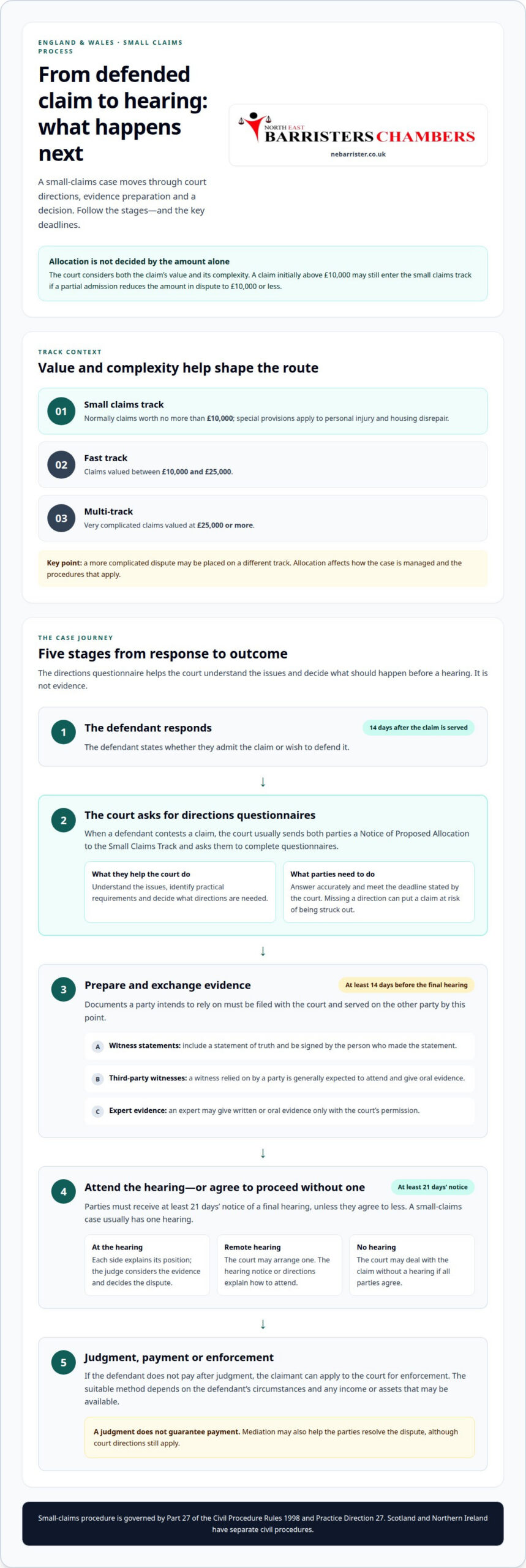
When a defendant contests a claim, the court usually sends both parties a Notice of Proposed Allocation to the Small Claims Track and asks them to file Directions Questionnaires. The forms help the court understand the issues, identify practical requirements and decide what directions are needed before a hearing. They are not evidence; they help shape the next stage.
In the process described by the Ministry of Justice, a defendant has 14 days after a claim is served to respond, stating whether they admit or wish to defend it. Once a defended claim reaches the allocation stage, parties should complete each questionnaire accurately and meet the court’s stated deadline. A missed direction can put a claim at risk of being struck out.
Before the hearing, the court may direct the parties to prepare witness statements, disclose documents and provide expert evidence where appropriate. In England and Wales, documents a party intends to rely on must be filed with the court and served on the other party at least 14 days before the final hearing. A witness statement needs a statement of truth and must be signed by its maker. A third-party witness relied on by a party is generally expected to attend and give oral evidence.
A small-claims case usually has one hearing. The court may deal with the claim without a hearing if all parties agree. A remote hearing may be arranged by the court; the hearing notice or directions tell you how to attend. At the hearing, each side explains its position and the judge considers the evidence before deciding the dispute. In England and Wales, parties must receive at least 21 days’ notice of a final hearing unless they agree to less.
If the defendant does not pay after judgment, the claimant can apply to the court for enforcement. The suitable method depends on the defendant’s circumstances and any income or assets that may be available. A judgment establishes the amount owed, but does not guarantee payment. Mediation may also help the parties resolve the dispute, although court directions still apply.
Small Claims in court – What Is the Small Claims Track?
In England and Wales, civil claims are allocated to one of three court tracks. The court considers the claim’s value and complexity, and the track determines how the dispute is managed and which procedures apply.
The three civil court tracks
The small claims track is generally for lower-value, less complex disputes; the fast track covers claims valued between £10,000 and £25,000, while the multi-track is for very complicated claims valued at £25,000 or more. These tracks help the court match a case’s procedure to its demands.
The amount alone may not decide allocation. A more complicated dispute can be placed on a different track, and a claim initially above £10,000 may enter the small claims track if partial admission reduces the amount in dispute to £10,000 or less. Allocation therefore affects the case’s timetable and management, not just its label.
Civil Procedure Rules that apply
According to the Ministry of Justice, the rules governing the small claims track in England and Wales are in Part 27 of the Civil Procedure Rules 1998. Practice Direction 27 also applies. These rules set the framework for how the court manages small claims and what costs may be recoverable.
Small claims hearings are generally informal, but parties still need to disclose the evidence they intend to rely on. If a party wants other relevant evidence, they must ask the court for a specific direction. An expert may give written or oral evidence only with the court’s permission. The small claims track applies in England and Wales; Scotland and Northern Ireland have separate civil procedures.
Risks of losing and appealing
If you lose, you may have to pay the judgment sum and any costs the court is permitted to award under the small claims rules. The court may also order further costs, assessed summarily, if a party has behaved unreasonably. If the judgment remains unpaid, the successful party may seek enforcement.
An appeal may be possible, but losing alone does not establish a basis to challenge the decision. A proposed appeal should identify a legal or procedural error, rather than simply disagreeing with the judge’s view of the evidence. If advocacy would help you present your position, get help with your civil case.
Recoverable costs
Small claims costs are restricted, so winning does not usually mean recovering all the money spent bringing or defending a case. In England and Wales, the court generally cannot order one party to pay the other’s costs, fees or expenses, except in specified categories. These limits help keep costs proportionate to the dispute’s value.
A successful claimant may ask the court to award court fees and certain case-related expenses, such as reasonable travel costs for attending the hearing, witness expenses and expert fees. The court decides whether each item falls within an allowed category and is reasonable. Keep receipts and records, and list each expense clearly when asking the court to award it.
- Court fees: fees paid in connection with the claim may be recoverable.
- Travel and witnesses: reasonable hearing travel expenses and witness expenses may be claimed.
- Expert evidence: an expert’s fees may be recoverable where relevant to the case.
- Legal costs: fixed solicitors’ costs may be allowed, but ordinary legal spending is not automatically recoverable.
These categories are not a promise of full repayment. For example, paying for extensive expert work does not mean the court will order the other party to cover the entire bill. Small-claims costs are governed by Part 27 and Practice Direction 27.1, which set the applicable rules and sums. The court also expects parties to keep their costs proportionate to the claim.
A party’s conduct can affect costs. If someone behaves unreasonably, the court may order further costs, assessed summarily, despite the usual small claims limits. If the court reallocates a case to another track, that track’s costs rules apply as though the claim had been allocated there from the outset. Consider this risk when weighing settlement against continuing.
Small claims track scope and monetary threshold
In England and Wales, the Ministry of Justice says the small claims track is normally for claims with a financial value of not more than £10,000, subject to special provisions for personal injury and housing disrepair claims. This guide to the small claims track focuses on an important distinction: the threshold is a starting point, not an automatic decision based only on the total claimed.
A case worth more than £10,000 may still be allocated to the small claims track. For example, if a defendant partially admits a claim, the court may consider the amount left in dispute. A claim initially worth more than £10,000 may enter this track if that disputed amount falls to £10,000 or less. Complexity also matters, since the court may allocate a more complicated case to a different track.
Personal injury claims have a further distinction. For a claim valued at no more than £10,000, the claim form asks whether expected damages for pain, suffering and loss of amenity are no more than £1,000 or more than £1,000. That question concerns a specific part of the damages, not the whole claim value, so the figures should not be treated as interchangeable.
Housing disrepair has separate allocation conditions. According to the Ministry of Justice, a tenant’s claim against a landlord concerning repairs or other work to residential premises is normally allocated to the small claims track when the estimated repair cost is no more than £1,000 and the financial value of any other damages claim is no more than £1,000. Both limits matter.
Anyone using a guide to the small claims track should separate the total amount claimed, the sum still disputed and any special claim category. Those details help explain why the court may not allocate a case solely by its headline value. If you need support presenting how your claim fits the threshold, discuss your civil claim.
North East Barristers Chambers
North East Barristers Chambers provides direct access legal advice and court representation for civil disputes, without requiring you to instruct a solicitor. A Direct Access Barrister can explain how the small claims rules relate to your case and what the court process involves.
A barrister can assess how your case’s value and complexity relate to track allocation, explain directions and evidence requirements, and help you prepare to present your position. This may be useful when completing a directions questionnaire, weighing the cost of continuing or getting ready for a hearing. Advice should focus on the issues in your case, not just the claim’s headline value.
Decide how you want to approach your claim
Turn the court’s requirements into a clear plan for your dispute. Identify the central issue, the outcome you want and the evidence supporting your position. Then decide whether you can present your case confidently yourself or would benefit from legal advice and advocacy.
This guide to the small claims track can help you understand the framework, but applying it to your own circumstances takes careful judgement. North East Barristers Chambers provides Direct Access Barrister Services and Court Representation, with legal work including civil and criminal law. For a civil dispute, a barrister can help clarify your position and prepare you to engage with the court process.
If you’re ready to discuss your situation, contact North East Barristers Chambers. A clear next step can make the process feel more manageable.
Frequently Asked Questions
What is the small claims track in England and Wales?
It is a court track for handling eligible civil disputes through a comparatively straightforward process. The Ministry of Justice identifies Part 27 of the Civil Procedure Rules 1998 as the rules governing it. The track determines how the court manages a case, including its directions and hearing. It does not mean that every claim below the financial threshold must be allocated there.
What types of cases can be allocated to the small claims track?
Eligible civil disputes can include money claims and some personal injury or housing disrepair claims, subject to the relevant allocation rules. For example, a tenant’s repair claim is assessed against separate limits for repair costs and damages. The court considers the dispute’s value and complexity when allocating it, so both the subject matter and the amount genuinely in dispute may affect the track.
What is the small claims track financial limit in 2026?
In England and Wales, the usual financial limit is £10,000, subject to special provisions for personal injury and housing disrepair claims. The Ministry of Justice states that the track normally covers claims with a financial value of not more than £10,000. The figure is not an absolute bar: the court may allocate a claim above it to the track in some circumstances.
How do I start a small claim in England and Wales?
For a straightforward money claim that does not concern property or goods, you can start online through Money Claims Online. Claimants can pay the court fee and generate documents through the service, while defendants can respond online. Alternatively, send a claim form and the court fee to the National Civil Business Centre. The defendant’s response determines whether the claim is admitted or defended.
What are the court fees for making a small claim?
The issue fee depends on the claim and the procedure used. For the process described, the maximum court fee payable to issue a claim is £455. People on a low income may be exempt from paying court fees. A hearing fee may also apply later, so include court charges in your costs planning rather than treating the issue fee as the only possible fee.
Can I recover legal costs and other expenses in a small claim?
Even if you win, you usually cannot recover all your legal spending from the other party. The court may allow specific items, including court fees, reasonable travel to the hearing, witness expenses and expert fees. Keep evidence of expenses such as a witness’s attendance costs and an expert’s charge. Unreasonable conduct can result in a further costs order, so your conduct matters throughout the case.