
Why pay for two legal teams when one specialist can handle your case from start to finish? It’s a common frustration for business owners. You’re likely stuck in a stalemate over contractual interpretation, watching costs climb whilst your commercial relationships hang by a thread. You want a resolution that doesn’t involve heavy financial leakage or endless delays. Instructing a contract dispute barrister through the Direct Access scheme allows you to bypass solicitor fees, giving you a direct line to senior legal strategy and expert advocacy.
I’ll show you how to resolve your conflicts efficiently and cost-effectively by working with a specialist directly. In this 2026 guide, I’ll explain how to get a clear legal assessment of your position and secure professional representation in court or mediation. You’ll learn exactly how to manage your case with confidence, ensuring you protect your revenue whilst keeping your legal spend under control. By the end of this article, you’ll have a clear roadmap for managing the legal process with transparency and pragmatism.
Key Takeaways
- Learn how to use the Public Access Scheme to instruct legal counsel directly, allowing you to bypass solicitor fees and manage your budget more effectively.
- Understand why engaging a contract dispute barrister at the start of a conflict provides a clear strategic advantage and signals your commitment to a resolution.
- Discover the step-by-step process for assessing your contractual position, from identifying a specific breach to determining your total liability.
- Explore the hierarchy of dispute resolution and why expert advocacy in mediation can often settle a claim before it ever reaches a courtroom.
- Gain insights into protecting your commercial interests and revenue whilst navigating complex legal disagreements with a straightforward, pragmatic approach.
Understanding Contractual Disputes and the Value of a Specialist Barrister
A contract dispute is rarely just a simple misunderstanding. It is a breakdown in the legal framework that governs your commercial relationships. These conflicts typically arise from disagreements over specific terms, failures in performance, or a total breach of obligations. I often see business owners who feel stuck because a supplier or client isn’t meeting their end of the bargain. Whether it’s a debt that hasn’t been paid or a service that didn’t meet the agreed standard, the impact on your cash flow and reputation can be severe.
Understanding the foundational principles of English contract law is essential, but applying those rules to a live conflict requires a specialist’s eye. A contract dispute barrister provides a perspective that is fundamentally different from that of a general practitioner. We spend our professional lives in court, which means we see the “end game” before the first letter of claim is even sent. This foresight allows us to predict judicial outcomes and build a strategy that aims for a pragmatic resolution, rather than just endless litigation. Professional advocacy isn’t just for the courtroom; it’s a tool for early resolution that signals to the other party that you’re serious about protecting your interests.
The Direct Access Advantage for Businesses
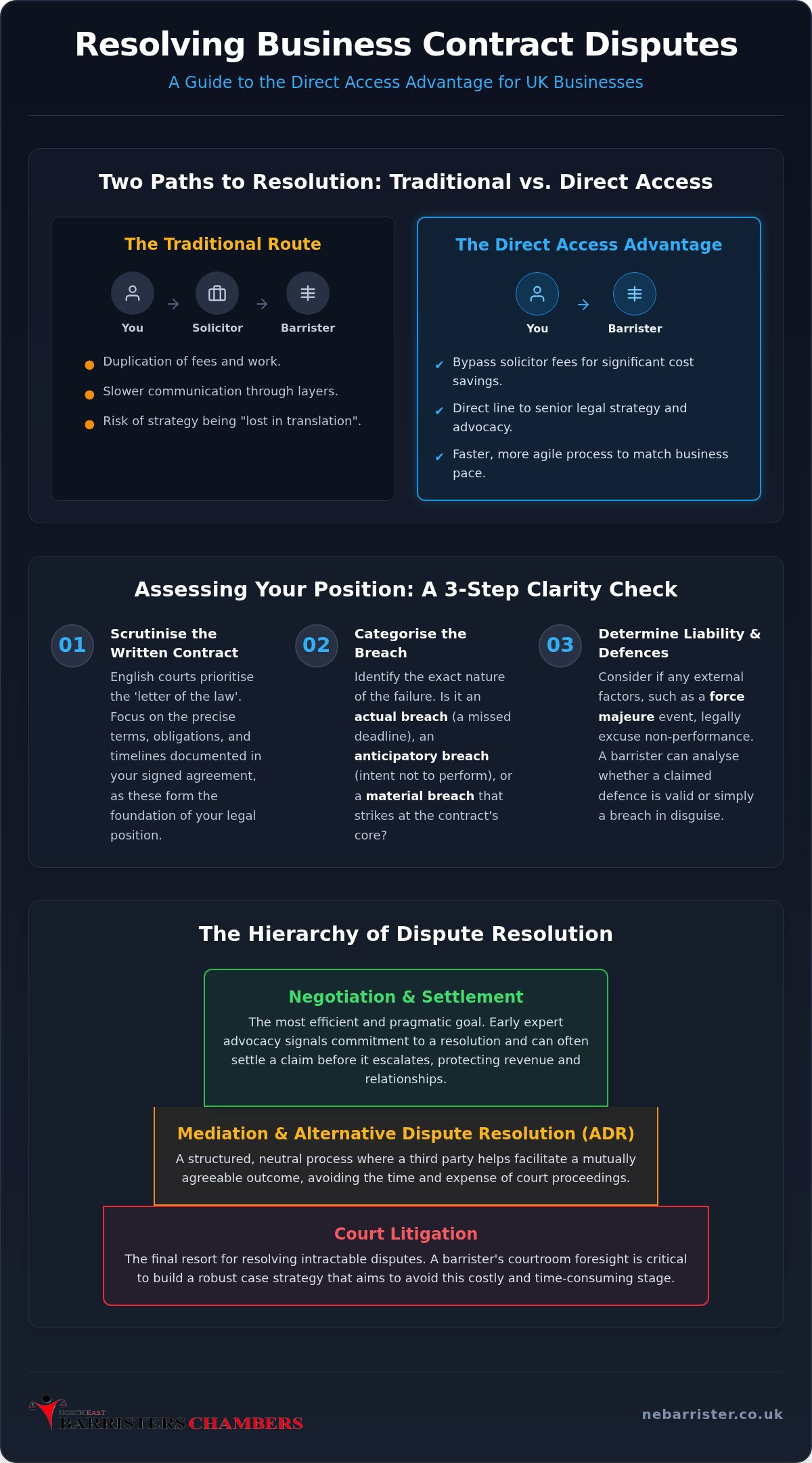
The Public Access scheme has fundamentally changed the landscape for SMEs and individuals. In the traditional model, you were required to hire a solicitor who would then instruct a barrister on your behalf. This often led to a duplication of fees and a slower pace of work. By instructing me directly, you can reduce legal costs UK wide whilst gaining immediate access to senior legal strategy. You remove the middleman, which speeds up communication and ensures your case doesn’t get lost in translation. I act as your single point of accountability, providing a direct, agile service that matches the pace of modern business.
When to Seek Expert Legal Advice
Timing is everything in commercial law. I often refer to the period just before a contract is terminated or a claim is filed as the “danger zone.” If you act impulsively without a clear legal assessment, you risk committing a breach yourself, which can be a costly mistake. Seeking advice from a contract dispute barrister at this stage allows for tactical correspondence that can often settle a matter before it escalates to court. Whether you need a formal legal opinion on the strength of your position or a robustly drafted response to a threat, early intervention is your best chance of resolving the dispute with minimal financial leakage.
Assessing Your Position: Identifying Breach, Performance, and Liability
Before you take formal action, you must look closely at the document that defines your relationship. I often find that clients get caught up in the “spirit of the agreement” or what was discussed over a coffee. Whilst those conversations matter, English courts prioritse the “letter of the law” as written in your signed contract. You need to determine if the other party has failed to perform a specific obligation or if they’ve committed a material breach. A material breach is a failure so significant that it strikes at the very heart of the agreement, potentially giving you the right to terminate the contract entirely.
In a 2026 commercial context, we also have to consider external factors like force majeure or frustration. If an unforeseen event makes performing the contract impossible, the legal position shifts. Following government guidance on contract management can help you track these risks, but a contract dispute barrister is needed to interpret how these clauses apply to your specific facts. I can help you identify whether the current situation truly excuses non-performance or if it’s simply a breach in disguise.
Categorising the Breach of Contract
Not all breaches are equal. You might be facing an actual breach, where the deadline has passed and the work isn’t done. Alternatively, you might encounter an anticipatory breach, where the other party makes it clear they don’t intend to honour the agreement in the future. I also distinguish between a breach of condition, which is a major term, and a breach of warranty, which is a minor term that might only entitle you to damages rather than termination. To help me assess your case, you should gather the following evidence:
- All signed versions of the contract and any subsequent amendments.
- Email chains and message logs discussing performance or delays.
- Invoices, payment receipts, and proof of any financial loss.
- Dated logs of specific incidents or missed milestones.
Evaluating Potential Damages and Remedies
Once a breach is identified, we must look at the remedy. Most commercial claims focus on compensatory damages, aiming to put you back in the position you would have been in if the contract had been performed correctly. In rarer cases, I might argue for specific performance, where the court orders the party to actually carry out their duties. You must remember your duty to mitigate losses; the law doesn’t allow you to let costs spiral if you could have taken reasonable steps to reduce the damage. Liquidated damages are pre-agreed sums set out in the contract that become payable upon a specific breach. If you’re unsure where you stand, contacting me for an initial assessment can provide the clarity you need to move forward.
Strategic Dispute Resolution: From Negotiation to Court Representation
Once we’ve assessed your position, we need a clear strategy to resolve the conflict. I follow a logical hierarchy of resolution that begins with robust negotiation. Often, a well-drafted letter of claim from a contract dispute barrister is enough to bring the other party to the table. It signals that you aren’t just making empty threats; you have senior legal counsel ready to take the matter further. This early intervention frequently prevents a disagreement from spiralling into a full-blown court battle. My goal is always to find the quickest route to a settlement that protects your commercial interests.
In 2026, the legal landscape prioritises Alternative Dispute Resolution (ADR) more than ever. The courts expect parties to engage in good faith efforts to settle before taking up judicial time. Using ADR methods like mediation can save you months of uncertainty and significant expense. Managing civil litigation costs UK wide is a core part of my approach. I ensure that the financial investment you make in legal fees remains proportionate to the value of your claim, avoiding the “win at any cost” trap that often leads to financial leakage. The same principle applies whether you are dealing with a commercial contract or a property-related conflict; for example, those facing a land ownership conflict may benefit from consulting a boundary dispute barrister who can provide equally focused direct access representation.
The Power of a Barrister in Mediation
I act as a specialist advocate during mediation, helping you navigate the high-pressure environment of settlement talks. We often use the Competition and Markets Authority’s guidance on unfair contract terms to challenge clauses that are legally lopsided or unenforceable. Mediation is now a mandatory step for claims under £10,000, and it’s a highly effective way to reach a legally binding agreement. I’ll provide a neutral evaluation of your chances at trial, which helps you make informed decisions about when to settle and when to hold your ground.
Preparing for Civil Court Representation
If negotiation and mediation fail, I’ll prepare your case for a formal hearing. This stage involves drafting precise “pleadings” and witness statements that form the backbone of your evidence. My role in court is to present your case with professional authority, using cross-examination to test the other party’s version of events. Whilst court timelines can be lengthy, I’ll keep you updated on every procedural step. For a comprehensive overview of how the process works and what to expect at each stage, our guide to civil court representation UK covers the latest 2026 procedural updates in detail. I’ll manage your expectations regarding potential outcomes, ensuring you have a realistic view of the risks and rewards as we move through the litigation process.
How to Instruct a Barrister Directly for Your Contractual Claim
The Public Access scheme, often called Direct Access, is a modern way to manage legal disputes. It allows you to engage a contract dispute barrister without the need for a solicitor. This approach is particularly effective for commercial contract cases where the issues are clearly defined. By removing the traditional layer of a solicitor, you gain direct access to senior legal expertise whilst significantly reducing your total spend. It’s a pragmatic choice for businesses that want a faster, more streamlined service.
Before I can accept your instructions as a contract dispute barrister, I must perform a suitability test. This is a regulatory requirement to ensure that your case is appropriate for the Direct Access scheme. If a case is exceptionally complex or requires intensive administrative management, I might suggest that a solicitor is involved. However, for the majority of contractual disagreements, I can handle the instruction directly. Transparency is a cornerstone of this process. You’ll receive a client care letter and a clear fee quote before any work begins, ensuring there are no surprises regarding costs.
Step 1: Gathering Your Documentation
To provide the most accurate assessment, I need to see the full picture. You should organise your contract, any variations, and all written correspondence in chronological order. This saves time and ensures I don’t miss a critical email or message. A brief summary of the dispute and your desired outcome is also incredibly helpful. If your conflict involves a failure of professional standards, you may also need the input of a civil negligence claim barrister to evaluate the breach of duty alongside the contractual issues.
Step 2: The Initial Consultation and Instruction
Starting the process is straightforward. You can submit an enquiry via my chambers website with a brief outline of your situation. We’ll then discuss the scope of work required. You might only need a one-off advice session to understand your position, or you may require full representation for a mediation or court hearing. We’ll agree on a fixed-fee or an hourly rate arrangement based on the complexity of the task. This clarity allows you to budget effectively and maintain control over your legal expenses. If you’re ready to resolve your conflict, instructing a barrister directly is the most efficient next step.
Expert Advocacy with North East Barristers: Protecting Your Commercial Interests
Choosing a contract dispute barrister shouldn’t feel like navigating a maze of corporate bureaucracy. At North East Barristers, I offer a modern alternative to the traditional, often detached, London-based firms. I pride myself on being an agile and independent practitioner who travels to meet the needs of my clients, regardless of where they are in the country. This mobile approach ensures that you receive senior-level advocacy without the stuffiness or high overheads typically associated with larger chambers. My commitment is to provide jargon-free, straightforward advice that helps you see the wood for the trees in complex legal situations.
A direct partnership between a business and a barrister creates a unique synergy. You get the person who will actually argue your case in court or mediation involved from day one. This eliminates the risk of key details being lost in translation between different legal teams. It’s a pragmatic, service-oriented model designed for the modern businessperson who values clarity, reliability, and results over decorative prose and formal posturing. I focus on providing a straightforward solution in a field that is often unnecessarily complex.
Why Our Direct Access Model Works
The success of the Direct Access model at North East Barristers rests on three main pillars. First, there is a direct line of accountability. When you instruct me, you are working with the expert who will be standing in the courtroom. You don’t have to worry about your case being handed off to a junior associate. Second, our fee structure is designed for transparency. By bypassing the solicitor, you avoid additional disbursements and administrative mark-ups. I often provide fixed-fee options for specific stages of work, such as drafting a letter of claim or attending a mediation session. Finally, we offer agility. Contract breaches often require an immediate response to prevent further financial damage. I can react quickly to urgent situations, providing the professional advocacy you need exactly when you need it.
Taking the Next Step
If you are currently facing a contractual stalemate, the best move is to seek a preliminary assessment before the situation escalates. I adopt a solution-provider mindset, focusing on how to resolve your dispute with the least amount of friction possible. My goal is to protect your commercial interests and keep your business moving forward. Whether you need a robust defence against a claim or want to enforce your rights under an agreement, I am here to act as your friendly guide through the legal process. I’ll help you navigate the complexities of the 2026 legal landscape with confidence and ease.
Contact North East Barristers for an initial consultation on your contract dispute to discuss your options and secure the expert representation you deserve.
Take Control of Your Contractual Future
Resolving a commercial disagreement doesn’t have to be an overwhelming or prohibitively expensive process. By using the Direct Access scheme, you can secure senior legal strategy that prioritises your commercial interests and cash flow. You’ve seen how identifying a breach early and engaging in professional mediation can often prevent a case from ever reaching a courtroom. This approach ensures you remain in the driving seat of your legal journey whilst keeping your professional spend manageable.
Working with a contract dispute barrister gives you the tactical advantage needed to settle conflicts with clarity and confidence. I am Direct Access qualified and provide national UK coverage, offering specific expertise in high-value commercial litigation. I’ll act as your straightforward solution-provider, ensuring every step of the process is transparent and entirely jargon-free. There is no need for the traditional layers of solicitor fees when you can have a direct line to the person who will argue your case. If you’re ready to protect your revenue and find a resolution, instruct a specialist contract dispute barrister directly today.
Legal challenges are undoubtedly complex, but with the right expert by your side, you can find a pragmatic path forward. I look forward to helping you navigate these hurdles and securing the outcome your business needs to thrive.
Frequently Asked Questions
Can I hire a barrister without a solicitor for a contract dispute?
Yes, you can. The Direct Access scheme allows you to instruct a contract dispute barrister directly for advice and representation. This bypasses the need for a solicitor, which often simplifies communication and reduces overall legal spend. I’ll assess your case initially to ensure it’s suitable for this streamlined approach. It’s a pragmatic way to secure senior legal expertise whilst maintaining direct control over your case strategy and budget.
How much does a contract dispute barrister cost in the UK?
Fees for a contract dispute barrister are not standardised and depend on the case’s complexity and the barrister’s seniority. I provide transparent fee quotes or fixed-fee options for specific stages of work, such as an initial conference or drafting a letter of claim. This gives you budget certainty from the outset, allowing you to manage your legal expenses without the hidden costs found in traditional legal structures.
What is the difference between a breach of contract and a material breach?
A breach occurs when any term is not met, but a material breach is far more serious. It is a failure so fundamental that it undermines the entire purpose of the agreement. Whilst a minor breach might only entitle you to damages, a material breach can give you the legal right to terminate the contract and claim for significant losses. I can help you identify which category your dispute falls into.
Will I have to go to court for a contractual disagreement?
Going to court is often the last resort. Most contractual disagreements are resolved through robust negotiation or mediation before they ever reach a judge. The UK court system strongly encourages Alternative Dispute Resolution (ADR) and can penalise parties who refuse to engage in it. I focus on achieving a settlement that protects your commercial interests whilst avoiding the time and expense of a full trial.
Can a barrister help me draft a settlement agreement?
Yes, I can draft or review settlement agreements to ensure they are legally robust. Once a resolution is reached through negotiation or mediation, it’s vital to document the terms in a binding way. This prevents future disputes and ensures all parties understand their final obligations. I provide the professional drafting needed to close a matter permanently and securely, protecting you from future liability or claims.
How long does it take to resolve a commercial contract dispute?
The timeline depends on the resolution method chosen. Mediation can often resolve a dispute in a single day, whereas a full court case may take 12 to 18 months to reach a final hearing. Factors such as the volume of evidence and the court’s schedule play a significant role. I work to move your case along as efficiently as possible to minimise commercial disruption and financial leakage.
Can I recover my legal fees from the other party?
In many cases, the general rule is that the losing party pays the winner’s costs. However, this is subject to the court’s discretion and the specific track your case is on. For example, in the Small Claims Track for claims under £10,000, cost recovery is very limited. I will provide a clear assessment of your potential for cost recovery as part of our initial strategy and consultation.
Is my case suitable for the Direct Access scheme?
Most commercial contract cases are suitable for Direct Access instruction. I perform a suitability test at the start to ensure your case doesn’t require the high-volume administrative support that a solicitor typically provides. If the matter is primarily about legal interpretation, evidence analysis, and advocacy, it’s usually an ideal fit for the scheme. This allows for a direct and efficient partnership between the client and the barrister.