
What if you could bypass the solicitor’s office entirely and still walk into court with one of the country’s sharpest legal minds by your side? With solicitor guideline hourly rates for senior practitioners reaching £579 in 2026, the prospect of facing a legal dispute often feels like a choice between financial exhaustion or the terrifying uncertainty of representing yourself. You likely feel that the civil justice system is becoming increasingly inaccessible to anyone without a corporate budget. I agree that the traditional legal model is often unnecessarily expensive and opaque for the average person.
This guide explores how you can secure expert civil court representation UK whilst significantly reducing your legal expenses through the direct access scheme. I will show you how to maintain control of your case and communicate directly with the person arguing your position in front of a judge. We will cover the latest 2026 procedural updates, the growing trend of fixed fee arrangements, and the practical steps to bypassing the middle-man to get the professional advocacy you deserve.
Key Takeaways
- Understand how the direct access scheme allows you to secure expert civil court representation UK without the additional overheads of a solicitor intermediary.
- Learn how taking responsibility for your own case administration can lead to significant savings on your overall legal expenditure.
- Explore which types of civil disputes, from property conflicts to contractual breaches, are most suitable for direct professional advocacy.
- Gain a clear overview of the litigation journey, ensuring you are prepared for every stage from the initial Letter Before Action to the final trial.
- Discover the practical steps for instructing a barrister, including how to verify accreditation and prepare your case papers for a professional assessment.
What is Civil Court Representation in the UK?
Civil court representation UK refers to the professional advocacy provided during non-criminal disputes. This involves presenting evidence, cross-examining witnesses, and delivering legal arguments to a judge. Whether you are dealing with a complex breach of contract or a sensitive property dispute, the advocate acts as your specialist voice in the courtroom. Their primary goal is to ensure your position is heard clearly and framed within the context of current laws.
Adhering to the Civil Procedure Rules (CPR) is the most challenging part of any claim. These rules dictate how cases must progress through the courts. A single mistake in filing or a missed deadline can lead to your case being dismissed or facing severe cost penalties. Professional representation is vital for avoiding these pitfalls. While the traditional model once forced you to hire a solicitor before you could speak to a barrister, the Public Access Scheme has modernised the process. You can now instruct a barrister directly, which allows you to focus your resources on the actual advocacy in court.
The Difference Between Legal Advice and Advocacy
I find it helps to separate these two roles. Legal advice focuses on the merits of your claim and the overall strategy. Advocacy is the specific, refined skill of representing a client during a hearing. While many legal professionals can offer advice, barristers are the primary specialists for courtroom advocacy. They spend their professional lives in court, developing the ability to present persuasive arguments and respond to a judge’s questions in real time.
Who Can Represent You in a Civil Court?
You have several choices when deciding who will speak for you in court:
- Solicitors: Some have “higher rights of audience” which allows them to appear in the senior courts.
- Barristers: These specialists can be instructed via a solicitor or through the public access route.
- Litigants in Person: You have the right to represent yourself, though this carries significant risks.
I often see Litigants in Person struggle with the technicalities of court procedure. Without professional support, it is easy to feel overwhelmed by the opposing side’s legal team. Choosing direct access means you handle your own paperwork whilst I handle the complex legal arguments in front of the judge. This approach offers a pragmatic middle ground for those who want expert advocacy without the high hourly rates of a traditional solicitor firm.
Direct Access vs Traditional Solicitor-Led Representation
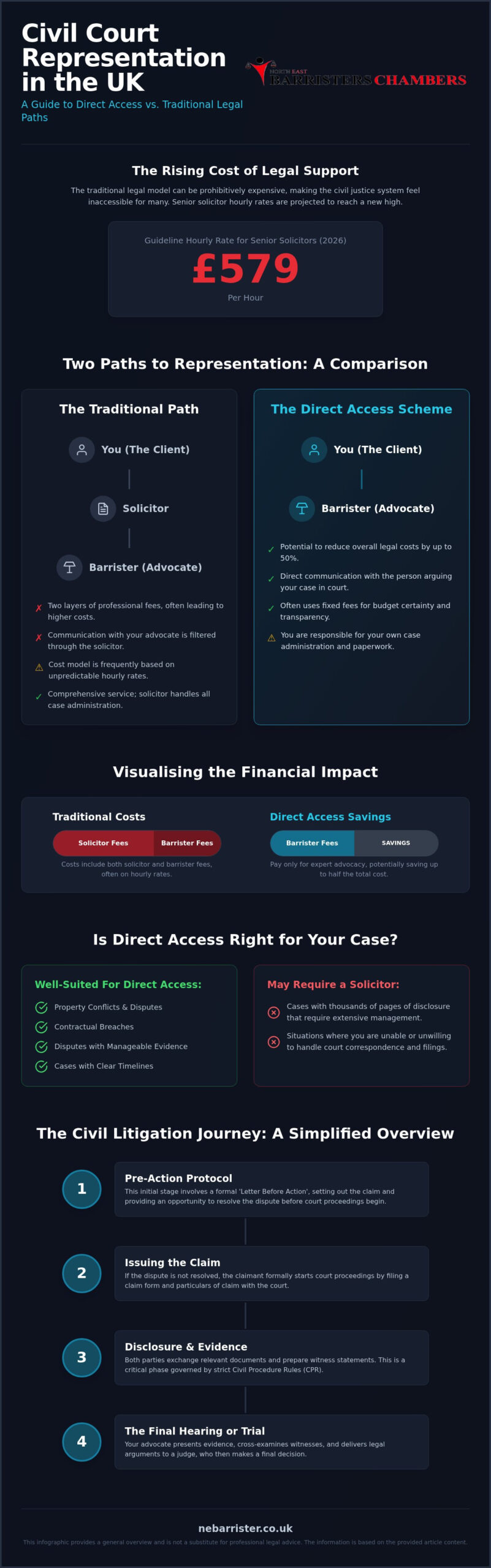
Choosing the right path for civil court representation UK often comes down to how much of the process you want to manage yourself. In a traditional solicitor-led model, you hire a solicitor who then instructs a barrister on your behalf. This creates two distinct layers of professional fees. Direct access removes that middle-man. You speak directly to me, the person who will actually stand up in court and argue your case. I believe this direct line of communication is invaluable. It ensures that nothing is lost in translation between different legal professionals.
The financial impact of this shift is substantial. By managing your own administration, such as filing forms and organising your evidence, you can often reduce legal costs UK by up to 50%. While solicitors provide a comprehensive service that includes high-volume document management, many clients find they don’t need that level of support. If you’re comfortable handling court correspondence, you can keep your budget focused on expert advocacy. You can find more details on UK government advice on going to court to see how these roles differ in practice.
Cost Comparison: Managing Your Legal Budget
I prioritise transparency when it comes to fees. Traditional law firms often rely on hourly rates that can spiral quickly. In 2026, senior solicitor rates in London have reached £579 per hour. In contrast, many direct access barristers offer fixed fees for specific hearings or pieces of advice. This gives you certainty. You know exactly what a hearing will cost before we start. This approach is particularly effective for small claims and fast-track cases where the financial stakes require a proportional legal spend.
Suitability for Direct Access
Not every case is right for direct instruction. I recommend this route for disputes with manageable evidence and clear timelines. If your case involves thousands of pages of disclosure, a solicitor’s team might be necessary to process the data. However, for most contractual or property disputes, you can easily handle the filings yourself. You should evaluate your own ability to stay organised and meet court deadlines. If you feel confident managing the timeline, instructing a barrister directly provides the highest level of courtroom expertise at a fraction of the traditional cost.
Common Civil Disputes Suitable for Direct Instruction
I find that many clients initially worry that direct access is only for “simple” cases. This is a common misconception. Direct instruction is highly effective for a wide spectrum of complex matters where the technicality of the law is just as important as the facts of the case. In 2026, the landscape of civil court representation UK has become more intricate due to updated procedural rules. Having a specialist advocate ensures your case is presented in strict accordance with The Civil Procedure Rules 1998. Whether you are a business owner or a private individual, you can access high-level advocacy for almost any non-criminal dispute.
Property and Land Conflict Resolution
Property disputes are often technically demanding and emotionally draining. Boundary issues, for instance, require a precise analysis of title deeds and historical plans. A boundary dispute barrister provides the specific expertise needed to resolve these conflicts, often preventing them from escalating into a full trial. I also frequently assist with possession claims and disrepair issues through landlord tenant dispute barrister services. This is particularly relevant following the Renters’ Rights Act 2026, which replaced Section 21 evictions with a new Section 8 framework. Expert advocacy is now essential for navigating these updated possession grounds in court.
Commercial and Contractual Litigation
For businesses, a contractual disagreement can be a significant distraction. You can instruct a contract dispute barrister to handle everything from service level agreement breaches to complex partnership breakups. I also manage professional negligence claims directly. If a professional service provider has failed in their duty of care, you can seek my opinion on the merits of your claim without the need for a solicitor’s retainer. This direct route is equally effective for debt recovery and insolvency proceedings. It allows for quick, authoritative action that is often the difference between a successful recovery and a total loss. By handling your own paperwork, you keep your budget focused on the courtroom expertise that actually decides the outcome.
The Civil Litigation Process: From Pre-Action to Trial
I find that most clients feel the greatest relief once they understand the structured path a claim must follow. Before you ever step into a courtroom, you must comply with the pre-action protocols. This starts with issuing a formal Letter Before Action. This document gives the opposing party a final opportunity to settle the dispute without further costs. If they refuse to engage, we move to the formal litigation stage by filing the Claim Form and Particulars of Claim at court. This is the point where your civil court representation UK becomes a formal matter of record.
Once the claim is defended, the court allocates it to a specific track based on its value and complexity. In the first quarter of 2026, the median time from issuing a claim to trial was 37.6 weeks for small claims and 54.3 weeks for fast and multi-track claims. Because these timelines are significant, I focus on moving your case forward efficiently. This includes the meticulous preparation of the trial bundle. This bundle is the primary resource the judge will use to navigate your evidence. If it is poorly organised, it can frustrate the court and weaken your position. If you are ready to begin your claim, instruct a barrister directly to ensure your documents are court-ready from day one.
Drafting Legal Documents with a Barrister
Pleadings are the foundation of your entire case. If your Particulars of Claim or Defence are poorly drafted, the court has the power to strike them out entirely. I provide professional drafting to ensure your legal arguments are robust and compliant with court rules. I also offer specialist advice on quantum, which is a formal assessment of what your claim is worth. This prevents you from wasting time on unrealistic figures. Furthermore, I assist in drafting witness statements that are designed to withstand the pressure of cross-examination by the opposing side.
What Happens During a Civil Court Hearing?
A civil hearing follows a methodical rhythm that I will guide you through. I begin with an opening statement to define the legal framework and the issues the judge must decide. The most intense phase is the presentation of evidence and the cross-examination of witnesses. This is where I test the opposing side’s evidence to find inconsistencies or gaps in their story. After all evidence is heard, I deliver closing submissions to summarise why the law supports your position. Finally, the judge will deliver their judgment, either immediately or at a later date.
Instructing a Barrister Directly for Civil Advocacy
I believe the first step to securing expert civil court representation UK is verifying your barrister’s credentials. Every barrister qualified to accept direct instructions must be registered as a public access practitioner with the Bar Standards Board. You can easily check this on their website to ensure your advocate has completed the necessary specialist training. Once you’ve confirmed their status, the process begins with an initial assessment of your case papers. I’ll review your documents to ensure the dispute is suitable for the direct access scheme and that it’s in your best interests to proceed without a solicitor.
Transparency regarding costs is a cornerstone of my practice. Unlike the open-ended hourly rates often found in traditional law firms, I prefer to agree on a fixed fee for specific stages of the litigation. This might include a set fee for drafting a defence or a separate fee for representing you at a one-day hearing. This approach gives you total budget certainty. It’s vital that we maintain clear communication regarding court dates and deadlines. Since you’ll be managing the day-to-day administration, I rely on you to keep me informed of any correspondence from the court or the opposing side immediately.
Preparing Your Case for Instruction
I can work most efficiently when your evidence is well-organised. I recommend arranging your documents in strict chronological order before sending them to me. A clear, one-page summary of the dispute and your desired outcome is also incredibly helpful. This allows me to grasp the core issues quickly. You should also understand the limits of my role under public access. While I handle the complex legal arguments and courtroom advocacy, I cannot act as your formal address for service. You’ll need to be prepared to send out the documents I draft and handle the basic filing tasks yourself.
Securing Your Court Date
Once we’ve agreed to work together, my clerk becomes your primary point of contact for logistics. They’ll liaise with you to ensure I’m available for your specific hearing dates. I provide national representation across all UK civil courts, so I can travel to meet you wherever the hearing is listed. We’ll finalise the instruction letter and fee agreement before any work begins. This document outlines exactly what I’ll be doing for you and the agreed price for that work. This methodical approach ensures there are no surprises, allowing you to focus entirely on the legal merits of your case.
Take Control of Your Civil Case
Managing a legal dispute doesn’t have to mean financial ruin or going it alone. By choosing the direct access route, you can secure high-level civil court representation UK whilst keeping your legal budget under control. I’ve shown you how bypassing the traditional solicitor model allows you to focus your resources on expert advocacy and strategic advice. You handle the paperwork; I handle the courtroom arguments. This pragmatic approach ensures you have a specialist by your side through every stage of the litigation process, from the first Letter Before Action to the final judgment.
I am direct access accredited and specialise in civil litigation with transparent fixed-fee structures. This means you get total clarity on costs and a direct line to the person arguing your case. If you’re ready to protect your interests with professional support, instruct an expert barrister for your civil case today. Taking the first step toward resolution is much easier when you have a clear path and a dedicated professional to guide you.
Frequently Asked Questions
Can I really hire a barrister for a civil case without a solicitor?
Yes, the Public Access Scheme allows you to instruct a barrister directly for your dispute. This removes the need for a solicitor intermediary, allowing you to work straight with the person who will argue your case. I provide civil court representation UK directly to individuals and businesses, provided the matter is suitable for this route. It’s a modern, efficient way to access high-level advocacy in 2026.
Is civil court representation through direct access cheaper?
It is generally much more cost-effective because you aren’t paying for two separate legal teams. By taking on the administrative tasks yourself, such as filing forms and managing correspondence, you avoid the high hourly rates of a traditional solicitor firm. I prioritise transparency by offering fixed fees for specific stages of your case. This ensures you have total budget certainty before any work begins on your behalf.
What types of civil cases are not suitable for direct access?
Cases involving massive volumes of document disclosure or those requiring significant investigative work may not be appropriate. If your dispute requires a large team to manage thousands of pages of evidence, a solicitor’s infrastructure is often necessary. I assess every case individually at the start. If I believe a solicitor is required for your protection or the efficient management of the claim, I’ll tell you immediately.
Do I have to do all the paperwork myself if I hire a barrister directly?
You are responsible for the day-to-day administration, such as filing documents at court and sending letters to the opposing side. However, I handle the complex drafting of legal documents. I’ll write your Particulars of Claim, Defence, and witness statements to ensure they meet the strict requirements of the court. You act as the administrative lead whilst I provide the specialist legal content and strategy.
Can a direct access barrister help me with a small claims court case?
Yes, I frequently assist with small claims where the financial stakes require a proportional legal spend. While these cases are designed for people to handle themselves, professional civil court representation UK can be a decisive advantage. I can provide a fixed-fee consultation to review your evidence or represent you at the final hearing. This ensures your legal arguments are presented persuasively and correctly to the judge.
What happens if my case becomes too complex for direct access?
If a case evolves to a point where a solicitor is essential, I’ll advise you to instruct one. This might happen if the court orders extensive disclosure that you cannot manage alone or if the case requires a formal address for service. In such instances, I can continue to act as your barrister, but the solicitor would take over the formal management and filing to protect your interests.
How do I find a barrister who accepts direct instructions for civil law?
You should check the Bar Standards Board Barristers’ Register to confirm a practitioner is Public Access accredited. This register lists all barristers in England and Wales and indicates whether they can accept instructions directly from the public. I am fully accredited and specialise in civil litigation. I offer national coverage for clients across the UK who need expert advocacy without the additional costs of solicitor overheads.
Will a barrister attend the court hearing with me?
Yes, representing you at the hearing is the core part of my service. Advocacy is the specialist skill of arguing a case in front of a judge and responding to their questions in real time. I’ll attend the court with you, present your legal arguments, and cross-examine witnesses. My role is to ensure your voice is heard and your position is framed correctly within the legal framework.
