
Did you know that the red line on your Land Registry title plan can represent nearly a metre of ground in reality? If you’re currently locked in a heated argument over a fence or a driveway, hiring a boundary dispute barrister through the direct access scheme is likely the most pragmatic move you’ll make this year. I understand how draining these conflicts feel. It often starts with a simple garden project but quickly spirals into sleepless nights and genuine concerns about your property’s market value. You probably fear that the traditional legal route is a financial black hole, especially when hearing about nightmare cases where legal costs far exceed the value of the land itself.
I’m here to show you that there’s a more efficient way to protect your home. By instructing a specialist directly, you can secure a definitive legal opinion and a resolution that prioritises clarity over conflict. This guide explores the ‘general boundaries’ rule under the Land Registration Act 2002 and explains how the direct access model provides a cost-effective path to peace of mind. I’ll help you navigate the complexities of 2026 property law so you can resolve your dispute, protect your investment, and finally move on with your life.
Key Takeaways
- Understand why Land Registry title plans are only indicative and how the ‘general boundaries’ rule impacts your legal standing.
- Learn how instructing a boundary dispute barrister via the direct access scheme can reduce your legal costs by up to 50%.
- Discover why combining Alternative Dispute Resolution (ADR) with a specialist surveyor’s report is often the fastest path to a settlement.
- Identify the essential evidence, from historical deeds to physical site photos, required to secure a definitive legal opinion.
- Gain a clear strategy for resolving neighbour conflicts while protecting your property’s long-term market value.
Boundary Disputes: Why is Specialist Advocacy Required?
A boundary dispute is a formal legal disagreement between neighbours regarding the exact location of the dividing line between their parcels of land. These conflicts rarely start out of thin air. They are usually sparked by specific changes to the physical environment that force a confrontation over property rights. Common triggers include:
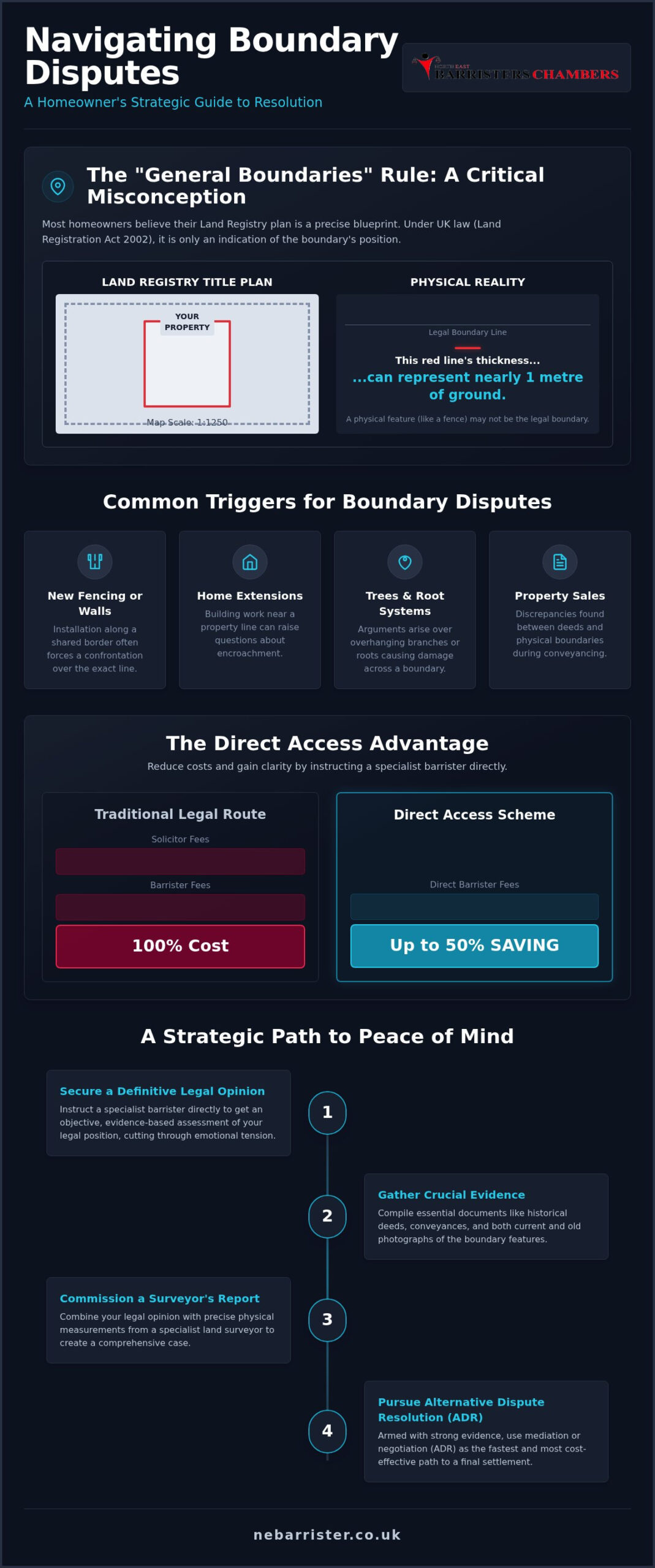
- Installing new fencing or walls along a shared border.
- Planning or building home extensions near the property line.
- Arguments over overhanging trees or encroaching root systems.
- Discovering discrepancies between physical boundaries and Title Deeds during a property sale.
Because your home is likely your most significant financial asset, any perceived threat to its footprint feels like a personal attack. This emotional weight is why judgements often become clouded, leading to irrational decisions and long-term neighbourly resentment. Instructing a boundary dispute barrister early in the process is a strategic move. I provide an objective, evidence-based legal opinion that cuts through the tension. While a surveyor can tell you where a line might sit based on measurements, a barrister interprets the law to determine who actually owns that strip of land. This clarity prevents you from making expensive mistakes based on a misunderstanding of your rights.
Common Types of Land Disagreements
Disputes generally fall into a few complex categories. Encroachment is perhaps the most frequent, occurring when a structure or fence is built on land that doesn’t belong to the builder. Then there are easements and rights of way, which focus on access rather than ownership. You might find yourself arguing over a shared driveway or a path that a neighbour insists they have a right to use. Finally, there is the doctrine of adverse possession. This legal principle allows someone to claim ownership of land through long-term occupation, even if they aren’t the registered owner on the deeds. It’s a high bar to clear, but it remains a frequent point of contention in UK property law that requires specialist interpretation.
The Escalation of Neighbourly Conflict
Without early intervention, minor disagreements can rapidly evolve into ruinous civil litigation. It’s easy for legal fees to spiral when parties become entrenched in their positions. I always advise clients to maintain a professional distance from their neighbours whilst the dispute is ongoing. Direct confrontation rarely helps and often provides the other side with evidence they can use against you in court. Seeking advice from a boundary dispute barrister ensures your interests are protected without the unnecessary heat of a personal row. Trespass is defined as the unjustifiable interference with land which is in the immediate and exclusive possession of another person.
The Technical Reality: Land Registry Plans vs Physical Boundaries
Most homeowners believe their Land Registry title plan is a precise blueprint of their property. This is a significant misconception. In the UK, the Land Registry operates under the “general boundaries” rule, as defined by Section 60 of the Land Registration Act 2002. This means the red line on your plan provides only an indication of the boundary’s position rather than its exact location to the centimetre. In reality, the thickness of that red line on a standard map can represent up to a metre of ground. If you are arguing over a few inches of land for a new fence, the title plan alone will rarely provide the answer you need.
As a boundary dispute barrister, I often have to explain that there is a distinct difference between a physical boundary and a legal boundary. A fence or a hedge is merely a physical feature that may or may not sit on the legal line. My role is to look beyond the digital maps and interpret the underlying legal documents that originally created the boundary. If you find yourself in this position, discussing your case with a specialist can help you understand the strength of your position before you commit to a legal battle.
The Limitations of Title Plans
Ordnance Survey maps form the basis of most title plans, but they are subject to scale limitations. On a 1:1250 scale map, even a thin pen stroke covers a significant area of land. The Land Registry rarely guarantees exact property lines because their primary purpose is to record ownership, not precise dimensions. The government’s own guidance on property boundaries confirms that these plans are not definitive. For those requiring absolute certainty, the only way to fix an exact line is through a “Determined Boundary” application, which involves a high-precision survey and formal legal certification.
Historical Deeds and Evidence
When modern plans prove insufficient, we must search for “extrinsic evidence” within historical deeds. These older documents often contain the original conveyance or transfer that first divided the land into separate plots. I look for a hierarchy of evidence, prioritising the wording of the original deed over modern site features or witness statements. A 1920s conveyance might trump a 2026 digital plan because the original wording often carries more legal weight in defining the parties’ initial intent when the land was first partitioned. By examining these historical records, a boundary dispute barrister can build a case based on legal fact rather than modern assumptions.
Resolving the Conflict: A Strategic Path to Resolution
Resolving a land conflict requires a methodical approach rather than an emotional one. While your instinct might be to argue over every inch, the most successful outcomes are achieved through strategic negotiation and evidence-based pressure. Prioritising Alternative Dispute Resolution (ADR) is essential because the financial stakes of a full court battle often outweigh the value of the land in question. By focusing on a settlement early, you can avoid the high costs and lengthy delays associated with the UK court system.
A boundary dispute barrister acts as your strategic lead in this process. I don’t just provide a legal opinion; I help you coordinate the technical evidence needed to bring your neighbour to the negotiating table. This usually involves a combination of historical deed analysis and modern survey data to create a clear, undeniable picture of your property rights.
Step 1: Expert Evidence Gathering
The foundation of any successful claim is high-quality evidence. You’ll need to instruct a specialist boundary surveyor to produce a high-precision plan that goes beyond standard Ordnance Survey data. Following the RICS guidance on boundary resolution ensures that the technical data is robust enough to stand up in court if necessary. Alongside this, you should gather photographic evidence of historical fences, walls, or markers. Once this data is collected, reviewing your legal position with a direct access barrister allows you to understand the merits of your case before taking formal action.
Step 2: Negotiation and Mediation
Once we have the evidence, the next step is drafting a formal “Letter of Claim”. This document sets out your legal argument and the evidence supporting it, often encouraging the other side to settle without further escalation. Mediation is frequently the most cost-effective route for resolving these issues, much like the strategies used in landlord tenant disputes. A “Without Prejudice” meeting allows both parties to discuss a settlement amongst themselves without those admissions being used against them in court. This process prioritises a pragmatic solution that protects your property value whilst ending the dispute quickly.
Step 3: Court Proceedings (The Last Resort)
If negotiation fails, the final option is filing a claim in the County Court or the First-tier Tribunal (Property Chamber). This is where expert advocacy becomes critical. A boundary dispute barrister will represent you at the hearing, presenting your case and cross-examining the other side’s experts. Understanding your options for civil court representation UK practitioners can provide through direct access is essential at this stage. You must be aware of the “costs following the event” rule, which typically means the losing party pays the winner’s legal fees. This risk makes the strategic advice you receive in the early stages even more vital for your financial protection.
The Direct Access Advantage: Reducing Costs Whilst Securing Expertise
Historically, instructing a barrister required hiring a solicitor first. This two-tier system often led to duplicated work and inflated bills. Under the Direct Access scheme, you can now bypass the solicitor and work directly with me. This model is particularly effective for property matters. In fact, choosing this route can reduce legal costs by up to 50% in many property cases. By removing the middleman, you aren’t just saving money; you’re ensuring that the person who will eventually argue your case in court is the same person giving you tactical advice from day one.
I’ve found that direct communication leads to better results. When we speak without an intermediary, nothing gets lost in translation. I can provide quick, agile advice that responds to your neighbour’s latest move in real time. This direct link allows us to build a more robust strategy together. If you’re ready to take control of your situation, you can contact me to discuss direct access services today.
Why a Barrister is Ideal for Boundary Issues
Barristers are specialists in land law and the complex rules of evidence that govern boundary lines. While solicitors are often generalists, I spend my time in courtrooms and tribunals dealing with the technicalities of property disputes. My primary focus is advocacy. If your case proceeds to a hearing, I am already intimately familiar with the facts because we’ve worked together from the start. I understand how to present technical survey data in a way that a judge will find persuasive.
Another major advantage is the “Counsel’s Opinion”. This is a formal, written assessment of your legal position. Often, presenting a neighbour with a well-reasoned opinion from a boundary dispute barrister is enough to end a conflict. It shows them that you have expert backing and that their legal position may not hold up under judicial scrutiny. This single document can often save you thousands of pounds by forcing a settlement before court papers are even filed.
Managing Your Own Case
Direct access requires a partnership. You take on the role of managing the administrative side of the case, such as organising paperwork and sending out the letters I help you draft. I provide the high-level legal expertise and representation. This division of labour keeps your expenses down while ensuring the law is handled correctly. Most boundary cases are highly suitable for the public access scheme, especially when the facts are clear and the evidence is well-organised. Direct instruction typically allows for a fixed-fee structure for specific pieces of work, so you know exactly what you’ll pay for an opinion or a court appearance before I begin.
Instructing Your Boundary Dispute Barrister: How to Start
I treat every land conflict as a practical problem that requires a precise legal solution. Starting the process shouldn’t feel like a leap into the dark. My approach is built on transparency, ensuring you understand the costs, timelines, and legal merits of your case before we take a single formal step. I provide national representation, regularly travelling to represent clients in courts and tribunals across the UK, from the South Coast to the Scottish border. Distance is never a barrier to securing specialist advocacy.
When you work with a boundary dispute barrister through the direct access scheme, the first stage is always an assessment of your evidence. I need to see the facts as they exist on paper and on the ground. This initial consultation allows me to give you a blunt, honest appraisal of your chances of success. If the law isn’t on your side, I’ll tell you early to save you from wasting thousands of pounds on a losing battle. If you have a strong claim, we’ll build a strategy to resolve it as quickly as possible.
Your Initial Document Checklist
To provide an accurate opinion, I need a complete picture of your property’s history. Please gather the following documents before our first meeting:
- Land Registry Title Registers and Plans: These are the essential starting points for both your property and your neighbour’s.
- Historical Deeds: Any original conveyance or transfer documents that pre-date digital registration often contain the most vital clues.
- Expert Evidence: Previous surveyor reports or “Party Wall” notices that might have been served during earlier works.
- Dispute Timeline: A clear summary of when the conflict started, what was said, and copies of all correspondence between you and your neighbour.
Organising these documents chronologically saves me time and saves you money. It allows me to pinpoint the exact moment the legal boundary was first defined or subsequently altered.
The Process of Direct Instruction
Instructing me is a straightforward, three-step process designed for speed and clarity. First, you submit your enquiry via my online portal, providing a brief overview of the conflict. Second, I will issue a client care letter. This is a mandatory document under Bar Council regulations that clearly outlines the scope of my work and my fee structure. Direct instruction typically allows for a fixed-fee benefit, meaning you’ll know exactly what a specific piece of work costs before I begin, with no hidden hourly surprises. Finally, we schedule a conference. This is a dedicated session where we finalise our strategy, review the evidence, and decide on the next move, whether that’s a formal letter of claim or preparing for a tribunal hearing. My goal is to act as your expert guide, providing the clarity you need to resolve your dispute with confidence.
Securing Your Property Rights with Confidence
Resolving a property line conflict doesn’t have to be a financial or emotional drain. We have explored how the ‘general boundaries’ rule often causes confusion and why historical deeds carry more weight than modern digital plans. By choosing the Direct Access model, you gain a clear, strategic path to resolution that avoids the unnecessary overheads of the traditional solicitor-led route.
As a boundary dispute barrister, I provide the expert advocacy and objective analysis needed to protect your home’s value. My practice offers national UK coverage for all property matters, ensuring you have a seasoned specialist in your corner regardless of your location. Whether you need a formal legal opinion to settle a neighbourly row or robust representation in a tribunal, direct instruction is the most pragmatic way to reduce your legal spend whilst securing high-level expertise.
Don’t let a minor disagreement escalate into a lifelong feud or a ruinous court case. You can instruct a specialist Direct Access Barrister for your boundary dispute today and take the first step toward a definitive resolution. I am here to provide the clarity and professional guidance you need to move forward with peace of mind.
Frequently Asked Questions
Can I hire a barrister directly for a boundary dispute?
Yes, you can instruct a boundary dispute barrister directly without using a solicitor. This is possible through the Direct Access scheme, which was established to make legal expertise more accessible to the public. By cutting out the middleman, you communicate directly with the specialist who will handle your case. It is a highly efficient way to get a definitive legal opinion on your property line without paying for two separate sets of legal professionals.
How much does a boundary dispute barrister cost in the UK?
Fees for a boundary dispute barrister vary based on the complexity of the case and the level of expertise required. Most practitioners provide a transparent fee structure, often using fixed fees for specific stages like a case review or a court hearing. This approach gives you financial certainty from the outset. While I cannot provide a single quote here, the direct access model typically reduces your overall legal spend compared to traditional solicitor-led litigation.
Is a Land Registry plan legally binding in a boundary dispute?
A Land Registry title plan is not legally binding to the centimetre. Under the Land Registration Act 2002, these plans show ‘general boundaries’ only. This means the red line on the plan is merely an indication of the border. To find the exact legal boundary, we must interpret the original conveyance deeds and examine historical evidence on the ground. Relying solely on a digital map is a common mistake that often leads to avoidable conflict.
What is the Party Wall Act and does it apply to my fence?
The Party Wall etc. Act 1996 usually applies to shared structural walls or excavations near a boundary, not standard garden fences. If you are building an extension or a substantial brick wall on the boundary line, you must serve notice on your neighbour. However, timber fences are generally governed by property law and the deeds rather than this specific Act. I can help you determine if your project triggers these legal requirements before you start work.
Can I claim adverse possession if a fence has been in the wrong place for years?
You can claim adverse possession if you have occupied a strip of land as your own for a continuous period, usually 10 or 12 years. The rules changed significantly with the 2002 Act, making it harder to claim registered land. You must prove factual possession and an intention to exclude others. This is a complex area where a barrister’s opinion is essential to assess if your long-term use meets the high legal threshold required for success.
How long does it take to resolve a property line disagreement?
Resolution timelines depend entirely on the method used. A settlement reached through mediation can be finalised in a few months if both parties are pragmatic. However, if the dispute proceeds to a full trial in the County Court or First-tier Tribunal, it can take 12 to 18 months to reach a conclusion. My goal is always to find the fastest, most cost-effective path to a binding agreement to avoid these long delays and high costs.
What happens if my neighbour refuses to go to mediation?
If a neighbour refuses to engage in mediation, they may face significant costs penalties from a judge later. The UK courts now expect parties to attempt Alternative Dispute Resolution (ADR) before a trial. If one party unreasonably refuses to negotiate, the court can order them to pay a larger portion of the legal fees, even if they eventually win. This rule is a powerful tool to encourage neighbourly cooperation and avoid unnecessary litigation in 2026.
Is it possible to win a boundary dispute without going to court?
It is entirely possible to resolve a dispute without ever stepping into a courtroom. Many cases are settled through a ‘Determined Boundary’ application to the Land Registry or via a binding mediation agreement. These outcomes provide the same legal certainty as a court order but at a fraction of the cost. I specialise in drafting settlement terms that protect your property rights and bring the conflict to a permanent, legally robust end without a trial.