
Why are you paying for a middleman when the person who actually speaks for you in court is the only specialist you might truly need? It’s a question many parents ask whilst facing spiralling hourly rates and the daunting complexity of the Family Court. I understand the stress of navigating the £270 C100 application fee or the constant fear of losing contact with your children. Instructing a child arrangement order barrister directly allows you to bypass traditional structures, ensuring your voice is heard by the judge without the unnecessary expense of a solicitor’s hourly rate.
I’m here to show you that direct instruction is a strategic choice that puts a specialist advocate in your corner. By using this modern approach, you can significantly reduce your legal spend whilst retaining expert representation for your final hearing. It’s about taking control of your case and gaining the confidence to face the system. In this guide, I’ll walk you through the 2026 legal landscape, including the new CAFCASS Pathfinder model and recent changes to parental involvement rules. You’ll learn exactly how to manage your application and secure the advocacy required to achieve a clear, stable Child Arrangement Order.
Key Takeaways
- Understand the modern shift to Child Arrangement Orders and how the court prioritises the child’s welfare over outdated concepts of “custody”.
- Discover how instructing a child arrangement order barrister directly can substantially reduce your legal spend by bypassing the traditional solicitor-led model.
- Learn to navigate the procedural requirements of the Family Court, including mandatory mediation sessions and the completion of the C100 application.
- Prepare effectively for CAFCASS safeguarding calls and welfare assessments to ensure your perspective is accurately represented.
- Identify the specific expertise needed in a specialist advocate to handle complex family dynamics such as parental alienation or relocation cases.
Understanding Child Arrangement Orders and the Direct Access Route
A Child Arrangement Order is the legal framework that determines where your child lives and who they spend time with. We’ve moved away from the old language of “custody” and “access”. Those terms often created a “winner and loser” dynamic that didn’t help families. Modern orders are child-centric. They focus on the practicalities of the child’s life rather than the parents’ rights. When you work with a child arrangement order barrister, you’re focusing on these practical outcomes from the very start.
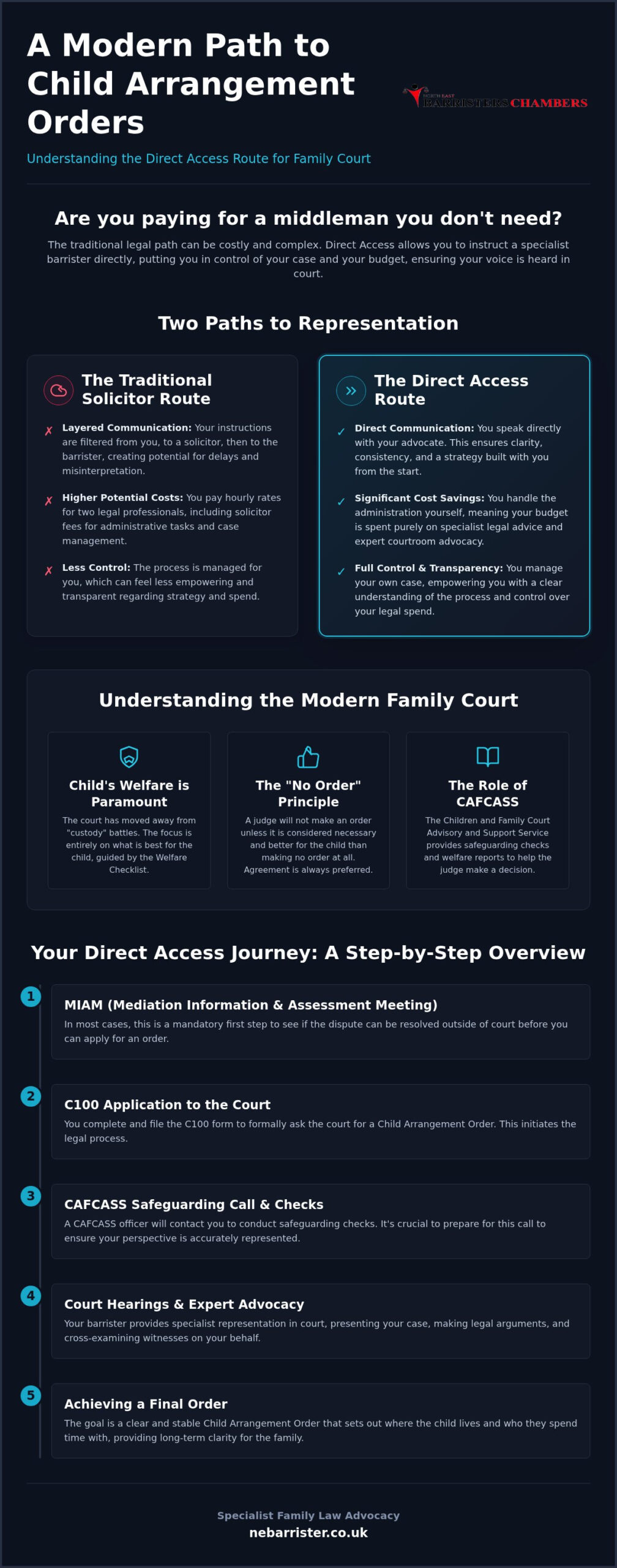
I often see parents who feel overwhelmed by the system. The Public Access Scheme, often called Direct Access, is the legal mechanism that allows you to instruct me directly. You don’t need a middleman for every step of the journey. Whilst you’ll handle the day-to-day administration, like filing papers or sending emails, I provide the specialist legal advice and advocacy in court. It’s a partnership that puts you in control of your case and your budget.
The Legal Framework of a Child Arrangement Order
The court operates on the “No Order” principle. This means a judge won’t make an order unless it’s strictly necessary for the child’s welfare. If you can agree on things outside of court, that’s always preferred. When the court does step in, it uses a “Welfare Checklist” to guide its decisions. This includes the child’s wishes, their emotional needs, and any risk of harm. In 2026, this process is often managed through the CAFCASS Pathfinder model, which gathers information earlier to protect children. The child’s welfare is always the court’s paramount consideration.
Barrister vs Solicitor: The Direct Access Difference
There’s a clear distinction between what I do as a specialist barrister and what a solicitor traditionally provides. Solicitors typically manage “litigation”. They handle the ongoing correspondence and file management. Barristers are specialists in “advocacy”. We’re the ones standing in front of the judge, presenting your case and cross-examining witnesses. I focus on the courtroom strategy and the legal arguments that will actually influence the judge’s decision.
By hiring a barrister without a solicitor, you’re cutting out a layer of communication. You speak directly to the person who will represent you in the courtroom. This doesn’t just improve clarity; it also offers significant cost-saving potential. You aren’t paying two sets of legal fees for the same case. It’s a direct, efficient way to get expert representation when you need it most.
The Benefits of Instructing a Barrister Directly for Family Matters
Instructing a child arrangement order barrister directly changes the entire dynamic of your case. I get to hear your account of the family situation without it being filtered through several layers of legal staff. This ensures that the evidence I present in court is exactly what you intended. It also removes the lag time often seen when a solicitor has to brief a barrister shortly before a hearing. I’m involved from the start, which means the strategy we build together is consistent from the first application to the final order.
You also gain immediate control over your legal spend. Traditional models often involve paying high hourly rates for administrative tasks like filing papers or basic correspondence. When you work with a child arrangement order barrister under the direct access scheme, you handle the admin yourself. This ensures every penny of your budget goes toward specialist legal expertise and courtroom advocacy. It’s an efficient way to secure high-level representation without the overheads of a full-service firm.
Specialist Advocacy in High-Conflict Disputes
High-conflict cases require a specific set of skills that barristers hone through daily courtroom experience. I bring an objective assessment to your evidence, often described as the “cold light of day” view. This helps identify which points will actually resonate with a judge and which might be counterproductive to your goals. In the heat of a courtroom, professional advocacy can de-escalate tensions. I focus the conversation on the child’s welfare, which often helps move a stuck case toward a resolution.
Transparent Fee Structures and Budget Control
I believe in financial clarity during what is already a stressful time. Most direct access work operates on a fixed-fee basis, providing much-needed certainty. You can find more detail on how these costs are structured in my guide to direct access barrister fees. This structure allows you to budget for specific milestones, such as the First Hearing Dispute Resolution Appointment (FHDRA) or a Dispute Resolution Hearing (DRA). It is a “pay as you go” model that gives you the flexibility to choose exactly when you need my support. If you want to explore how this could work for your specific circumstances, reach out for a straightforward discussion about your case.
Navigating the Family Court Process Without a Solicitor
Navigating the court process as a litigant in person can feel like learning a new language whilst under immense pressure. When you work with a child arrangement order barrister, we split the workload. You take on the role of the administrator, and I provide the legal muscle. This journey begins with the Mediation Information and Assessment Meeting (MIAM). Unless you have a valid exemption, such as evidence of domestic abuse, the court requires you to attempt mediation before filing your application. Under the 2026 procedural rules, judges are now more active in checking that parties have seriously considered alternative dispute resolution.
Once mediation is concluded, you’ll need to submit the C100 form. As of July 2026, the court fee for this application is £270. This form is your first chance to outline your “statement of case”. Following this, you’ll progress through several key stages:
- The Bundle: This is a chronological collection of all relevant documents. Judges rely on this heavily, so it must be clear, indexed, and paginated correctly.
- FHDRA: The First Hearing Dispute Resolution Appointment is where the court identifies the issues and checks if a settlement is possible.
- DRA and Final Hearing: If an agreement isn’t reached, the Dispute Resolution Appointment or a Final Hearing will follow to determine the child’s future.
Managing Paperwork and Correspondence
Organising your case files is the best way to help your barrister succeed. I recommend keeping a digital and physical folder where every email and court order is filed by date. When you’re self-representing, you’re responsible for “service”. This means you must ensure the other parent receives copies of your applications and evidence within the court’s strict deadlines. Always maintain a professional, neutral tone in your correspondence. Emotional emails to the other party or the court can be used as evidence of your behaviour, so keep your communications focused on the child’s needs.
The Barrister’s Role in Drafting Documents
While you manage the admin, I can take the lead on the most critical paperwork. A child arrangement order barrister is trained to draft Witness Statements that are legally robust and focused on the welfare checklist. For every hearing, I’ll prepare a Position Statement. This is a short document that tells the judge exactly what we want and why. If your case involves complex legal points or the new 2026 expert evidence regulations, I’ll also draft a Skeleton Argument. This ensures the judge has a clear roadmap of our legal position before we even step into the courtroom.
Managing CAFCASS and Welfare Assessments as a Direct Access Client
CAFCASS (the Children and Family Court Advisory and Support Service) acts as the eyes and ears of the judge. They are an independent body tasked with advising the court on what is truly in your child’s best interests. When you work with a child arrangement order barrister under the direct access scheme, you will interact with CAFCASS officers directly. There is no solicitor to filter these communications, so your first impression is vital. I’ll help you prepare for these interactions to ensure you remain focused on your child’s welfare rather than the conflict with the other parent.
In 2026, the court process often follows the CAFCASS Pathfinder model. This involves earlier information gathering and a more investigative approach. If the court identifies complex issues, it may order a Section 7 report. This is a detailed welfare assessment that often involves home visits and interviews with the children. Managing these visits without a solicitor requires a calm, organised approach. I use the final report to build your courtroom strategy, either by highlighting favourable recommendations or by preparing a robust challenge to any points we dispute.
The Initial Safeguarding Letter
Before your first hearing, CAFCASS conducts background checks with the police and social services to identify any immediate risks. They will then contact you for a safeguarding phone call. The officer is looking for a parent who prioritises the child’s emotional stability and safety. A common mistake is using this call to list every grievance you have against the other parent. This behaviour can make you appear focused on the conflict rather than the child. Instead, focus on the practicalities of the child’s routine and any genuine safety concerns you have.
Challenging a CAFCASS Report
If a CAFCASS recommendation does not favour your position, it is not the end of the road. Whilst judges rely heavily on these reports, they are not bound by them. As your child arrangement order barrister, I can cross-examine the CAFCASS officer during a hearing to test the logic of their recommendations. We might challenge the report if the officer has missed significant evidence or if their assessment doesn’t align with the welfare checklist. If there are serious, disputed allegations of harm, I will represent you in a “finding of fact” hearing. This is a specific trial where the judge determines the truth of the allegations before a final Child Arrangement Order is made. If you have received a report that you feel is inaccurate, contact me to discuss your representation as soon as possible.
Securing Expert Advocacy: How to Choose Your Family Law Barrister
Choosing a child arrangement order barrister is a significant decision that directly impacts your family’s future. You need a specialist who focuses on “Private Law Children” cases rather than a general practitioner. This is the area of law specifically dealing with disputes between parents about their children. I recommend checking the Bar Standards Board register to ensure your chosen advocate has the necessary “Direct Access” certification. You should also prioritise a barrister for court hearing UK representation who provides a clear, fixed-fee quote. This transparency is essential for managing your budget effectively throughout the proceedings.
Experience with specific family dynamics is equally vital. If your case involves complex issues like parental alienation or international relocation, ask about their previous work in those areas. A barrister who understands the nuance of these disputes can craft a more persuasive argument for the judge. In 2026, where the CAFCASS Pathfinder model prioritises early information gathering, having an advocate who can interpret those early signals is invaluable. This expertise ensures that your case is presented with the professional authority required to influence the court’s decision.
The Direct Access Instruction Process
The first step is usually a simple enquiry via email or a web form. When you reach out, include the date of any upcoming hearings and a brief summary of the child’s current arrangements. You can find more detail on how to direct access to a barristers chambers for a preliminary consultation in my step-by-step guide. Once we agree to work together, I’ll provide a Client Care Letter. This document acts as our contract, outlining the scope of the work, the fees involved, and what you can expect from me. It ensures there are no surprises regarding costs or service delivery.
Preparing for Your First Consultation
To make our first session productive, gather all your existing court orders and any CAFCASS reports you’ve received. Having these ready helps your child arrangement order barrister assess the case quickly. Create a clear timeline of key dates, such as when the child last saw the other parent or when specific incidents occurred. It’s also helpful to define your “ideal outcome” and your “acceptable compromise” before we speak. Remember that the barrister is your advocate, not your witness, so focus on the facts of the child’s needs rather than personal grievances. This preparation allows me to hit the ground running and focus on the legal strategy that will secure the best result for your family.
Taking Control of Your Family Court Journey
Navigating the Family Court doesn’t have to mean facing astronomical hourly rates or feeling lost in the system. By choosing the direct access route, you’re placing your case in the hands of a courtroom specialist from day one. You’ve seen how managing your own administration whilst relying on a professional for advocacy can streamline the process and focus your budget on what truly matters: your child’s welfare.
Instructing a child arrangement order barrister directly gives you the expert voice needed to navigate CAFCASS assessments and complex hearings with confidence. It’s about moving from uncertainty to clarity. If you’re ready to secure high-level representation with fixed-fee transparency, you can instruct a specialist family law barrister directly today. I provide direct access certified expertise and dedicated court representation to help you achieve a stable future for your children.
You don’t have to do this alone. With the right specialist by your side, you can approach the courtroom with a clear strategy and the reassurance that your account of the family dynamic is finally being heard.
Frequently Asked Questions
Is it cheaper to hire a barrister without a solicitor?
Yes, instructing a child arrangement order barrister directly is generally more cost-effective because you aren’t paying for two layers of legal representation. You handle the administrative tasks yourself, such as filing forms and sending emails, whilst paying the barrister a fixed fee for their specialist advice and courtroom advocacy. This model ensures your budget is spent on high-level expertise rather than the high hourly rates of a solicitor’s office for general file management.
Can a direct access barrister help with the C100 form?
I can certainly advise you on what to include and help draft the “statement of case” section to ensure it is legally focused. Whilst direct access barristers don’t usually file the C100 form for you, providing the professional wording ensures your application is robust from the start. This prevents common mistakes that can lead to delays in the Family Court, such as failing to address the welfare checklist correctly in your initial submission.
Do I have to go to court if I hire a barrister?
Not every case ends in a courtroom battle. I often assist clients in negotiating settlements through correspondence or by providing a “cold light of day” assessment that encourages a resolution before a hearing is necessary. However, if an agreement cannot be reached, my primary role is to provide expert advocacy during court proceedings. Having a specialist involved early can actually increase the chances of settling a dispute without a full trial.
Can a barrister represent me in all family court hearings?
Yes, a barrister can provide representation at every stage of the process. This includes the First Hearing Dispute Resolution Appointment (FHDRA), any interim hearings, the Dispute Resolution Appointment (DRA), and the Final Hearing. I am also available for finding of fact hearings if there are disputed allegations that require a specific trial. This continuity of representation ensures that the strategy we develop at the start of your case remains consistent throughout.
What happens if my case becomes too complex for direct access?
If a case becomes exceptionally complex or requires intensive “litigation” tasks that a barrister is prohibited from doing, I will advise you immediately. This might include situations where there is a vast amount of ongoing third-party correspondence or complex disclosure requirements. In such instances, you might choose to hire a solicitor for a limited period, but many parents find they can manage the administration themselves with my specialist guidance and courtroom support.
How do I pay a direct access barrister?
Payment is typically made via bank transfer before the work begins. Under the direct access scheme, I work on a fixed-fee basis for each specific task or hearing. This means you will know the exact cost of a consultation, a piece of drafting, or a day in court before you commit. This “pay as you go” approach provides financial transparency and helps you maintain strict control over your legal budget throughout the entire case.
Will a judge treat me differently if I don’t have a solicitor?
Judges do not treat you differently for not having a solicitor. They are very accustomed to parents representing themselves in the 2026 Family Court system. In fact, having a child arrangement order barrister can be seen as a positive step, as it ensures that the legal arguments are presented clearly and concisely. This often makes the judge’s job easier and ensures that the focus remains on the child’s best interests rather than procedural errors.
Can a barrister communicate with my ex-partner’s solicitor?
Yes, I can communicate with the other party’s legal representative regarding the hearings and any settlement offers. However, because I don’t “conduct litigation”, I don’t handle the daily back-and-forth correspondence that a solicitor traditionally manages. You remain the primary point of contact for administrative matters, but I take the lead on the professional negotiations and the legal discussions required to move your case toward a successful conclusion in the courtroom.
