
Why pay for a middleman when you could work directly with the expert who will actually stand up for you in court? For many, the traditional route of hiring a solicitor feels like an expensive necessity, yet it often leads to escalating fees and a sense of detachment from your own case. By seeking direct access to a barristers chambers, you can bypass the standard hierarchy and take control of your legal journey. I believe that professional advocacy should be accessible and transparent, rather than hidden behind layers of costly administration and confusing jargon.
I understand the anxiety that comes with managing your own litigation. It’s natural to worry about missing a deadline or failing to grasp complex court procedures. This article provides a clear, step-by-step roadmap for 2026 to help you instruct a specialist barrister directly. You will discover how to secure elite court representation whilst significantly reducing your total legal expenditure through fixed-fee structures. I will explain exactly how to manage the process, what to expect during your first consultation, and how to ensure your case is handled with the precision it deserves.
Key Takeaways
- Understand how to bypass traditional solicitor fees by instructing an expert advocate directly for your criminal, civil, or family law matter.
- Discover a clear 5-step roadmap to secure direct access to a barristers chambers, from identifying the right specialist to preparing your first brief.
- Learn to evaluate your case’s suitability for direct instruction and whether you are ready to handle the administrative duties of a litigant in person.
- Gain practical tips on organising your evidence and case timeline to ensure your barrister has everything they need for a successful court outcome.
- Explore the strategic advantages of “unbundled” legal services, allowing you to pay only for the expert advocacy and advice you actually require.
Understanding Direct Access to a Barristers Chambers: The Basics
The legal landscape in the UK has shifted significantly over the last decade. For years, the only way to speak with a barrister was through a solicitor. That barrier is gone. By seeking direct access to a barristers chambers, you’re choosing a more agile and cost-effective way to manage your legal dispute. This arrangement, formally known as the Public Access Scheme, allows individuals and businesses to instruct a barrister directly. Understanding the Public Access Scheme is the first step toward reclaiming control over your legal costs and your strategy.
I’ve seen a surge in people choosing to hire a barrister without a solicitor in 2026. The reason is simple: it puts you in the driving seat. You’re trading your own administrative time for a significantly lower legal bill. You handle the heavy lifting, such as filing forms and organising your own bundles, while your barrister focuses on high-level strategy and courtroom advocacy. It’s a strategic partnership designed for the modern litigant who wants expert results without the middleman mark-up.
Barrister vs Solicitor: Who Does What?
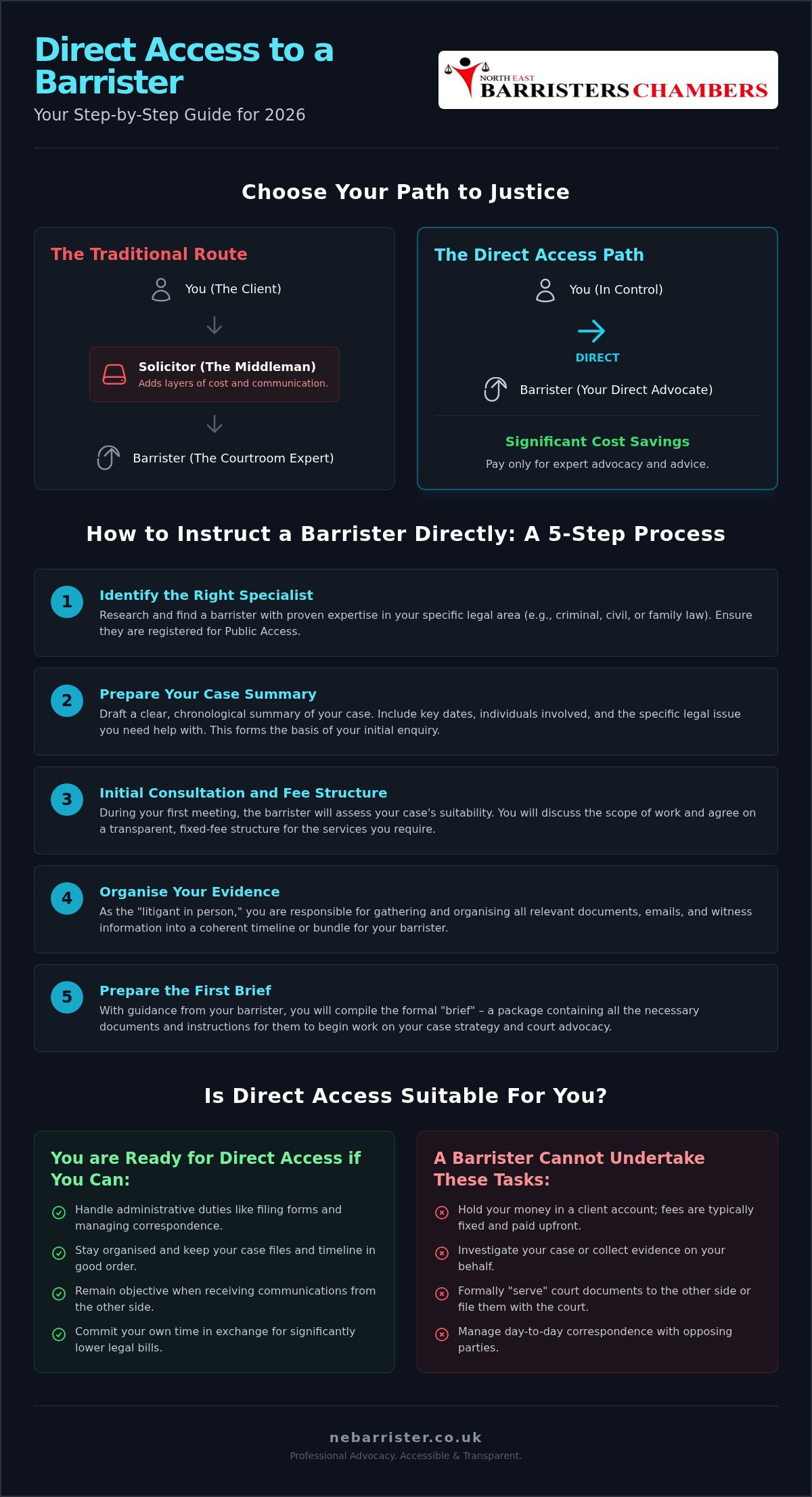
The distinction between these two roles is simple but vital. Barristers are specialist advocates. We spend our professional lives in the courtroom, mastering the art of persuasion and complex legal argument. Solicitors, on the other hand, traditionally act as the “engine room.” They manage the day-to-day correspondence and gather evidence. When you use direct access to a barristers chambers, you effectively step into the solicitor’s shoes. You become the “Litigant in Person” for administrative purposes, while I provide the specialist advice and representation you need to win your case.
The Legal Boundaries of Public Access
While this model offers immense freedom, it’s governed by strict Bar Standards Board rules. I can advise you on the merits of your case, draft your witness statements, and represent you at a final hearing. However, there are things a public access barrister cannot do. I cannot:
- Hold your money in a client account; all fees are usually fixed and paid in advance.
- Investigate or collect evidence on your behalf.
- Formally “serve” court papers to the other side or the court.
You must be prepared to manage these litigation tasks yourself. If your case becomes too complex for you to handle the admin, I’ll always be transparent and advise you if a solicitor’s involvement becomes necessary. This honesty ensures your case is never put at risk by administrative errors.
Is Your Case Suitable for Direct Instruction?
Not every legal dispute requires a full team of solicitors and paralegals. In many instances, the most effective way to resolve a conflict is to go straight to the expert who will argue your case. You can reduce UK legal costs significantly by determining if your matter is suitable for this model before you start spending. I often tell clients that while seeking direct access to a barristers chambers is a brilliant way to save money, it requires a certain level of personal commitment. It’s about clarity. You need to be organised, responsive, and prepared to handle your own case administration.
The emotional factor is equally important. When you act as your own “litigator,” you’re the one receiving the letters from the other side. This can be stressful. However, if you’re confident in your ability to remain objective and keep your files in order, the rewards are substantial. Resources like the Bar Council’s Direct Access Portal provide a helpful starting point for understanding the framework, but the real benefit comes from having a specialist barrister as your direct ally. It’s a pragmatic choice for those who value transparency and direct communication.
Family Law and Private Disputes
Family matters are particularly well-suited to this approach. Whether you’re dealing with child arrangement orders or complex financial remedy proceedings, having a barrister’s objective opinion early on is invaluable. I help clients manage the transition from mediation to court with precision. By instructing me directly, you ensure that your strategy is consistent from the first piece of advice through to the final hearing. This avoids the “lost in translation” effect that can happen when information passes through multiple layers of legal professionals. If you’re ready to take the next step, you can assess your case with a specialist to see if it’s the right fit.
Criminal Defence and Civil Litigation
In criminal and civil law, the focus is often on high-stakes advocacy. I provide direct representation in the Magistrates’ Court and Crown Court for a variety of offences. On the civil side, contract disputes, probate issues, and professional negligence claims are common areas where direct access shines. Businesses, in particular, use this route to save money on legal fees during commercial litigation. Instead of paying a solicitor’s hourly rate for case management, companies use their own internal resources for admin and hire me specifically for my courtroom expertise. It’s a modern, agile way to protect your interests without overextending your budget.
How to Instruct a Barrister Directly: A 5-Step Process
Instructing a barrister directly is a methodical process. It’s designed to ensure both parties understand the scope of work from the outset. When you seek direct access to a barristers chambers, you aren’t just hiring a lawyer; you’re entering a professional partnership. Your first task is to find a chambers with specific expertise in your area of law, whether that’s family, criminal, or civil litigation. Look for the “Public Access” accreditation on their profile. This ensures the barrister has completed the mandatory training required by the Bar Standards Board to work directly with the public.
I’ll be honest; the quality of your initial approach often dictates the speed of the response. If you provide a clear, chronological summary of your dispute, you make it easy for the chambers to assess your case. Unlike solicitor-led instructions, you should be aware of a key legal nuance called the “Cab Rank Rule” exception. While barristers usually must accept any case within their expertise, we can decline a direct access instruction if we believe the case is too complex for a client to manage without a solicitor. This isn’t a rejection of you; it’s a professional safeguard to ensure your case isn’t compromised by administrative weight.
Step 1: The Initial Enquiry to the Chambers
Your first point of contact will be the Clerk. Think of the Clerk as the business manager of the chambers. They handle my diary, negotiate fees, and match clients with the right expert. When you email, include key dates, court locations, and any upcoming deadlines. To help the Clerk assign the right expert, write a single sentence defining your legal goal. For example: “I want to secure a child arrangement order for holiday contact.” This clarity allows the Clerk to provide a quote quickly and confirm my availability for your specific court dates.
Step 2: Fees and Financial Agreements
Transparency is one of the greatest benefits of this model. You’ll typically work on a fixed-fee basis, which means you know exactly what each court hearing or advice session will cost before work begins. For drafting documents or written advice, I might provide an hourly rate, but I’ll always give you a capped estimate to help you budget effectively. Under the Public Access Scheme, payment is required in advance. This is a regulatory requirement; I cannot begin work until the fee is cleared and the Instruction Letter is signed. This letter acts as our formal contract, clearly listing what I will do and, crucially, what administrative tasks remain your responsibility. For a detailed breakdown of what to expect to pay, our guide to direct access barrister fees in the North East provides a comprehensive 2026 price reference.
Managing the Admin: Your Role as the Litigant in Person
When you choose direct access to a barristers chambers, you’re accepting a dual role. You’re the client, but you’re also the case manager. This means taking over the administrative duties that a solicitor would usually handle. I provide the strategic direction and the expert court representation, but you’re responsible for the paper trail. It’s a pragmatic trade-off. By doing the legwork yourself, you ensure your legal budget is spent on high-value advocacy rather than basic data entry.
The most important tool in your arsenal is a clear, chronological timeline. Judges and barristers love order. If your evidence is a scattered pile of emails and screenshots, your case will struggle. I always advise clients to build their file from the earliest event to the most recent. This structure allows me to find facts quickly during a hearing, which can be the difference between a successful outcome and a missed opportunity. Your goal is to make the facts as easy to digest as possible for everyone involved.
Preparing the Court Bundle
A court bundle is the master set of documents that both the judge and the advocates use during a hearing. If it’s poorly organised, the judge will be frustrated before you’ve even started. Pagination is the key here. Every single page must be numbered consecutively and indexed. In 2026, most courts require digital bundles. This means using PDF software to create a single, searchable file with electronic bookmarks. If you’re unsure how to structure this, I can provide a template to keep you on the right track and ensure your bundle meets the required standards.
Handling Court Correspondence
As a litigant in person, you must communicate directly with the court office and the other side. This requires a professional, neutral tone. Avoid emotional language in your emails to the court; keep them functional and brief. You’ll need to file documents according to strict deadlines set by court orders. If the other side serves an application, you must respond within the time limits. Most importantly, you must keep me informed. Send me every new piece of correspondence as soon as it arrives. I can’t advise you on a letter I haven’t seen. If you’re ready to start building your case file, contact my chambers today for a consultation on how to manage your specific admin requirements.
The Strategic Benefits of Direct Access to a Barristers Chambers
The primary advantage of seeking direct access to a barristers chambers is the removal of the traditional legal filter. In a solicitor-led model, every piece of advice and every strategic decision is relayed through a third party. This often leads to “Chinese whispers” where the nuance of your case is lost. By working directly with your advocate, you ensure that the person standing up for you in court has a first-hand, unfiltered understanding of your evidence and your goals. It’s about clarity. When I speak to you directly, I hear the details that a written brief might miss. This direct line of communication is the most effective way to build a robust, winning strategy.
Cost-efficiency is the other major driver. You aren’t paying for a solicitor’s office overheads or a team of paralegals to manage your file. Instead, you’re paying purely for the specialist advice and courtroom advocacy you actually require. This “unbundled” approach allows you to scale your legal spend according to the complexity of the hearing. There is a profound sense of relief that comes from instructing a barrister for court hearing UK proceedings directly and knowing your costs are fixed and transparent. You’re no longer at the mercy of unpredictable hourly rates that can spiral out of control during a long-running dispute. If you want to understand exactly how those fixed costs are structured, our direct access barrister fees north east price guide sets out the full picture for 2026.
Accessing Specialist Expertise
Direct access has democratised the legal profession. In the past, only large corporations or high-net-worth individuals could easily access the elite expertise of the Bar. Today, the modern Bar is agile and accessible. I use video consultations and remote hearings to provide national coverage, meaning you can hire a specialist regardless of where your court is located. This flexibility allows you to tailor your legal strategy to your specific budget. You get the same level of advocacy as a corporate giant, but on your own terms. It’s a pragmatic solution for the 2026 legal market.
Taking the Next Step
If you’re currently feeling overwhelmed by solicitor fees or frustrated by a lack of progress, transitioning to direct access is a strategic move. It requires you to be organised, as we discussed in the previous section on administration, but the trade-off is a faster, more responsive legal service. Decisions are made quickly because you’re talking directly to the expert who will be arguing the case. Choosing a chambers with a national reputation for advocacy ensures your case is handled with the highest level of professionalism and care. Enquire about direct access to our barristers chambers today to discover how we can help you secure the best possible outcome for your case.
Take Control of Your Legal Strategy in 2026
Choosing direct access to a barristers chambers is a decisive step toward resolving your legal dispute with clarity and confidence. By taking on the administrative role yourself, you unlock the ability to work directly with a specialist advocate without the unnecessary layer of solicitor fees. You’ve learned that success in this model relies on being organised, maintaining a clear timeline, and understanding the boundaries of the Public Access Scheme. This modern approach ensures your budget is spent where it matters most: on the expert advice and courtroom representation that will actually influence your outcome.
I provide expert advocacy in criminal, civil, and family law for individuals and businesses across the UK. My practice is built on transparent, fixed-fee structures that provide financial certainty from day one. You don’t have to face the court system alone or settle for fragmented legal advice. If you’re ready to secure elite representation on your own terms, you can instruct an expert barrister directly today. I’m here to act as your direct ally and guide you through every stage of the legal process. Let’s work together to achieve the successful outcome you deserve.
Frequently Asked Questions
Is it really cheaper to instruct a barrister directly than to use a solicitor?
Yes, instructing a barrister directly is almost always more cost-effective because you eliminate the solicitor’s hourly management fees. By taking on the administrative work yourself, you ensure your budget is spent purely on specialist legal expertise. This unbundled approach allows you to pay for a single hearing or a specific piece of advice rather than a full-service package that includes significant office overheads.
Can I instruct a barrister directly for a family law or divorce case?
You can certainly instruct a barrister for family law matters, including divorce and child arrangement orders. Seeking direct access to a barristers chambers is a popular choice for private family disputes where a clear, objective opinion is needed. I provide specialist representation for financial remedy proceedings and contested hearings, ensuring you have expert advocacy without the layers of communication typical in traditional cases.
What happens if my direct access case becomes too complicated for me to manage?
I will tell you immediately if a case becomes too complex for the direct access model. If the administrative weight or the legal intricacies exceed what a litigant in person can safely manage, I have a professional duty to recommend that you involve a solicitor. This ensures your interests are never compromised. In such scenarios, I can often continue to act as your advocate whilst a solicitor handles the litigation.
Do I have to pay for a barrister’s services in advance?
Yes, payment in advance is a mandatory requirement under the Bar Standards Board rules for all public access work. I cannot begin work on your case or attend a court hearing until the agreed fee has been cleared. This structure provides transparency for both parties, as it ensures all costs are fixed and agreed upon before any legal work is undertaken, preventing unexpected bills at the end of your case.
Can a direct access barrister represent me in any court across the UK?
I can represent you in any court across England and Wales. While my chambers is based in the North East, the modern Bar is highly mobile. I regularly travel to various jurisdictions to provide expert advocacy in criminal, civil, and family courts. Whether your hearing is in a local Magistrates’ Court or the High Court in London, direct access to a barristers chambers provides you with national reach.
Will I be expected to speak in court if I hire a barrister directly?
No, you will not be expected to argue your case once you have hired a barrister for court hearing UK proceedings. My primary role is to act as your voice in the courtroom, presenting your evidence and making legal submissions to the judge. Whilst you remain the point of contact for the court’s administration, I handle the actual advocacy. You will only need to speak if you are called as a witness to give evidence.
How do I check if a barrister is authorised for public access work?
You should check the Bar Standards Board (BSB) Barristers’ Register to verify a practitioner’s status. Every barrister authorised to accept direct instructions must be registered and have completed specific training. The register will confirm if they hold a current practising certificate and whether they have any disciplinary findings. This step is essential for your peace of mind and ensures you are working with a regulated professional.
Can I still get Legal Aid if I choose the direct access route?
No, you cannot obtain Legal Aid if you choose to instruct a barrister through the direct access scheme. This route is designed for private paying clients who wish to manage their own litigation to save on solicitor costs. If you believe you are eligible for public funding, you must contact a solicitor who is authorised to provide Legal Aid services. I always recommend checking your eligibility before committing to a private fee arrangement.
One Response