
Why pay for two layers of legal representation when one specialist advocate can handle your case from start to finish? For years, the UK’s split legal profession has left many people feeling confused and overcharged, leading to the common question: can I hire a barrister directly? The answer is a resounding yes, and it is more straightforward than you might think.
I understand the frustration of feeling disconnected from the person actually arguing your case in court. You want clarity, direct communication, and a way to reduce mounting legal fees whilst maintaining high-quality advocacy. The Public Access scheme, regulated by the Bar Standards Board, was designed to provide exactly that. It empowers you to instruct an expert barrister for criminal, civil, or family law matters without the traditional requirement of hiring a solicitor first.
In this 2026 guide, I will explain how you can use the Direct Access scheme to your advantage. You will discover how to save time and money, learn which specific cases are suitable for this route, and see how a direct partnership with an experienced barrister provides the transparency and results you deserve.
Key Takeaways
- Learn how the Public Access scheme works and get a definitive answer to the question, “can I hire a barrister directly” for your specific legal needs.
- Understand the differences between a barrister’s specialist advocacy and a solicitor’s case management to choose the most effective representation for your case.
- Identify whether your matter, particularly in family or criminal law, is suitable for direct instruction to help you streamline the legal process.
- Follow my straightforward process for engagement, from the initial conflict check through to the final suitability assessment and courtroom representation.
- Discover how the direct access model can lower your overall legal costs by providing transparent fees and removing the need for two layers of representation.
Can I Hire a Barrister Directly? Understanding the Public Access Scheme
The short answer is yes. Since 2004, the Public Access Scheme has legalised direct instruction. This means you no longer have to follow the old, expensive route of hiring a solicitor just to speak with a barrister. I’ve seen how this change has transformed the legal experience for individuals and businesses alike. It effectively broke the traditional monopoly that solicitors held over barrister access; it opened the door for a more transparent, efficient way of working.
The Bar Standards Board (BSB) regulates this scheme strictly to ensure consumer protection. Not every barrister can do this. We must undergo specific training and meet rigorous standards to accept instructions from the public. Today, thousands of barristers are qualified to work directly with you. This ensures you receive expert advocacy whilst knowing your interests are protected by a professional code of conduct. It’s a modern solution designed for a world that values clarity and directness.
The Origins of Direct Public Access
The rules changed to improve access to justice across England and Wales. Before 2004, the “split profession” meant the public was often disconnected from the specialists actually arguing their cases. The BSB stepped in to certify barristers for this work, ensuring we could manage client relationships safely and effectively. In 2026, the legal landscape has evolved to favour the client. You now have the power to choose the most efficient path for your case. I find that this approach removes the intimidation often associated with the law and replaces it with a straightforward, service-oriented mindset.
Direct Access vs. Traditional Instruction
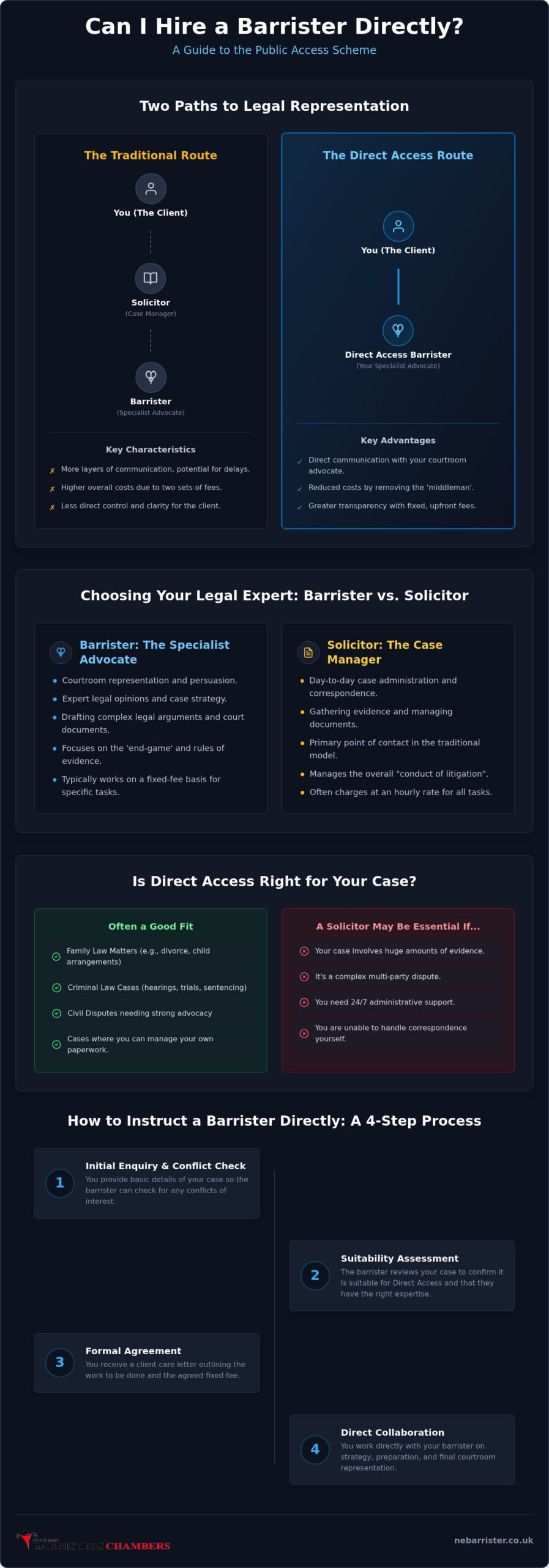
The traditional Solicitor-Barrister-Client triangle often creates friction. In that model, you provide information to a solicitor, who then briefs the barrister. It’s a three-way conversation where details can sometimes be diluted. When you ask, “can I hire a barrister directly?” you are essentially asking to remove the middleman. By doing so, the flow of information becomes a direct line between you and me. This agile structure is why direct access is becoming the preferred choice for savvy litigants. You stay in the loop, costs remain manageable, and the strategy is clear from day one. I believe this direct connection builds a stronger foundation for your representation in court.
Barrister vs Solicitor: Who Do You Really Need for Your Case?
The UK legal system is unique because it splits the profession into two distinct roles. Solicitors generally act as case managers. They handle the day-to-day administration, gather evidence, and manage the paper trail. I, as a barrister, am a specialist advocate. My focus is on the courtroom, the rules of evidence, and the art of persuasion. When people ask, “can I hire a barrister directly?” they are often looking for that specific courtroom-first perspective without the added cost of a case manager.
Fee structures also differ significantly between the two. Solicitors often charge hourly rates for every phone call, letter, and administrative task. This can lead to unpredictable costs. In contrast, direct access barristers frequently work on a fixed-fee basis for specific pieces of work. Whether it is a written advice on your chances of success, drafting a formal court document, or representing you at a hearing, you know exactly what you are paying upfront. This transparency provides a sense of relief in what is often a stressful time.
The Specialist Advocate’s Role
I focus on the “end-game” of your case from the very first day. Because I spend my time in court, I know how judges think and what evidence actually carries weight. This independent view allows me to provide an objective assessment of your case, even if it’s not what you were hoping to hear. There is also a massive benefit to continuity. When you hire me directly, the person who drafts your legal arguments is the same person who stands up to deliver them in court. Nothing gets lost in translation between a solicitor’s brief and a barrister’s performance.
When a Solicitor is Still Essential
Direct access isn’t a universal fix. Some cases involve a heavy “conduct of litigation,” which means managing vast amounts of evidence or dealing with complex multi-party disputes. If your case requires constant administrative support or 24/7 document management, a solicitor’s involvement is still essential. I will always tell you honestly if your case is “Direct Access ready” or if your interests are better served by a traditional legal team. If you are unsure which path to take, I can help you assess your situation to find the most cost-effective solution for your specific needs.
By understanding these roles, you can make an informed decision. You don’t always need a full team to get high-quality results; sometimes, a direct line to an expert advocate is the most powerful tool you have.
When Direct Access is the Right Choice: Suitability Criteria
The answer to the question “can I hire a barrister directly” is a clear yes, but the real decision rests on whether your case is suitable for this route. Direct access works best when the legal issues are well-defined and the administrative burden is manageable. I find that clients who are organised, proactive, and capable of handling their own paperwork often see the greatest benefits. You essentially take on some of the tasks a solicitor would usually perform, such as gathering your own evidence and managing your own files. It’s a partnership that requires you to be the primary point of contact for the court.
Family and Civil Law Suitability
Many family law matters, including divorce settlements and financial remedies, are perfectly suited for direct instruction. Child arrangement orders are another area where having a direct line to your advocate can provide clarity and reduce tension. In civil law, I often handle contract disputes, probate issues, and professional negligence claims directly. These cases thrive under direct access when there’s a clear timeline of events. If the core dispute is about legal interpretation or courtroom advocacy rather than a massive disclosure exercise involving thousands of documents, you’re likely a good candidate for this scheme.
Criminal Defence and Direct Access
If you’re facing criminal law court representation, direct access can be a highly effective tool. This is particularly true for driving offences or minor charges in the Magistrates’ Court where you want an expert to protect your licence or reputation. I also represent clients in more serious Crown Court matters through the Public Access scheme. However, it’s important to understand the limitations. I cannot represent you at a police station during an initial arrest; that stage almost always requires a solicitor. Once the case moves toward a court hearing, the direct access model allows for a focused and agile defence strategy. If you want to understand how a barrister for court hearing UK proceedings can protect your interests from the outset, my dedicated guide covers the full scope of expert advocacy available to you.
You must also consider your own temperament. Are you organised enough to handle your own correspondence? Whilst I provide the legal strategy and advocacy, you’ll be responsible for receiving court orders and ensuring deadlines are met unless I have a specific extension to conduct litigation. If you feel overwhelmed by the thought of managing your own case files, the traditional solicitor-led route might be a better fit. My goal is to ensure you have the right level of support, not just the lowest cost. I’ll always tell you honestly if I believe your case requires the extra layer of a solicitor.
How to Instruct a Barrister Directly: A Step-by-Step Guide
Instructing me directly is a logical, step-by-step process designed for efficiency. Many people start by asking, “can I hire a barrister directly” because they want to avoid the administrative hurdles and extra costs of a traditional law firm. The first step is always an initial enquiry followed by a conflict check. This ensures I have no professional ties to other parties in your case. Once cleared, I conduct a suitability assessment. If I believe you need a solicitor, I will tell you immediately. My priority is your best interest, not just taking on a case.
After confirming suitability, we agree on a fixed fee. You then sign a Client Care Letter, which serves as our formal contract. Once this is in place, you begin preparing your “bundle”—the collection of documents I need to review. This leads to our first consultation and, ultimately, your court representation. This method keeps you in control of the timeline and the budget from start to finish. For a detailed walkthrough of each stage, my guide on direct access to a barristers chambers covers every step of the process in full. It’s a modern way of working that prioritises results over red tape.
Preparing Your Case for Review
To get the most value from our time, you should organise your documents chronologically. Provide a clear “instruction” summary that outlines the facts, the current status of the case, and what you hope to achieve. In your initial email, include the court hearing date and a brief list of the main parties involved. This helps me provide a fast, accurate response. I find that clients who take the time to tidy their paperwork at the start often have the most successful outcomes.
The Client Care Letter Explained
This document is your protection and our roadmap. It clearly defines the “Terms of Work,” outlining exactly what I will do and what is excluded from the fee. It’s a transparent way to work that removes the fear of hidden costs. You can reduce UK legal costs significantly by being prepared before we sign this agreement. Being organised means I spend less time sorting through paperwork and more time building your legal strategy. It’s about working smarter to protect your interests.
If you are ready to move forward with your case, you can contact me today to start your enquiry and see if direct access is right for you.
The Financial Reality: Is a Barrister Cheaper Than a Solicitor?
People often hesitate because they believe legal costs are additive. The assumption is that a barrister is an expensive “extra” on top of a solicitor’s bill. This is the “double-fee” myth. In reality, when you ask can I hire a barrister directly, you’re usually looking at a way to consolidate your spending. By instructing one specialist advocate rather than a team of generalists, you’re paying for specific expertise rather than a high-street firm’s overheads. It’s about paying for the result you need, not the administrative hours you don’t.
You save money by taking on the administrative legwork yourself. Whilst a solicitor might charge you for every minute spent filing a document or making a phone call, the direct access model puts that responsibility in your hands. This doesn’t just cut costs; it keeps you intimately involved in every detail of your case. Early advice from a barrister can also prevent expensive mistakes. I’ve seen many cases where a single hour of expert consultation saved thousands in wasted court fees later down the line. It’s a strategic investment in your outcome.
Fixed Fees vs. Hourly Rates
Most direct access work is performed on a fixed-fee basis. This provides a level of financial peace of mind that traditional hourly billing simply cannot match. You’ll know the cost of a specific hearing or a written advice before I even open your file. This transparency allows you to budget for your legal case throughout 2026 without the fear of “hidden costs” appearing on a monthly invoice. It’s a straightforward, business-like approach to litigation that avoids the friction of unpredictable billing.
Value Beyond the Price Tag
The value of this model extends beyond the invoice. Direct communication is inherently more efficient. You don’t have to wait for a solicitor to relay a message or interpret my advice. You get the information straight from the source. This agility often leads to better settlements; an elite advocate who understands the nuances of your case can often negotiate a resolution far more effectively than a generalist. I believe that direct access barrister services represent the future of the UK legal profession. It’s a model that rewards preparation, values transparency, and puts the client’s needs first.
Secure Expert Advocacy for Your Case
The legal landscape in 2026 offers more flexibility than ever before. By choosing the Public Access route, you take control of your legal journey. You now understand how removing the middleman reduces costs and ensures that your strategy is handled by the specialist who will actually stand up in court. Whether you’re managing a complex family matter, a civil dispute, or a criminal charge, the answer to can I hire a barrister directly is a clear path toward efficient, transparent justice.
I provide specialist advocacy in Criminal, Civil, and Family law with transparent fixed-fee options that remove the guesswork from your budget. My focus is on providing expert representation across all UK courts whilst remaining accessible and straightforward. You don’t have to navigate this complex field alone or overpay for layers of service you don’t need. If you’re ready to move forward with a modern, agile approach to your legal needs, I am here to help.
Instruct a specialist barrister directly today and gain the clarity you deserve.
Frequently Asked Questions
Can a barrister do everything a solicitor does?
No, there are still distinct differences in our roles. Whilst I can provide specialist advice and courtroom representation, I cannot hold client money or manage the general administrative “conduct of litigation” unless I have a specific extension to my practising certificate. Solicitors typically handle the day-to-day management of a case, such as gathering initial evidence and dealing with constant correspondence from the opposing side.
What happens if my case becomes too complex for direct access?
I have a professional duty to assess the suitability of your case continuously. If the matter becomes too complex or the administrative burden grows too large for you to manage, I will tell you honestly. In these situations, I will advise you to instruct a solicitor. You can still retain me as your advocate, but the solicitor will take over the logistical management of the case to protect your interests.
Do I have to pay my barrister in advance?
Yes, payment is required before I begin work on your case. This is a regulatory requirement because barristers cannot hold client money in a “client account” in the same way solicitors do. Once we agree on a fixed fee for a specific task, such as a consultation or a hearing, the fee is paid to my chambers. This ensures complete transparency and avoids any unexpected bills at the end of the process.
Will I get legal aid if I hire a barrister directly?
No, the direct access scheme is only available for privately funded cases. If you believe you are eligible for legal aid, you must consult a solicitor who holds a legal aid contract. I cannot assess your eligibility for public funding or accept legal aid instructions directly from you. If you go direct, you are responsible for covering all legal fees yourself.
Can a barrister represent me in any court in the UK?
Yes, I have “rights of audience” in every court and tribunal across England and Wales. Many clients ask, “can I hire a barrister directly” for local matters, but my services are national. Whether your hearing is in a local Magistrates’ Court or the High Court in London, I am qualified to stand up and argue your case on your behalf.
What should I do if I have already hired a solicitor but want to go direct?
You are entitled to change your legal representation at any point in your case. You should first settle any outstanding invoices with your current solicitor and request your full case file. Once you have possession of your documents, you can contact me for a suitability assessment. I can then review your file and determine if we can proceed on a direct access basis.
Is there a register to check if my barrister is qualified for direct access?
Yes, the Bar Standards Board maintains a public register of all practising barristers in England and Wales. This Barristers’ Register confirms whether a professional is “Public Access registered.” It is an essential tool for consumer protection; it allows you to verify that I have completed the mandatory training required to accept instructions directly from the public.
Can a barrister help me with the paperwork and filing court documents?
I can draft all your formal court documents, but you are usually responsible for the physical filing and service. Unless I am specifically authorised to conduct litigation, I cannot file documents at court or serve them on the other party for you. I provide the expert legal content and strategy, whilst you handle the administrative task of sending the documents to the court.