
Worried you’ll be caught off guard, lose your train of thought or give an answer that’s taken the wrong way? Knowing the cross-examination questions to expect can help you feel more prepared, but there is no fixed script. Questions depend on your case and the evidence, so memorising answers may leave you less ready for what is actually asked.
It’s understandable to feel nervous about being questioned. Cross-examination can be challenging, but you can prepare by learning how it works and practising how to listen carefully and answer truthfully and clearly. A moment of uncertainty does not automatically mean your evidence will be damaged.
This guide explains common question styles, what to do if you don’t understand a question and practical ways to stay focused without rehearsing set lines. It also outlines how questioning can differ in criminal, civil and family cases, and why procedures vary across the UK. A barrister can help you understand the evidence and process, prepare for questioning or represent you in court.
Key Takeaways
- Use examples of cross-examination questions to expect to recognise why a question is being asked, not to predict your exact hearing.
- Review the evidence and note anything you’re unsure about, so you can focus preparation on the issues that matter.
- Listen to each question, ask for clarification if needed and answer truthfully in your own words.
- Criminal, civil and family proceedings can involve different issues and safeguards, and the process also depends on the UK jurisdiction.
- A barrister can help you understand the evidence, prepare for court and provide representation without coaching you to give a particular account.
What is cross-examination and why might you be questioned?
Cross-examination takes place after a witness has given their initial evidence. The other party, or their barrister or other representative, asks questions about that evidence. The aim is to test what the witness remembers, clarify points in dispute and examine the basis and reliability of their account. Cross-examination is questioning by another party to test and clarify evidence, not proof by itself that a witness is dishonest.
The evidence given first is commonly called evidence-in-chief. It is usually led by the party who called the witness and may involve questions that allow them to explain what they saw, heard or did. Cross-examination follows, giving the other side an opportunity to explore the account from a different perspective. The broad purpose is outlined in Cross-examination in law, although court procedures and terminology can vary.
If you’re trying to understand the cross-examination questions to expect, remember that they are shaped by the evidence and issues in your case. There is no standard set of questions that applies to everyone. A question may be direct or challenging without being an accusation of lying.
Who may be cross-examined in court?
Witnesses may be questioned by another party after giving evidence. In civil or family proceedings, a party who gives evidence may also be questioned by the other side. In a criminal case, a defendant’s position is different from that of an ordinary witness. Whether they give evidence, and how questioning is handled, depends on the case and applicable rules. Not everyone involved in court proceedings will be cross-examined. The court, the evidence and the circumstances all matter.
There can also be limits or adjustments to how questioning takes place. Rules and arrangements vary across England and Wales, Scotland and Northern Ireland, and may depend on the type of case and the people involved. Being a party or witness does not, on its own, mean you will be questioned by the opposing side.
What is the questioner trying to establish?
A questioner may ask you to recall events in more detail, explain how you know something or respond to a difference between your account and another piece of evidence. For example, if a written statement gives one date but you remember a different date, you may be asked about the discrepancy and how confident you are in your recollection. The purpose is to examine the evidence, not to make you guess or fill gaps.
Questions may also test whether an account is consistent with documents, other testimony or something said earlier. A challenge can feel uncomfortable, especially if the question is put firmly. But a disagreement or inconsistency does not automatically show that anyone has lied or acted improperly. The court considers the evidence as a whole. Cross-examination is one part of that process and does not decide the case by itself.
Understanding this purpose can help you listen to the question rather than assume what the questioner thinks of you. The relevant procedure depends on the court, jurisdiction and circumstances, so do not assume questioning works the same way in every case.
What cross-examination questions should you expect?
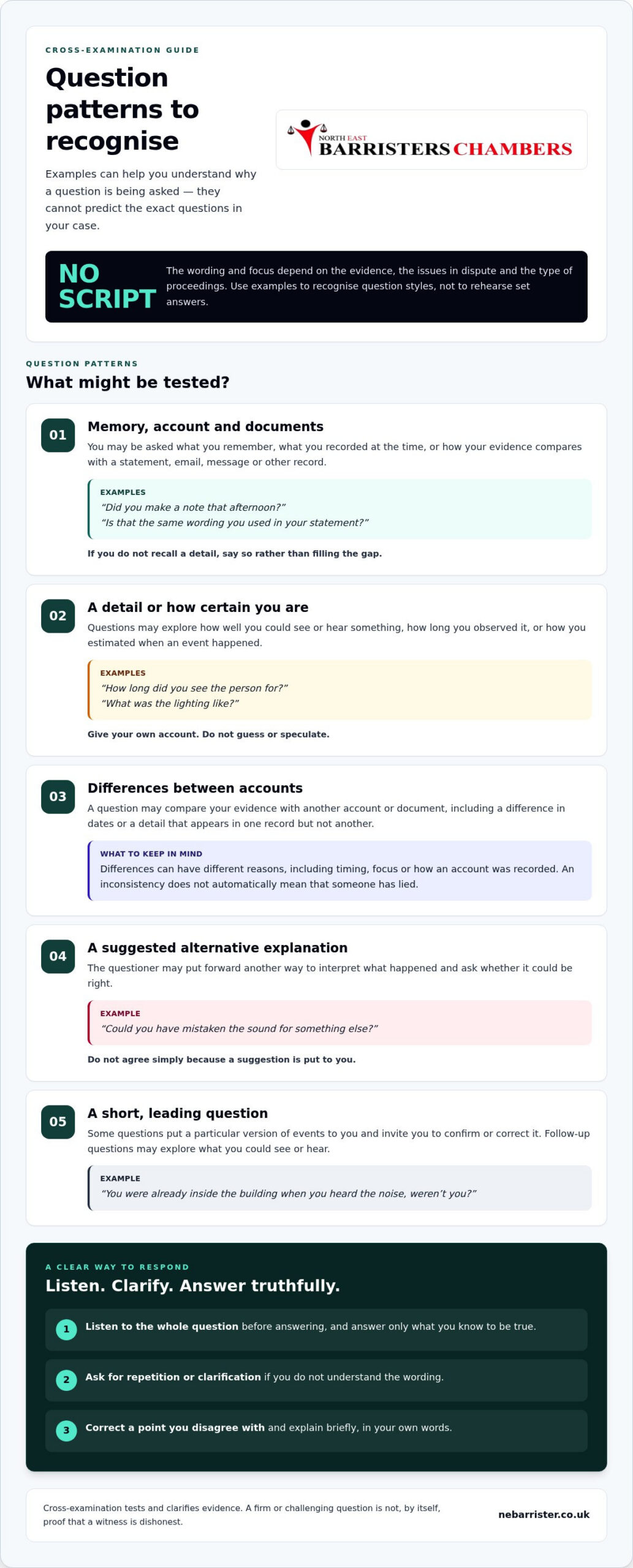
There is no general list that can predict the exact questions in an individual case. The wording and focus depend on the evidence, the issues in dispute and the type of proceedings. Examples can help you recognise the purpose of a question, but they are not a forecast or a script to learn.
Some questions are short and leading. They may put a particular version of events to you and invite confirmation or correction, such as, “You were already inside the building when you heard the noise, weren’t you?” The questioner may then ask follow-up questions about what you could see or hear. Listen to the whole question and answer only what you know to be true.
Questions about your memory, account and documents
Questions may ask what you remember, what you recorded at the time or how you reached a particular conclusion. For example, you could be asked, “Did you make a note that afternoon?” or, “Is that the same wording you used in your statement?” If a document is put to you, you may be asked to read or comment on a specific passage. You do not have to remember every detail. If you don’t recall something, say so rather than trying to fill the gap.
A question may compare your evidence in court with a written statement, email, message or other record. The questioner might ask why one account mentions a detail that another does not. There can be different reasons for a difference, including timing, focus or the way an account was recorded. Address any discrepancy honestly, but remember it does not automatically mean that someone has lied.
Questions that challenge a detail or suggest another explanation
Some questions test how certain you are about a detail. For instance, you might be asked, “How long did you see the person for?” or, “What was the lighting like?” If accounts differ about when an event happened, you could be asked how you arrived at your estimate. The question may also suggest another explanation: “Could you have mistaken the sound for something else?” Your task is to give your own account, not to agree simply because a suggestion is put to you.
Questions may be framed firmly or ask you to accept a proposition before you have had a chance to explain. If you don’t understand the wording, ask for it to be repeated or clarified. If a question contains something you disagree with, say so and explain briefly. Don’t guess, speculate or adopt an inaccurate answer. A calm, truthful correction is more useful than trying to anticipate what the questioner wants to hear.
Where the evidence raises complex issues, direct-access barrister advice can help you understand the material and the questions it could raise, without rehearsing a fixed account.
How cross-examination can differ between criminal, civil and family cases
The questions put to you depend on what the court needs to decide and your role in the case. A witness may be asked about what they observed, while a party giving evidence may also be questioned about their own position or documents. The examples below are illustrative, not a complete account of court procedure.
| Type of case | Issues questions may explore |
|---|---|
| Criminal | What a witness saw or heard, differences between accounts, and evidence supporting either the prosecution or defence case. |
| Civil | Disputed events, communications, records, and the facts relevant to the claim or response. |
| Family | Evidence relevant to the family issue before the court, which may include arrangements for a child or financial matters. |
This comparison is only a guide. Procedure depends on the relevant court, jurisdiction, evidence and circumstances. Rules can differ across England and Wales, Scotland and Northern Ireland, and cases within the same broad category may raise different issues; for those seeking context on criminal defence in other legal systems, specialist practices such as abogadopenalexperto.cl illustrate how courtroom defence and procedural safeguards are handled internationally. The cross-examination questions to expect in your case cannot be determined by its label alone.
Cross-examination in criminal proceedings
In a criminal case, questions may test the prosecution’s evidence or examine evidence relied on by the defence. A witness may be asked about their opportunity to observe an event, their recollection or how their account fits with other evidence. A defendant is not simply in the same position as a witness. Whether they give evidence and the arrangements for questioning depend on the case and applicable rules. Some cases also involve protections or limits on questioning, so it is unsafe to assume that every witness will be questioned in the same way. For further context on criminal proceedings and advocacy, see this guide to criminal law court representation.
Cross-examination in civil and family proceedings
In civil proceedings, questions may focus on the facts behind a claim or response. For example, a witness might be asked about the timing of an exchange of messages, or a party about a document said to support their account. In family proceedings, questioning relates to the specific issue the court must decide. That could concern disputed family arrangements or, in a financial case, information and documents relevant to the parties’ finances. Where financial evidence is central, this guide to financial remedy proceedings provides related context.
Family and civil cases can also involve restrictions or adjustments to questioning, depending on the circumstances and applicable rules. The fact that a question is permitted or put firmly does not mean the court has already decided the point. It is part of examining the evidence the court must consider. In cases where proceedings touch upon complex debt or financial restructuring, legal resources from practices like the Law Offices of Matthew T. Desrochers, P.C. illustrate how formal debt relief and resolution options are handled.
How to prepare for cross-examination and answer questions clearly
Good preparation means becoming familiar with the evidence and understanding the process, not learning lines to repeat. The cross-examination questions to expect depend on your case, so no rehearsal can guarantee you will know what comes next. A steady approach can help you respond accurately, even if a question surprises you.
Work through these practical steps before the hearing:
- Review the relevant material. Read your statement and any documents you may be asked about. If you have a legal representative, discuss the evidence with them and ask about anything you’re unsure of.
- Note uncertainties honestly. Mark details you don’t remember clearly or where a document differs from your recollection. Don’t try to resolve a genuine gap by guessing.
- Clarify the procedure. Make sure you understand when and where you need to attend, what will happen when you give evidence and who to speak to if you need help.
- Plan the practical details. Arrange your journey, allow time to arrive and consider any communication or access needs that could affect your participation.
Review your evidence without rehearsing a script
Reading your statement and relevant records can refresh your memory and help you identify topics that may need explaining. If you have an authorised legal adviser, discuss the material with them. Preparation should make you familiar with what the evidence says, not create certainty where you are unsure. If you can’t recall a detail, note that rather than inventing an answer or trying to memorise wording.
Keep a clear distinction between what you remember personally and what you know from a document or someone else. If you notice an apparent difference between your account and a record, raise it with your representative so you can understand the issue. The aim is to be ready to explain your genuine evidence, not to alter it to make it sound more polished.
What to do when a question feels difficult
Listen to the whole question before answering. Take a moment to think, then respond truthfully in your own words. If you haven’t understood, ask for the question to be repeated or put another way. If it contains an assumption you disagree with, say so clearly. You don’t need to guess or speculate to fill a pause.
Answer the question asked and avoid adding details you’re not sure about. If you need to explain your answer, do so briefly and accurately. If you feel distressed, have a communication need or are concerned about how questioning will be arranged, tell your representative as early as possible. They can advise you about the process and relevant options for your circumstances.
The safest core approach is to listen carefully, take a moment and answer truthfully. A barrister can help you understand the evidence and prepare for court without coaching you to give a particular account. Arrange barrister advice to discuss preparation or representation for your case.
When a barrister can help you prepare for cross-examination
General guidance can explain how questioning works, but it cannot assess the evidence in your case. A barrister can review relevant statements and documents, identify points that could be challenged and explain how the hearing is likely to deal with them. This can help you understand the issues without trying to predict every question or memorise a set of answers.
Preparation is not coaching. A barrister can help you become familiar with the process and your evidence, but should not tell you to give a particular account or shape your evidence to suit a case. Your answers must remain truthful and in your own words. If you’re a witness rather than a party, the advice and representation available will depend on your role and the circumstances.
What case-specific advice can add
A barrister can examine how the evidence fits together and explain which points may matter at the hearing. For example, they may help you understand why a document is relevant, where accounts differ or what issue the court needs to decide. They can also talk through the hearing process so you know what to expect procedurally. Advice should be based on your case, not a generic list of cross-examination questions to expect.
No barrister can guarantee the exact questions another party will ask or the result of a case. The purpose of preparation is to understand the evidence, identify areas of uncertainty and approach the hearing with a clearer grasp of what may happen. It is not to remove every surprise or make a difficult hearing effortless.
Deciding whether to seek representation
Consider how complex the issues are, how serious the possible consequences may be and how confident you feel managing the hearing. You may want help understanding legal arguments, dealing with documents or presenting your case. The right level of support depends on your role, the case and applicable procedural requirements. A barrister can advise or represent you, depending on what is appropriate.
Direct access can allow you to instruct a barrister without first instructing a solicitor, where appropriate. A barrister can discuss the evidence and the support relevant to your circumstances. If you need representation, the arrangements will depend on the requirements of your case and court. This gives you the option of advice focused on your matter, alongside general information.
If you’re unsure what preparation or advocacy would be useful, explore direct-access barrister services and discuss the needs of your case. Clear advice can help you understand the process and prepare responsibly, without promising a particular outcome.
Take your next step with a clearer plan
You don’t need to predict every question before deciding what support may help. Start by considering what would better equip you for the hearing: a clearer understanding of the issues, advice about the evidence or representation in court. The right next step depends on your role and the circumstances of your case.
You can discuss your situation with a barrister and consider what kind of help may be appropriate. Our chambers provides direct-access advice and court representation in criminal, civil and family matters for individuals and businesses across the UK. You do not need to arrive with polished answers. An initial discussion can focus on your concerns and the practical questions you want to resolve.
Use what you’ve learnt about the cross-examination questions to expect as a starting point, not a script. Explore direct-access barrister advice and representation to discuss support for your case.
Frequently Asked Questions
Will I know the cross-examination questions before the hearing?
Usually, you shouldn’t expect to receive a complete list of questions in advance. You may know the issues in dispute and have seen relevant statements or documents, which can indicate the topics the other side may explore. But the exact questions depend on how the evidence is presented and what arises during the hearing. Reviewing the case material can help you understand the context, but it cannot provide a reliable script.
Can cross-examination questions be leading questions?
Yes, a question may suggest the answer the questioner is testing, such as, “You didn’t see who entered the room, did you?” Whether and how questions may be put can depend on the proceeding, the witness and the applicable rules. If a leading question does not reflect your recollection, don’t agree just to move on. Give an accurate response, and explain briefly if the question’s premise is wrong or incomplete.
Can I ask for a question to be repeated during cross-examination?
Yes. If you didn’t hear or understand a question, tell the court and ask for it to be repeated or clarified. This is especially useful if a question has several parts, refers to an unfamiliar document or uses a term you don’t understand. Don’t answer a different question because you feel under pressure to respond quickly. The court can manage the questioning, and your representative can raise an issue if clarification is needed.
What happens if I cannot remember an answer in cross-examination?
Say that you can’t remember. Don’t guess at a date, sequence or detail simply because you think an answer is expected. If you remember part of an event but not all of it, make that distinction clear. Explain what you do recall and where your memory stops. An honest answer about the limits of your recollection is more accurate than presenting an estimate as certain.
Can a witness be asked about an earlier statement or document?
Yes, a witness may be asked about a previous statement or a document relevant to their evidence. The question might ask whether they recognise it, whether they made or received it, or how a passage compares with what they now recall. If you’re shown a document, take time to identify the part being discussed. Don’t assume you must agree with the questioner’s interpretation. Explain what you genuinely know about it.
Can I have a barrister represent me during cross-examination?
A barrister may represent a party in court, but the arrangements depend on your role and the case. If you’re a witness, that does not necessarily mean you’ll have your own barrister questioning or advising you during another party’s cross-examination. If you’re a party, a barrister may advise or represent you where appropriate. Our chambers provides direct-access advice and representation. The cross-examination questions to expect will still depend on the evidence and proceedings.