
Why pay for two sets of legal fees when the person actually standing up in front of a judge is the only one you really need to speak to? If you are facing serious criminal charges, the traditional route of hiring a solicitor just to hire a barrister can feel like a costly and confusing detour. I know that the pressure of a looming trial is heavy enough without the added stress of escalating costs and a lack of direct communication. It is a common frustration to feel that your voice is being filtered through a complex hierarchy before it ever reaches the courtroom.
This 2026 guide is designed to help you secure expert crown court representation by instructing a barrister directly through the Public Access scheme. I will show you how to bypass unnecessary intermediaries to achieve transparent, fixed-fee pricing whilst maintaining the highest standard of advocacy. We will explore the latest Sentencing Act 2026 updates and the new Criminal Procedure Rules, ensuring you understand exactly how this streamlined approach puts you in control of your defence. By the end of this article, you will have a clear roadmap for navigating the legal system with confidence and professional support.
Key Takeaways
- Understand the distinction between indictable-only and “either-way” offences to navigate the Crown Court hierarchy effectively.
- Learn how the Public Access scheme allows for expert crown court representation without the added expense of a solicitor intermediary.
- Discover why the Plea and Trial Preparation Hearing (PTPH) is a critical turning point for your defence and bail status.
- Gain insights into strategic trial preparation, including evidence review and witness management, directly from your courtroom advocate.
- Find out how to secure transparent, fixed-fee pricing through a formal instruction letter tailored to your specific case needs.
Navigating the Crown Court: Understanding Serious Criminal Proceedings
The Crown Court is where the most significant legal battles in England and Wales take place. It is a formal, high-stakes environment designed to handle complex cases that carry the potential for life-changing outcomes. For a comprehensive Crown Court overview, it helps to view this institution as the venue for trials that require a jury’s verdict and a judge’s sentencing expertise. Unlike the Magistrates’ Court, which deals with summary offences like minor motoring issues, the Crown Court is reserved for matters that demand a more rigorous level of scrutiny.
In this arena, the quality of your crown court representation is often the deciding factor in the success of your defence. It is not just about having someone who knows the law; it is about having an advocate who can command the room and present your case with clarity. When you are facing a trial here, you are no longer just dealing with paperwork. You are dealing with the power of oral persuasion.
Indictable-Only vs Either-Way Offences
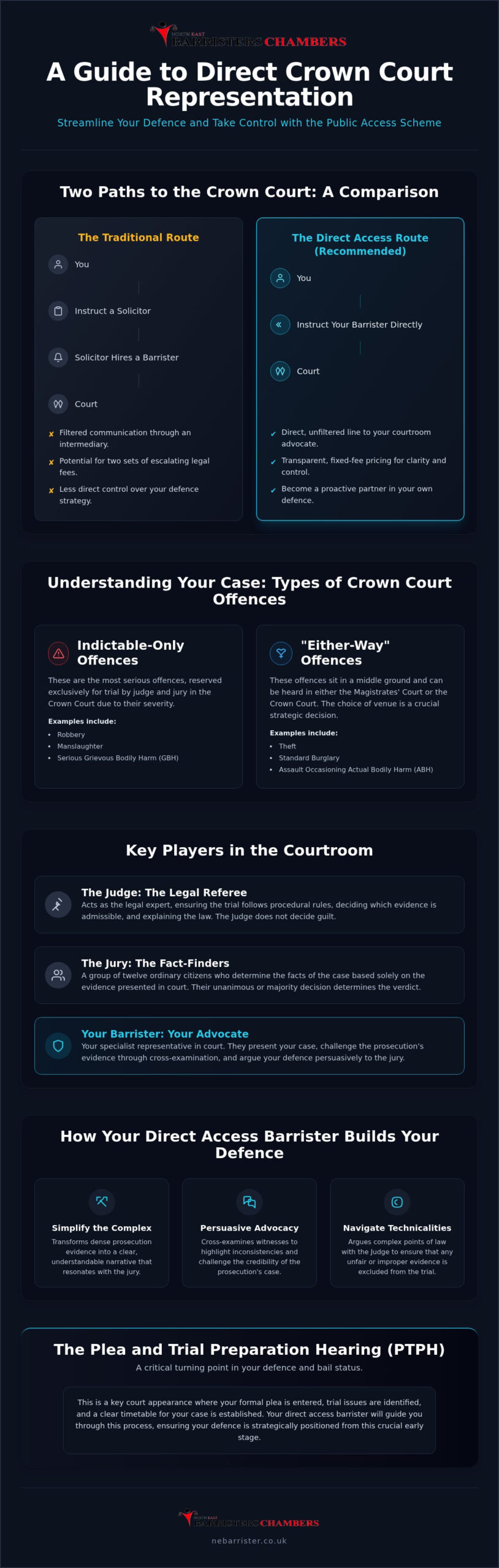
Understanding where your case sits in the court hierarchy is the first step in building a strategy. Criminal charges are generally split into two categories when they reach this level. Indictable-only offences are those reserved exclusively for Crown Court due to their severity. These include the most serious charges, such as robbery, manslaughter, or certain types of grievous bodily harm (GBH). These cases must be dealt with by a circuit judge and a jury.
Either-way offences, such as theft or standard burglary, sit in a middle ground. They can be heard in either the Magistrates’ or the Crown Court. I often find that clients are surprised to learn they have a choice in where their trial is heard. Choosing the Crown Court can be a strategic move. While the sentencing powers are higher, a jury of twelve peers often provides a different perspective on the facts than a bench of magistrates. I work with you to decide which venue offers the best chance for a fair hearing based on the specific evidence in your case.
The Function of the Jury and Judicial Oversight
The courtroom operates through a distinct division of labour. The Judge acts as the legal referee. They ensure the trial follows the rules, decide which evidence the jury is allowed to hear, and explain the law to everyone involved. They don’t decide if you are guilty; that task belongs solely to the Jury. A jury consists of twelve ordinary people who must determine the facts of the case based on what they see and hear in the courtroom.
This creates a unique challenge for your advocate. To succeed, your crown court representation must be able to bridge the gap between technical legal rules and the common sense of the jury. I focus on:
- Simplifying the complex: Turning dense prosecution evidence into a clear, understandable narrative.
- Navigating technicalities: Arguing points of law with the Judge to ensure unfair evidence is excluded.
- Persuasive advocacy: Cross-examining witnesses to highlight inconsistencies in their testimony.
Effective representation ensures that the jury hears your side of the story without the “static” of confusing legal jargon or procedural errors.
Direct Access Barristers: Bypassing Solicitors for Crown Court Advocacy
Many people believe they must hire a solicitor before they can even speak to a barrister. That is no longer the case. The Public Access Scheme, often referred to as Direct Access, has fundamentally changed how individuals secure crown court representation. It allows you to skip the traditional middleman. By removing the solicitor intermediary, you gain a direct line to the specialist who will actually argue your case in front of a jury. This isn’t just about cutting corners; it’s about creating a more efficient and personal legal experience.
I believe that the best results come from a clear, unfiltered connection between the advocate and the client. When you instruct me directly, you aren’t a file number being passed between departments. You are a partner in your own defence. We work together to ensure that every detail of your story is understood before the first hearing begins. This direct relationship eliminates the risk of your instructions being “lost in translation” between two different legal firms.
The Mechanics of Public Access Representation
Instructing a barrister directly is governed by a strict regulatory framework set by the Bar Council. It is a straightforward process, but it does require you to take an active role in your case. While I handle the legal strategy, drafting, and courtroom advocacy, you act as the “litigant in person” for certain administrative tasks. This might include gathering witness contact details or organising your own evidence folders. If you want to understand the specifics of this process, my guide on direct access legal advice provides a clear, step-by-step checklist.
While the government offers general advice on representing yourself in court, doing so in the Crown Court without professional advocacy is incredibly risky. Direct Access offers the perfect middle ground. You manage the logistics you are comfortable with, and I provide the elite courtroom skills needed to navigate complex rules of evidence and cross-examination.
Efficiency and Cost-Effectiveness
The most immediate benefit of this model is financial. In a traditional setup, you pay a solicitor to manage the file and then pay a barrister to appear in court. This often leads to “double-billing” where both professionals are charging to read the same documents. Direct access can often halve legal costs by removing solicitor overheads and the high administrative costs of large law firms. You are paying for the barrister’s time and expertise alone.
Beyond the money, this model leads to faster decision-making. We can adapt our strategy quickly as new evidence emerges without waiting for a third party to relay messages. If you are facing serious charges and want a more agile approach, you can enquire about direct instruction to see if your case is a good fit for this modern method of crown court representation.
Key Stages of Crown Court Representation and Defence
Entering the Crown Court for the first time can be a daunting experience. Unlike the faster pace of the Magistrates’ Court, proceedings here move with a deliberate, formal rhythm. Every step is governed by the Criminal Procedure Rules, which were significantly updated in April 2026 to modernise disclosure and case management. Understanding this timeline is essential for anyone seeking Crown Court Overview or specific guidance on how their case will progress. Effective crown court representation ensures that you aren’t just a passenger in this process; you are prepared for every hearing and every deadline.
The journey through the Crown Court is not just about the final trial. It is a series of strategic milestones where your advocate works to narrow the issues, challenge the prosecution’s narrative, and protect your interests. From the initial plea to the final closing speech, each stage requires a specific type of advocacy and a deep understanding of the rules of evidence.
The PTPH and Pre-Trial Management
The Plea and Trial Preparation Hearing (PTPH) is arguably the most critical early stage. This is usually your first appearance in the Crown Court. During this hearing, you will be asked to enter a formal plea. If you plead not guilty, the Judge will set a strict “timetable” for the trial. This includes deadlines for the prosecution to serve evidence and for us to submit your Defence Statement. I use this stage to identify flaws in the prosecution’s case early on, often arguing for specific disclosure of evidence that the police may have overlooked. Getting this right prevents the trial from being delayed and ensures we are fighting on the best possible terms.
Bail Applications and Appeals
For many, the most pressing concern is maintaining their freedom whilst awaiting trial. The court considers several criteria when deciding on bail, including the risk of failing to surrender, the likelihood of further offences, or potential witness interference. As part of my criminal law court representation, I focus on building a robust “bail package”. This might include proposing strict conditions such as a residence requirement, a financial security, or a curfew. If bail is refused at the first instance, I can guide you through the process of appealing that decision to a Judge in Chambers, ensuring every possible argument for your liberty is heard.
The Trial and Evidence Review
Once the case reaches trial, the focus shifts to the power of persuasion. This begins with the opening speeches, where the prosecution sets out their stall and I provide a concise counter-narrative. The heart of the trial, however, is cross-examination. This is where your advocate’s skill really matters. I meticulously review all disclosed evidence to find inconsistencies in witness testimonies. By the time we reach closing arguments, the goal is to have created a clear, logical reason for the jury to doubt the prosecution’s case. Every question asked during the trial is a building block towards that final speech.
Strategic Trial Preparation and Courtroom Advocacy
Success in the courtroom is rarely the result of luck. It is built on weeks of meticulous preparation and a forensic approach to the evidence. When I take on your crown court representation, my first task is to dismantle the prosecution’s narrative piece by piece. I look for the small inconsistencies that others might miss, such as a witness statement that contradicts CCTV footage or a digital trail that doesn’t align with the police timeline. This level of detail is what allows me to build a defence that stands up to the intense pressure of a trial.
Witness management is another vital part of my strategy. Standing in a witness box in the Crown Court is an intimidating experience for anyone. I spend time preparing you and your witnesses for the reality of the courtroom environment. We discuss how to remain calm, how to listen carefully to questions, and how to deliver testimony clearly. This preparation ensures that when the time comes for cross-examination, we are ready to test the credibility of the prosecution’s witnesses with precision and confidence.
Expert Analysis of Prosecution Evidence
The defence statement acts as the roadmap for your entire trial. It is a formal document where we set out exactly what is in dispute. I use this to force the prosecution to disclose hidden evidence that might support your case. If the matter involves technical data, such as forensic accounting or cell-site analysis, I work with independent experts to challenge the Crown’s findings. My goal is to ensure that no piece of evidence goes unchallenged if there is a way to cast doubt upon it. You can book a strategic case review to discuss how we can analyse the specific evidence in your matter.
Mitigation and Sentencing Hearings
In the event of a conviction or a guilty plea, the focus shifts to mitigation. This is where I argue for the most lenient sentence possible. Under the Sentencing Act 2026, courts now have a presumption to suspend custodial sentences of 12 months or less, and they can impose suspended sentences for terms of up to three years. I use these guidelines to your advantage, highlighting personal circumstances or a “Basis of Plea” that reduces your culpability.
A well-crafted plea in mitigation provides the judge with the context they need to see you as an individual, not just a case file. Whether we are arguing for a non-custodial outcome or a significantly reduced term, I ensure the court understands every factor that weighs in your favour. This final stage of crown court representation is just as critical as the trial itself for protecting your future.
Instructing Your Crown Court Barrister Directly
Taking the first step toward securing crown court representation can feel like a significant hurdle, especially when you’re already dealing with the stress of a criminal charge. The process of direct instruction is designed to be transparent and efficient. It moves away from the traditional, opaque methods of the legal industry and puts you in a position of informed control. I start every engagement with a clear assessment of your case to ensure that the direct access route is the most effective path for your specific circumstances.
My goal is to provide a service that is both authoritative and accessible. You won’t find yourself waiting days for a response from a junior clerk. Instead, you’ll deal directly with me. We’ll discuss the evidence, the potential outcomes, and the best strategy for your defence. This direct line of communication is what allows us to build a robust case whilst maintaining the agility needed to respond to prosecution updates.
Is Your Case Suitable for Public Access?
While many matters are perfectly suited for direct instruction, it’s my professional duty to identify when a case might require additional support. Public access is ideal for cases where the evidence is contained within a manageable volume of documents and doesn’t require a solicitor to conduct extensive, 24/7 investigative work. If your case involves hundreds of witnesses or requires a large team to manage daily litigation tasks, I might recommend a “hybrid” approach. This is where you hire a solicitor for the administrative heavy lifting while I provide the specialist crown court representation and trial strategy. I’ll always be honest about which model serves your interests best.
Securing Your Representation
Once we’ve determined that your case is a good fit for direct access, the formal process begins with an instruction letter. This document is your contract. It defines exactly what work I’ll perform, which hearings I’ll attend, and the fixed fees we’ve agreed upon. There are no hidden costs or surprise hourly rates. This level of clarity is a cornerstone of my practice and a primary reason why many clients choose this route to reduce legal costs UK wide.
To get started, you’ll need to provide your papers and any evidence you’ve received from the police or the prosecution. I’ll review these documents to provide a comprehensive fee quote. Once the instruction letter is signed and the fee is settled, we move straight into the preparation phase. From that moment on, you have a dedicated advocate who is fully briefed and ready to represent you at every scheduled hearing, ensuring your voice is heard and your rights are protected throughout the trial process.
Take Control of Your Defence Strategy
Choosing the right path for your legal journey shouldn’t be a source of extra stress. By opting for direct instruction, you strip away the layers of bureaucracy that often complicate serious criminal matters. You gain a direct line to the person who will actually stand before the jury, ensuring that nothing is lost in translation during your crown court representation. This model doesn’t just streamline the process; it focuses every penny of your budget on the specialist advocacy that truly matters in a trial environment.
I provide national coverage across all UK Crown Courts, bringing seasoned expertise and transparent, fixed-fee pricing to every case. You can bypass the escalating costs of traditional firms whilst receiving the highest standard of courtroom support. If you’re ready to simplify your legal process and secure a dedicated professional who understands every detail of your case, you can instruct a specialist Crown Court barrister directly today. Your defence deserves clarity, transparency, and a modern approach that prioritises your outcome. I’m here to guide you through every stage with confidence.
Frequently Asked Questions
Can I really have Crown Court representation without a solicitor?
Yes, you can. The Public Access scheme allows you to instruct a barrister directly for crown court representation. This path removes the need for a solicitor intermediary. I handle the advocacy and legal strategy while you manage certain administrative tasks. It is a regulated and increasingly popular way to access high-level courtroom expertise without the overheads of a traditional law firm.
How much does a Crown Court barrister cost for a trial?
Fees vary significantly based on the complexity of the case and the length of the trial. I provide transparent, fixed-fee quotes rather than open-ended hourly rates. This ensures you know exactly what the representation will cost from the outset. Factors like the volume of evidence and the number of hearings required will influence the final figure. I’ll always provide a detailed breakdown before any work begins.
What is the difference between a solicitor advocate and a barrister?
A solicitor advocate is a solicitor who has gained additional qualifications to represent clients in higher courts. A barrister is a specialist advocate who focuses almost exclusively on courtroom work and legal opinions. While both can appear in the Crown Court, barristers often have more intensive trial experience. I spend most of my professional life in the courtroom, which allows me to refine the persuasive skills necessary for jury trials.
Can a direct access barrister visit me in prison?
Yes, I can visit you in prison to discuss your case and prepare your defence. Direct access barristers have the same rights of access to clients in custody as solicitors do. These conferences are vital for reviewing evidence and taking your instructions in a secure environment. I travel to prisons across the country to ensure that every client receives the face-to-face support they need before their trial begins.
What happens if I cannot afford private Crown Court representation?
If you cannot afford private fees, you should check if you are eligible for Legal Aid. I don’t provide Legal Aid services directly, as the Public Access scheme is for privately funded clients only. You can apply for legal aid through a solicitor who handles such cases. They’ll assess your income and the merits of your case to see if the government will cover your legal costs.
Will hiring a barrister directly affect my chances of winning the case?
Hiring a barrister directly ensures that the person arguing your case in court is also the person who prepared it. This consistency can be a significant advantage. It eliminates the risk of important details being missed during a hand-over between a solicitor and a barrister. My focus is on providing elite crown court representation that is tailored specifically to your story, which often leads to a more cohesive and persuasive defence.
Can I switch from a solicitor to a direct access barrister mid-case?
Yes, it is possible to switch to a direct access model even if your case has already started. You’ll need to terminate your agreement with your current solicitor and request your case file. Once I’ve reviewed the papers, I can take over the advocacy and strategy. It is often best to do this as early as possible to ensure I have enough time to prepare for upcoming hearings.
What documents do I need to provide for a direct access instruction?
You should provide all papers served on you by the police or the prosecution. This includes the charge sheet, witness statements, and any exhibits or digital evidence. If you’ve already appeared in the Magistrates’ Court, I’ll also need the initial details of the prosecution case (IDPC). Providing these documents electronically allows me to review your matter quickly and provide an accurate fee quote for your representation. If you are facing an assault charge and want to understand what happens at a first court hearing for assault UK, my dedicated guide covers every procedural step and how to approach your initial appearance with confidence.
