
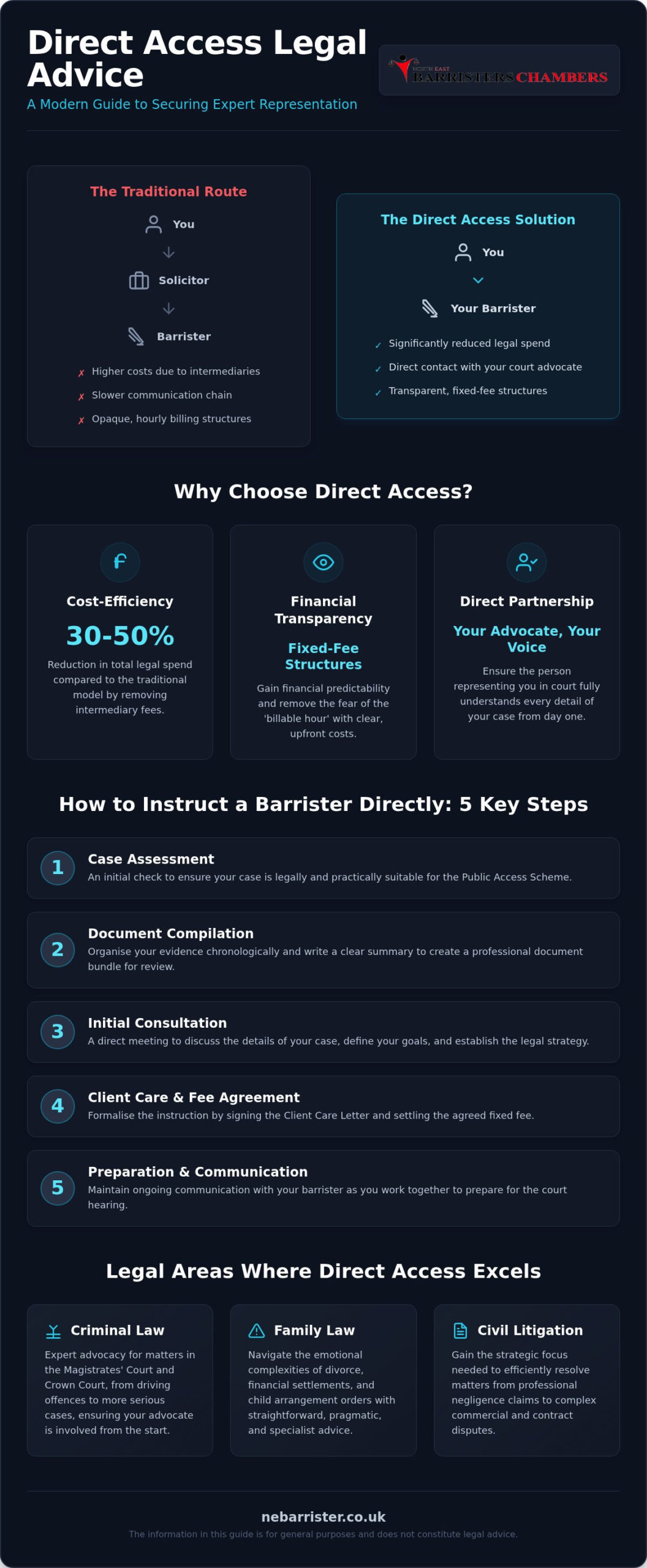
The traditional route of hiring a solicitor before a barrister might actually be the most expensive way to handle your legal matter. Most people assume they must navigate a complex chain of intermediaries, but this often leads to opaque fees and a frustrating sense of being removed from your own case. I understand the anxiety of not knowing if the person you’re speaking to is the one who will eventually stand up for you in court. By seeking direct access legal advice, you can change this dynamic entirely.
You deserve a more transparent and direct partnership. I promise that this guide will show you exactly how to navigate the UK legal system by instructing a specialist barrister directly, ensuring you secure expert court representation whilst significantly reducing your total legal spend. We’ll explore a structured, step-by-step plan to manage your criminal, civil, or family law matter with clarity and confidence. I will walk you through the practicalities of the Public Access Scheme, from initial consultations to final hearings, so you can move forward with a professional advocate by your side.
Key Takeaways
- Learn how to secure specialist direct access legal advice to bypass the traditional solicitor referral chain and gain direct contact with your court advocate.
- Understand the shift towards transparent, fixed-fee structures that offer financial predictability for your criminal, civil, or family law matter.
- Discover the practical steps for instructing a barrister, including how to assess case suitability and how to prepare a professional document bundle for review.
- Find out how to maximise the value of your legal sessions by organising evidence chronologically and writing a clear summary of events for your barrister.
- Explore the strategic benefits of a direct partnership, ensuring the person representing you in court fully understands every detail of your case.
Understanding Direct Access Legal Advice: The Modern Route to Justice
The legal system used to be a closed shop. For decades, the only way to reach a barrister was through a solicitor. This created a referral chain that added significant time and cost to every case. The introduction of the Public Access Scheme dismantled these barriers. It allows you to obtain direct access legal advice without an intermediary. I believe this is the most honest way to practice law. It puts you in direct contact with the person responsible for your advocacy, ensuring nothing is lost in translation between different offices.
The core difference lies in the nature of the work. Solicitors generally handle case management, such as issuing proceedings and managing client funds. Barristers, however, are specialist advocates. We focus on the “heavy lifting” of the courtroom and providing high-level legal opinions. By choosing the direct route, you take on the administrative tasks that a solicitor would usually perform. In return, you gain direct access to a specialist’s expertise at a more manageable price point. It’s a pragmatic solution for those who are organised and want to stay close to the heart of their case.
How Direct Access Benefits Individuals and Businesses
Cost-efficiency is the most immediate draw. Research suggests that using the direct access route can reduce total legal spend by 30% to 50% compared to the traditional model. With Grade A solicitor guideline rates reaching £579 per hour in 2026, the savings are substantial. This is particularly vital for SMEs facing contract disputes where every pound matters. You aren’t paying for a large firm’s overheads; you’re paying for the specific advice and representation you need. I provide fixed-fee structures so you know exactly what the work will cost before I begin. This transparency removes the fear of the “billable hour” that often haunts traditional legal engagements.
The Legal Areas Where Direct Access Excels
Not every case is suitable for this route, but many common legal issues are a perfect fit. I focus on three primary pillars where specialist advocacy makes the biggest difference:
- Criminal law: Whether it’s a driving offence in the Magistrates’ Court or a more serious matter requiring crown court representation, having your advocate involved from the start is invaluable.
- Family law: I help clients navigate the emotional complexities of divorce, financial settlements, and child arrangement orders with straightforward, pragmatic advice.
- Civil litigation: From professional negligence claims to complex contract disputes, I provide the strategic focus needed to resolve matters efficiently.
With over 1,500 enquiries now being made through the Bar Council’s portal every month, it’s clear that the public is embracing this modern approach. It’s a shift towards a more agile, client-focused legal market where you are the priority.
How to Instruct a Barrister Directly: A Step-by-Step Guide
Instructing a barrister yourself is a straightforward process, but it requires a methodical approach. I’ve found that the most successful cases start with a clear understanding of the roles involved. Unlike the traditional route, you take the lead on administrative tasks. This allows me to focus entirely on the legal strategy and advocacy. Seeking direct access legal advice is a partnership where transparency is the foundation.
The process typically follows five key stages:
- Step 1: Case assessment to ensure the matter is legally and practically suitable.
- Step 2: Compiling your document bundle in chronological order for review.
- Step 3: An initial consultation to define your goals and the legal strategy.
- Step 4: Signing the Client Care Letter and settling the agreed fixed fee.
- Step 5: Ongoing communication as we prepare for the court hearing.
Assessing Case Suitability
I always begin by determining if your case is a good fit for the Bar Standards Board guidance on public access. Some matters are simply too complex for a barrister to handle alone. If a case requires extensive investigative work, such as interviewing dozens of witnesses or managing large-scale evidence discovery, a solicitor’s involvement remains essential. You must also feel comfortable managing your own correspondence with the court and the opposing party. If you’re organised and proactive, this route works exceptionally well.
The Importance of the Client Care Letter
This document is our contract. It’s not just a formality; it’s a tool for clarity. It outlines exactly what I will do, what I won’t do, and what the total cost will be. In 2026, transparency is non-negotiable. The letter specifies the scope of work, whether it’s drafting a defence or representing you at a specific hearing. It ensures there are no surprises regarding fees or timelines. I believe this level of detail provides the relief and confidence you need during a stressful legal process.
Once we’ve agreed on the path forward, we can start the work immediately. If you’re ready to take control of your case, you can discuss your requirements with me directly to see if your matter fits the scheme. Preparation is everything. By gathering your documents early and being clear about your desired outcome, we can build a persuasive case together.
Direct Access vs Traditional Solicitor Routes: Choosing the Best Path
Choosing between a solicitor and a barrister depends entirely on your case’s specific needs. The traditional route often feels like a relay race. You hire a solicitor, who then instructs a barrister on your behalf. This means you are essentially paying for two sets of professionals to manage one case. By seeking direct access legal advice, you speak to the specialist advocate immediately. This isn’t just about saving money; it’s about speed. By cutting out the referral chain, you get answers faster and stay in the loop at every stage.
Case management is the primary difference. In the traditional model, the solicitor manages the “paper trail.” They file court documents, handle service, and manage client funds. In the direct access model, you take on these administrative responsibilities. I provide the expert drafting and strategic advice, but you are the person the court contacts for administrative matters. It’s a pragmatic trade-off. You invest some of your own time in exchange for lower costs and direct expertise from your advocate.
Solicitors are often generalists who handle a broad range of legal issues and manage the day-to-day life of a file. Barristers are specialists. We are trained specifically for the courtroom and for high-stakes legal problem-solving. If your case is heading toward a hearing, you need an advocate who understands the nuances of the law and the temperament of the court. Direct instruction ensures that your specialist is involved from the earliest possible stage, rather than being briefed at the last minute by a solicitor.
Calculating the Real Cost of Legal Advice
Traditional law firms often use hourly rates that can spiral as a case progresses. A Grade A solicitor in London might charge £579 per hour in 2026. When you add a barrister’s fee on top, you’re facing a “double-fee” structure. You can reduce UK legal costs by opting for my fixed-fee direct access model. This transparency prevents “hidden” disbursements and unpredictable monthly bills. I’ve found that many clients feel a sense of relief simply knowing the total cost upfront.
The Hybrid Model: When to Use Both
Sometimes, a case grows too large for one person to manage alone. If we reach a point where the evidence is overwhelming or the litigation involves complex procedural hurdles, I might recommend bringing in a solicitor for specific tasks. This is the hybrid model. It ensures your legal team remains proportionate to the case value. You maintain a barrister-led strategy whilst using support for heavy litigation. You can find more information on how these professional relationships work through the Bar Council Direct Access Portal, which provides a neutral overview of the scheme’s regulations.
Preparing Your Case: How to Maximise the Value of Legal Advice
To get the most out of your direct access legal advice, you must arrive prepared. I often tell my clients that the more work they do on the administrative side, the more time I can spend on the high-level legal strategy that actually wins cases. The first step is to organise your evidence chronologically. A messy pile of papers forces your barrister to spend billable time acting as a filing clerk. Instead, create a digital or physical folder where every email, contract, and witness statement is ordered by date. This simple act of organisation can save hours of professional review and ensure nothing is missed.
You should also write a concise ‘summary of events’. This is a narrative of what happened, written in plain English. It helps me grasp the facts of your case quickly without searching through disjointed notes. Identify your key witnesses and list the documentation you have available early in the process. As a ‘Litigant in Person’, you are responsible for the day-to-day management of the case. While I provide the expert advocacy, you remain the primary point of contact for the court and the opposing party. This role requires diligence, but it keeps you in total control of your case’s direction.
Administrative Responsibilities You Must Manage
Filing court forms is a critical task that you must handle yourself. You must adhere to strict legal deadlines; missing a ‘date for service’ or a filing window can be fatal to your case. You will also need to handle correspondence with the other side’s solicitors. This can be intimidating, but staying professional and focused on the facts will keep the process moving. Finally, you must prepare the ‘court bundle’. This is a paginated, indexed set of documents that the judge and all parties will use during the hearing. A well-prepared bundle reflects well on your case and ensures the hearing runs smoothly.
Communicating Effectively with Your Barrister
Setting clear objectives is the first part of our consultation for direct access legal advice. We need to define what a ‘win’ looks like for you. Is it a specific financial settlement in a family law dispute, or an acquittal in a criminal matter? Be honest about the ‘weak points’ in your case. I can’t protect you from a vulnerability I don’t know about. If you are facing charges and need to understand what happens at a first court hearing for assault UK, knowing the procedural steps is vital for your peace of mind. If you’re preparing for the criminal law court representation experience, understanding the procedural steps is vital for your peace of mind. If you’re ready to start building your bundle, you can instruct me directly for your case to ensure we hit the ground running.
Engaging Expert Advocacy: Why Direct Instruction Works for You
There is a profound psychological benefit to working directly with your advocate. In the traditional model, clients often feel like a passenger in their own case, watching from a distance as information is filtered through multiple layers. By choosing direct access legal advice, you aren’t just hiring a lawyer; you’re engaging a strategic partner. This direct connection ensures that your voice is heard and that the nuances of your situation are understood by the person who will eventually stand up for you in court. It replaces the “relay race” of the past with a focused, agile strategy that responds to your needs in real time.
Persuasive advocacy begins long before the courtroom doors open. It starts with a clear, direct conversation about the facts. When I work directly with you, I can build a more responsive strategy because there is no middleman to dilute the message. This agility is particularly valuable in fast-moving civil or family disputes where a quick, expert opinion can prevent a minor issue from escalating into a costly legal battle. You gain the confidence that comes from knowing your advocate is personally accountable to you.
The Barrister as a Strategic Partner
My role is to move you from a “legal problem” to a “structured solution.” This often involves providing an objective reality check. I use my courtroom experience to tell you honestly what a judge is likely to think of your evidence. This pragmatism is a powerful tool for achieving out-of-court settlements. If we can demonstrate a position of strength and clarity early on, the other side is often more willing to negotiate. I focus on the practical outcomes that matter to you, ensuring the legal process serves your best interests rather than just following a rigid, bureaucratic path.
Instructing North East Barristers Chambers
At North East Barristers Chambers, I am committed to providing national representation with total fee transparency. Whether your case is in London, Manchester, or Newcastle, I offer the same level of specialist expertise without the need for a solicitor. I specialise in complex litigation and sensitive personal matters, including acting as a financial remedy barrister for those navigating divorce settlements. My approach is straightforward: I provide clear, fixed-fee quotes so you can plan your finances with certainty.
The journey towards a resolution starts with a single step. I invite you to contact me for a preliminary assessment of your case. We will discuss your objectives, review your documentation, and determine if the Public Access Scheme is the right fit for your needs. If you’re ready to secure expert crown court representation and reclaim control of your legal matter, I am here to act as your guide and your advocate. Let’s build a structured plan for your criminal, civil, or family law matter today.
Secure Your Legal Future with Direct Expert Partnership
Navigating the legal system doesn’t have to be an opaque or overwhelming experience. By choosing direct access legal advice, you’ve seen how to bypass unnecessary intermediaries and work directly with the person who will represent you in court. This modern approach gives you the clarity of fixed-fee structures and the reassurance of a strategic partner who truly understands every detail of your case. It’s about moving away from detached, formal communications and towards a straightforward, service-oriented mindset.
We’ve covered how to assess your case suitability, the importance of an organised document bundle, and how a barrister-led strategy can resolve complex criminal, civil, or family law matters more efficiently. I provide expert advocacy in all UK courts, ensuring that your voice is heard through persuasive and professional representation. If you’re ready to secure specialist advice and transparent fixed-fee options, instruct a specialist barrister directly today. I am here to provide the professional guidance you need to move forward with confidence. You don’t have to face this process alone; let’s build your path to a resolution together.
Frequently Asked Questions
What is direct access legal advice?
Direct access is a scheme that allows you to instruct a barrister directly without having to hire a solicitor first. It’s a modern way to access the UK legal system that streamlines communication and reduces total costs. I provide direct access legal advice to help you secure specialist advocacy and strategic guidance for your criminal, civil, or family law matter without unnecessary intermediaries.
Is a barrister more expensive than a solicitor?
No, using a barrister directly is usually more cost-effective because you aren’t paying for two sets of legal professionals. While hourly rates vary, the direct route can reduce your total legal spend by 30% to 50% compared to the traditional model. I focus on fixed-fee structures so you have total transparency and can plan your budget with certainty from the very start.
Can I hire a barrister directly for a criminal case?
Yes, you can instruct a barrister directly for most criminal matters, including driving offences and Crown Court trials. I offer expert representation for a wide range of criminal charges. If your case is exceptionally complex and requires a solicitor’s investigative resources, I’ll tell you immediately. This ensures your defence is always handled by the most appropriate team for your specific situation.
Do I have to represent myself in court if I use direct access?
No, the main reason to use this route is so that I can represent you in court. I handle all the advocacy, cross-examine witnesses, and present your legal arguments to the judge. You only take on the administrative tasks, such as filing forms and managing your own correspondence. You get professional, persuasive representation while remaining in control of your case’s day-to-day management.
Can a direct access barrister help with divorce and child custody?
Yes, I frequently assist clients with sensitive family law matters, including financial settlements and child arrangement orders. Seeking direct access legal advice for family disputes allows you to get specialist opinions on complex financial remedies quickly. It’s a pragmatic choice for those who want expert courtroom skills without the high overheads often associated with traditional family law firms.
What happens if my case is too complex for direct access?
If I assess your case and find it requires a solicitor’s involvement, I will advise you to hire one. Some matters involve heavy litigation or the management of client funds, which barristers aren’t permitted to handle. In these cases, I can work as part of a hybrid team. This ensures you still benefit from my specialist advocacy whilst having the administrative support a complex case demands.
Will a barrister handle the paperwork and court filing for me?
No, a barrister cannot issue court proceedings or handle the formal service of documents on your behalf. I will draft the high-level legal documents, such as your Defence or Witness Statements, to ensure they’re professional and persuasive. However, as a ‘Litigant in Person’, you’re responsible for the physical act of filing these papers with the court and adhering to all deadlines.
How do I pay for direct access legal services?
Fees are typically paid in advance for each specific stage of work we agree upon. Because barristers don’t hold client money in the same way solicitors do, we operate on a clear, stage-by-stage basis. I provide a Client Care Letter that outlines the fixed fee for each task. This approach prevents unexpected bills and ensures you only pay for the specific expertise and time you need.
One Response