
Instructing a traditional high-street solicitor is no longer the only, or most cost-effective, way to protect your child’s future in court. When you face pivotal decisions regarding schooling, medical procedures, or relocation, securing an experienced barrister for specific issue order hearings gives you decisive courtroom representation. You already know how exhausting these disputes are; between deciphering procedural rules, preparing for Cafcass reports, and dreading escalating legal fees, the fear of being outmanoeuvred by the other party is entirely understandable.
You don’t have to carry this burden alone, nor do you need to pay double-tier legal fees for a solicitor intermediary. Direct access allows you to instruct a specialist family barrister directly, giving you authoritative advocacy tailored to your child’s welfare whilst maintaining transparent control over your legal expenditure. In this guide, I’ll explain how the Family Court evaluates applications under the Welfare Checklist, what judges expect, and how you can seamlessly instruct an independent trial advocate for your hearing.
Key Takeaways
- Understand how Section 8 Specific Issue Orders resolve acute parental disputes regarding schooling, medical care, and travel permissions.
- Discover how instructing a direct access barrister for specific issue order applications avoids costly solicitor intermediary fees whilst securing elite courtroom advocacy.
- Learn the essential criteria for choosing an advocate, including Bar Standards Board registration and proven Children Act trial experience.
- Master the five-stage direct instruction process, from gathering essential documents like your Form C100 to finalising hearing strategy.
- Align your evidence with the statutory Welfare Checklist to maximise your prospects of success at the First Hearing Dispute Resolution Appointment and final hearings.
Specific Issue Orders: When Is a Barrister Essential?
Parental responsibility grants both parents an equal say in crucial decisions regarding their child’s upbringing. However, when parents reach an absolute impasse over a defined question, negotiation ends and legal adjudication begins. Under Section 8 of the Children Act 1989, the Family Court has the statutory power to determine these isolated disagreements by granting a Specific Issue Order.
Unlike broad Child Arrangements Orders that govern living and contact routines, a Specific Issue Order targets a single, contentious issue. When mediation breaks down and court proceedings become unavoidable, instructing an experienced barrister for specific issue order applications provides decisive, objective trial advocacy. The court does not rule based on parental preference; it evaluates every detail strictly against the statutory Welfare Checklist, where your child’s best interests remain the court’s paramount consideration.
Common Grounds for Section 8 Specific Issue Applications
Specific Issue Orders resolve discrete disputes that parents cannot settle through direct dialogue:
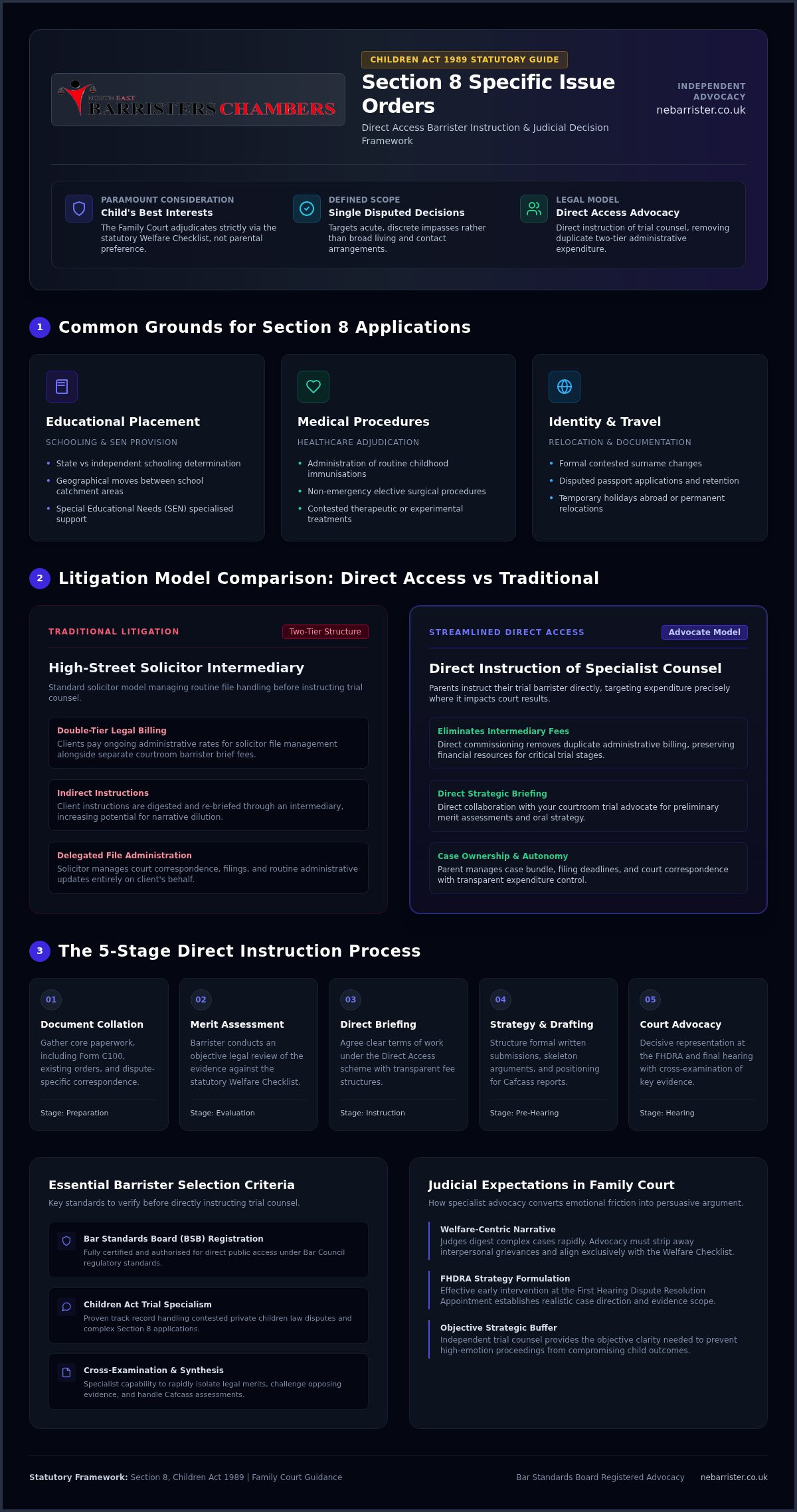
- Educational Placement: Resolving choices between state and independent schooling, geographical moves between catchment areas, or specialised special educational needs (SEN) provision.
- Medical Procedures: Adjudicating disputes regarding routine childhood immunisations, non-emergency elective surgeries, or experimental therapies.
- Identity and Travel: Deciding on contested formal surname changes, passport applications, and proposed temporary holidays abroad or permanent relocations.
The Decisive Advantage of Specialist Courtroom Advocacy
Family Court disputes inevitably carry high emotional friction. Presenting your own case or relying solely on written paperwork risks obscuring the legal merits behind interpersonal conflict. A direct access family barrister provides a focused, strategic buffer. Trial advocates specialise in the exact discipline that matters most in court: oral argument, evidence synthesis, and effective cross-examination.
Judges must digest complex facts rapidly. When you instruct an independent barrister for specific issue order hearings, you gain legal submissions structured precisely around judicial expectations and statutory welfare criteria. A barrister evaluates the case objectively, strips away distracting peripheral arguments, and presents a compelling, welfare-centric narrative that protects your child’s long-term interests.
Direct Access Barrister vs Traditional Solicitor: Decision Framework
Traditional family litigation often relies on a two-tier model. You hire a solicitor to run your case, manage routine correspondence, and assemble documents. Then, if the dispute proceeds to a contested hearing, that solicitor instructs independent counsel to represent you in court. While comprehensive, this structure means you pay two sets of legal fees for everyday file management alongside courtroom advocacy.
Instructing a barrister for specific issue order disputes via direct access offers a streamlined, pragmatic alternative. Under this model, you bypass the intermediary solicitor entirely. You collaborate directly with your trial advocate, targeting expenditure where it matters most: strategic legal advice, formal drafting, and persuasive courtroom advocacy.
Evaluating Cost Efficiency and Direct Case Control
Direct instruction eliminates duplicate administrative billing. Instead of paying a solicitor to digest your instructions and re-brief counsel, you brief your advocate firsthand. This creates clear transparency regarding your legal expenditure. You know precisely which services you are commissioning, from a preliminary merit assessment to hearing representation.
You also retain direct ownership of your case bundle. You send your own correspondence, manage filing deadlines, and handle court administrative updates yourself. Many parents find this autonomy empowering, particularly when reducing legal costs through direct access is essential to protecting their financial stability. If you want targeted advice on structuring your case, speaking to a direct access family barrister can clarify your best tactical options early.
When Is Direct Instruction Most Suitable for Parents?
While direct access delivers significant cost advantages, it requires a practical assessment of your own capabilities and case requirements:
- Organised Litigants: Ideal if you can file court documents on time, collate school or medical records systematically, and manage formal communications with the other side.
- Hearing-Specific Advocacy: Suited for parents who feel confident managing procedural paperwork but want authoritative, specialist courtroom representation for contested hearings.
- Defined Legal Impasses: Well-matched to Section 8 disputes, where the core conflict centres on a specific, isolated question rather than widespread, protracted financial litigation.
Conversely, direct instruction is not appropriate if you require someone to conduct litigation on your behalf, handle daily post, or if you are seeking Legal Aid funding. Barristers advise and represent you in court; they do not manage your ongoing administration.
Key Criteria for Choosing the Right Family Law Barrister
Selecting the right advocate requires looking beyond general legal credentials. Under English law, barristers must hold dedicated public access certification to accept instructions directly from parents. This means confirming that any prospective advocate is formally registered with the Bar Standards Board (BSB) to undertake direct access work.
Direct regulation guarantees that your counsel has completed specialist training to interface directly with lay clients without an intermediary solicitor. However, regulatory compliance is merely the baseline. To secure an order that protects your child’s future, you need an advocate whose everyday practice centres on contested private children litigation.
Assessing Family Court Track Record and Advocacy Skill
Courtroom dynamics in children proceedings differ fundamentally from commercial or general civil litigation. When evaluating a prospective barrister for specific issue order proceedings, examine their specific experience with Cafcass assessments:
- Section 7 Scrutiny: Your advocate must possess proven skill in analysing Cafcass reports, identifying factual omissions, and constructively challenging recommendations during cross-examination.
- Contested Applications: Look for demonstrable experience in handling contested Section 8 hearings where judicial findings on parental capability and schooling choices are required.
- Holistic Family Experience: Family disputes rarely exist in isolation; counsel familiar with interconnected matters, such as financial remedy proceedings, can evaluate your broader legal position with greater tactical awareness.
Transparent Pricing and Predictable Professional Fees
A primary driver for choosing direct access is financial clarity. Traditional law firms frequently operate on rolling hourly retainers with unpredictable disbursements. In contrast, an agile independent chambers provides agreed fee structures for distinct pieces of work.
Before instructing counsel, demand full transparency. Your barrister should provide explicit, itemised quotes for discrete tasks, such as reviewing the trial bundle, drafting a formal position statement, or providing on-the-day representation. Reliable counsel will evaluate your case papers first and offer an honest appraisal of your prospects of success before you commit to trial costs. This level of upfront clarity ensures you never face unexpected administrative overheads, allowing you to invest your resources entirely in high-impact courtroom advocacy.
Direct Instruction: Step-by-Step Guide for Parents
Instructing an advocate independently doesn’t require complex legal training, but it does demand systematic preparation. The process moves through five defined stages designed to take you from unorganised dispute papers to polished courtroom representation. When you instruct a direct access barrister for specific issue order proceedings, you become an active partner in your litigation strategy.
Stage 1 to 3: Document Collation, Instruction, and Strategic Conference
Success begins with disciplined document management. To instruct counsel effectively, execute the first three stages methodically:
- Stage 1: Collate Core Documents: Assemble your Form C100 application, any existing court orders, Cafcass safeguarding letters, and chronologically arranged exhibits. These exhibits might include school inspection reports, medical letters, or emails demonstrating the dispute.
- Stage 2: Submit Chambers Enquiry: Send your case summary and documentation directly to chambers. The clerking team reviews the material to ensure the matter is legally suitable for public access instructions.
- Stage 3: Strategic Client Conference: Meet with your barrister via video link or in chambers. This conference stress-tests your arguments against the Welfare Checklist, identifies fall-back positions, and settles your trial narrative.
Stage 4 and 5: Skeleton Arguments and Courtroom Representation
Once strategy is confirmed, your barrister handles the heavy legal lifting. In Stage 4, counsel drafts your position statement or skeleton argument. This critical document distils complex facts into punchy, persuasive legal propositions for the judge. It cites pertinent statutory provisions, references applicable case law, and outlines the precise directions or final declarations sought.
Stage 5 culminates in court representation. Whether appearing at the First Hearing Dispute Resolution Appointment (FHDRA) or a contested multi-day final hearing, your advocate leads oral argument. They conduct targeted cross-examination of the opposing party, challenge flawed welfare assessments, and deliver structured closing submissions. If you have an upcoming court date, you can instruct an experienced direct access barrister directly to secure specialist trial advocacy without paying dual-tier legal costs.
Preparing for Your Hearing: Maximising Prospects of Success
The Family Court maintains an uncompromising focus on your child’s welfare under Section 1 of the Children Act. Judicial patience wears thin when hearings descend into recriminations about past adult relationship conduct. Whether you seek permission for a specific school placement or need an urgent ruling on medical care, your prospects depend on demonstrating how your plan directly advances your child’s everyday interests.
Litigation success also requires understanding hearing procedure. The First Hearing Dispute Resolution Appointment (FHDRA) serves as a critical junction where the court identifies live disputes, assesses initial Cafcass safeguarding letters, and determines whether an early resolution is possible. If agreement can’t be reached, the bench issues case management directions leading to a contested final hearing. Entering this environment with an experienced barrister for specific issue order proceedings ensures your legal positions are clearly defined from the very first hearing.
Aligning Evidence with the Welfare Checklist Criteria
Judges evaluate applications against the statutory Welfare Checklist. To persuade the court, you must align your witness statements and supporting exhibits directly with these criteria:
- Objective Proof: Provide independent third-party evidence, such as school inspection ratings, SEN specialist assessments, or consultant medical letters, rather than relying on personal assertions.
- Practical Feasibility: Present a workable plan. Detail how transport logistics, morning routines, or medical follow-ups will operate practically without causing avoidable disruption to the child.
- Parental Decorum: Keep all written and oral evidence constructive. Demonstrating a cooperative attitude towards the other parent highlights your emotional maturity and supports your credibility in the eyes of the judge.
How to Instruct Chambers for Your Family Court Listing
Family Court listings can move quickly once directions are handed down, making early preparation essential. As soon as you receive formal notification of a hearing listing, contact chambers to secure your trial advocate. Booking counsel early provides the necessary time to conduct a pre-hearing conference, review court bundles thoroughly, and draft persuasive skeleton arguments before deadlines lapse.
Securing a direct access barrister for specific issue order representation across England and Wales gives you dedicated trial advocacy without paying dual-tier legal fees. By instructing chambers directly, you take decisive control over your legal presentation and ensure your child’s best interests are championed effectively in court.
Secure Decisive Advocacy for Your Specific Issue Order Hearing
Pivotal choices regarding your child’s education, medical care, or relocation shouldn’t be compromised by procedural confusion or escalating legal fees. Instructing an independent barrister for specific issue order proceedings via direct access removes unnecessary solicitor intermediary charges. This focused approach lets you target your resources directly where they deliver the highest impact: strategic case preparation and robust courtroom advocacy aligned with the statutory Welfare Checklist.
Our chambers provides specialist trial representation across England and Wales, with experienced barristers regulated by the Bar Standards Board to accept instructions directly from parents. Whether you face an upcoming FHDRA or a contested final hearing, you can instruct a specialist family barrister directly to present your case with clarity and precision. You don’t have to face the Family Court alone; take decisive action to protect your child’s best interests today.
Frequently Asked Questions
Can I instruct a barrister directly for a Specific Issue Order without using a solicitor?
Yes, you can instruct a barrister for specific issue order proceedings directly through the Direct Access scheme without retaining a solicitor. Barristers regulated by the Bar Standards Board can advise on your legal position, draft position statements, and represent you in court. Because you manage administrative tasks such as filing court forms and communicating with the other party yourself, you avoid paying dual-tier legal fees while securing specialist trial advocacy.
What is the difference between a Prohibited Steps Order and a Specific Issue Order?
Both orders fall under Section 8 of the Children Act 1989, but they serve opposite functions. A Specific Issue Order grants positive authorisation for an action when parents disagree, such as choosing a school or undertaking medical treatment. A Prohibited Steps Order stops a parent from taking a unilateral step, such as removing a child from the country or changing their surname, without explicit court approval.
How does the Family Court decide whether to grant a Specific Issue Order?
The Family Court’s paramount consideration is always the child’s welfare under Section 1 of the Children Act 1989. Judges evaluate applications strictly against the statutory Welfare Checklist. This framework considers the child’s ascertainable wishes and feelings, their physical and educational needs, the likely effect of changes to their circumstances, and any risk of harm. The judge weighs objective evidence rather than personal parental preferences to reach a decision.
What happens at the First Hearing Dispute Resolution Appointment (FHDRA)?
The FHDRA is the initial procedural hearing in your case. A judge or bench of magistrates reviews your application alongside an initial safeguarding letter from Cafcass. The court checks whether common ground exists to resolve the dispute immediately. If disagreement persists, the court issues case management directions, which often order formal witness statements or a Section 7 welfare report, before setting a date for a contested final hearing.
Can a barrister draft my C100 application form and witness statement directly?
Yes, a barrister can draft your formal witness statements, position statements, and settle the wording for your Form C100. However, because direct access counsel cannot formally conduct litigation, they cannot file documents with the court on your behalf. Your barrister will draft and structure your legal arguments professionally, and you then sign and submit the paperwork to the court and opposing party directly.
What occurs if the other parent refuses to comply with a Specific Issue Order?
A Specific Issue Order is a legally binding court instruction. If a parent breaches its terms, you can apply back to the Family Court for formal enforcement. The court takes non-compliance seriously and has powers to impose unpaid community work, order financial compensation, or vary existing child arrangements. In serious instances, defying a clear court order amounts to contempt of court, which carries severe legal and financial sanctions.
Can a direct access barrister represent me if Cafcass has submitted an adverse report?
Yes. Instructing an experienced barrister for specific issue order hearings is particularly valuable when facing an unfavourable Cafcass Section 7 report. While judges place substantial weight on Cafcass recommendations, they are not binding. A trial barrister can critically examine the officer’s methodology, highlight omitted evidence, and cross-examine the author during the final hearing to show why their recommendations don’t serve your child’s best interests.