
You don’t need to hire a solicitor and pay their heavy overheads just to hold a negligent professional to account. When an expert you’ve trusted makes a critical error, the fallout often feels both overwhelming and prohibitively expensive. I understand the anxiety that comes with questioning whether a mistake is actually legal negligence or how you’ll afford to fight your corner in the UK court system. If you’re searching for a civil negligence claim barrister in the North East, North East Barristers Chambers offers a direct route to bypass traditional legal structures while maintaining high-level advocacy.
I agree that the complexity of modern litigation is a major barrier to justice for many people. That’s why I’m here to show you how to manage your claim efficiently through direct access, giving you a clear roadmap to accountability without the standard law firm markups. In this guide, I’ll explain the specific grounds for a professional negligence claim and provide a transparent look at the litigation process. You’ll learn how to take control of your case and significantly reduce your legal costs by instructing a barrister directly for your 2026 claim.
Key Takeaways
- Understand the specialist role of a barrister in assessing liability and providing expert courtroom representation for complex professional disputes.
- Learn how to establish the legal grounds for a claim by proving a professional breached their duty of care through negligent advice.
- Discover how a civil negligence claim barrister north east can help you bypass solicitor fees by using the Direct Access scheme.
- Identify the critical evidence required to build a strong case, including original contracts and a detailed chronological timeline of the professional relationship.
- Evaluate the suitability of your claim for direct instruction to manage your litigation more efficiently and maintain transparent control over your legal costs.
What is a Professional Negligence Barrister?
A professional negligence barrister is a specialist advocate whose practice centres on disputes where professional advice or service has fallen below the expected legal standard. My role is distinct from that of a solicitor. While a solicitor typically manages the day-to-day administrative aspects of a case, I focus on the high-level legal strategy and tactical advocacy. If you are seeking a civil negligence claim barrister north east, you are looking for an expert who can assess the strengths of your case, draft formal court documents known as pleadings, and represent you directly in front of a judge.
Specialist civil law expertise is vital because these cases are rarely straightforward. They require a deep understanding of how to prove that a professional’s error caused you a specific financial loss. I provide the analytical rigour needed to determine liability early on. This saves you time and money by identifying whether a claim is worth pursuing before you commit to lengthy litigation. By instructing me directly, you gain access to this specialist courtroom experience without the traditional requirement of a solicitor acting as an intermediary.
Defining Professional Negligence in UK Law
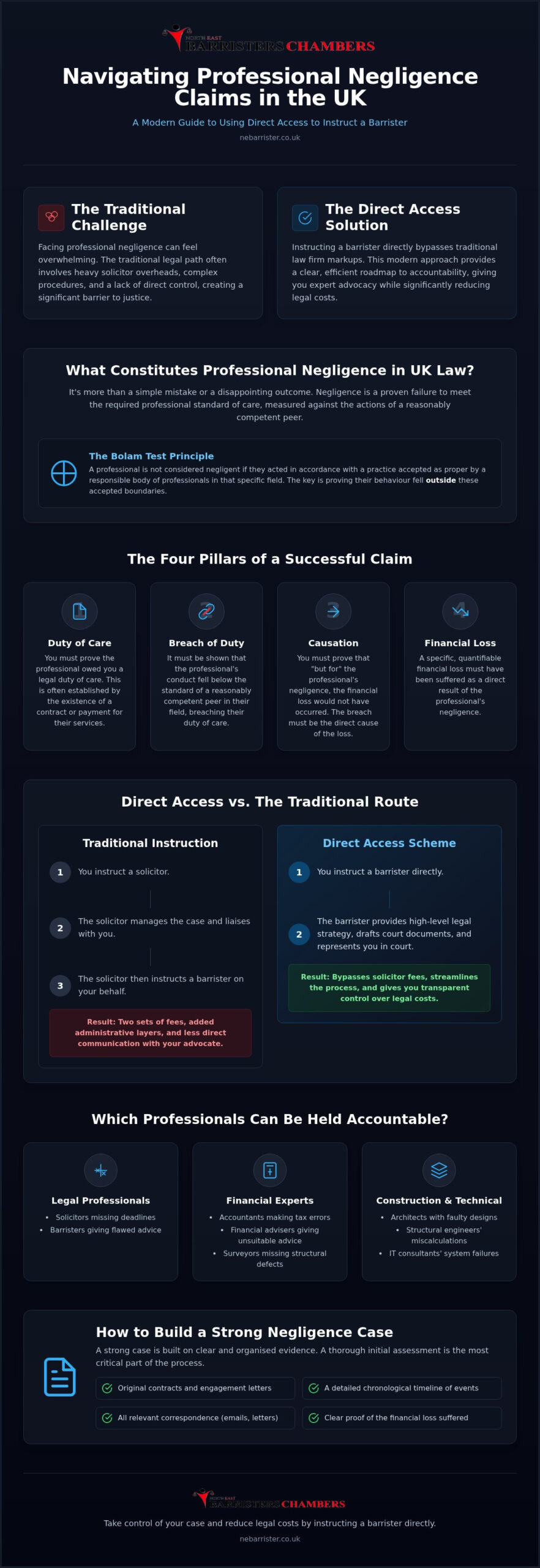
It’s a common misconception that every professional mistake qualifies as negligence. In the eyes of the court, a simple error of judgement or a disappointing outcome isn’t always enough to secure compensation. To succeed, we must prove that the professional failed in their duty of care toward you. This failure is measured against the standards of their peers. Under the Bolam test principle, a professional is not negligent if they acted in accordance with a practice accepted as proper by a responsible body of professionals in that specific field. My job is to scrutinise the evidence to see if their behaviour fell outside those accepted boundaries.
Which Professionals Can Be Held Accountable?
The scope of professional negligence is broad, covering almost any individual or firm that provides specialist advice or services. I frequently assist clients with claims against the following experts:
- Legal Professionals: This includes solicitors who miss critical limitation dates or other barristers who provide fundamentally flawed legal advice.
- Financial Experts: I handle disputes involving accountants who make tax filing errors, financial advisers who recommend unsuitable products, or surveyors who miss obvious structural defects in a property.
- Construction and Technical: This category covers architects with faulty designs, structural engineers who miscalculate loads, and IT consultants whose systems fail to meet contractual specifications.
Whether the error occurred in a boardroom in Newcastle or a construction site in Durham, the principles remain the same. You trusted an expert, they failed to meet the required standard, and you suffered a loss as a result. As a civil negligence claim barrister north east, I help you navigate these complexities with a focus on practical, cost-effective results.
Establishing the Grounds for a Professional Negligence Claim
Proving a professional was “wrong” is only the first step in a legal battle. To win a case, I must help you demonstrate that the error wasn’t just a lapse in judgement but a breach of a legal duty. The court doesn’t penalise professionals for every minor mistake; it penalises them when their conduct falls below the standard of a reasonably competent peer. As a civil negligence claim barrister north east, I look for a specific chain of events that links a professional’s failure directly to your financial loss.
I focus on building a narrative that satisfies the court’s strict requirements for liability. We don’t just point at a bad outcome. We scrutinise the original engagement, the advice given, and the specific actions taken. If any link in this chain is missing, the claim will likely fail. This is why a thorough initial assessment is the most important part of my work.
The Four Pillars of a Successful Claim
A strong case stands on four distinct legal foundations. First, we establish Duty. This is usually the easiest part; if you paid for a service, a duty of care likely existed. Second, we prove Breach. We compare the professional’s behaviour against what a competent peer would have done in the same situation. If they ignored clear industry guidelines or missed obvious data, they’ve breached that duty.
Third, we address Causation using the “but for” test. I must prove that “but for” the professional’s negligence, you wouldn’t have suffered the loss. If the loss would have happened anyway, regardless of their mistake, you don’t have a claim. Finally, we calculate Loss (Quantum). This is the exact financial impact of the failure, measured in pounds and pence. We don’t guess; we use evidence like bank statements, revised valuations, or tax assessments to prove the damage.
Limitation Periods: Is it Too Late to Sue?
In the UK, you generally have six years from the date of the negligent act to issue a claim. Once this window closes, you’re usually “statute-barred,” meaning the court will refuse to hear your case. However, there are exceptions for “latent damage.” This occurs when a mistake, like a poorly drafted property deed or a structural error, remains hidden for years. In these instances, you may have three years from the date you discovered the error to take action.
Because these timelines are strict, it’s vital to consult a civil law barrister as soon as you suspect something is wrong. Delaying can make it harder to gather evidence and might result in you losing your right to compensation entirely. If you’re worried about a deadline, I can quickly help you determine where you stand under current 2026 regulations. You can check your eligibility for Direct Access Barrister Services to get an expert opinion without delay.
Direct Access vs. Traditional Legal Instruction
For decades, the only way to reach a barrister was through a solicitor. This traditional “referral” model meant you paid for two sets of legal professionals to handle one case. Today, the Public Access Scheme has changed that. Instructing a civil negligence claim barrister north east directly allows you to bypass the middleman. You take on the administrative tasks that a solicitor would usually handle, such as sending letters and organising files, while I focus on the high-level legal strategy and advocacy.
I often find that clients prefer this direct line of communication. When you instruct me, you’re speaking to the person who will actually stand up in court and argue your case. There is no risk of your instructions being misinterpreted as they pass through a third party. This streamlined approach ensures that the legal advice you receive is filtered through a specialist lens from day one. It’s a pragmatic solution for those who want to be active participants in their own litigation.
The Cost Benefits of Direct Instruction
The most immediate advantage of direct access is the impact on your budget. By removing the solicitor’s hourly rates for administrative case management, this model significantly reduces legal costs UK wide. You aren’t paying for a double layer of legal fees. Instead, your investment goes directly toward the specialist advocacy and drafting required to move your claim forward.
Fixed fee arrangements are a cornerstone of my direct access practice. I believe in transparency, so I often provide clear quotes for specific stages of work, such as an initial advice note or representing you at a single hearing. This allows you to manage your litigation spend with total clarity from the outset. You only pay for the expert input you actually need, making complex negligence claims far more accessible than they used to be.
When is Direct Access Appropriate for Negligence?
Professional negligence litigation is demanding, and direct access isn’t right for everyone. It’s most effective when the facts of the case are clear but the legal arguments are complex. If you have well-organised documentation, including original contracts and a clear timeline of events, you are already halfway there. My role as a civil negligence claim barrister north east is to take that evidence and turn it into a persuasive legal argument.
If your case involves a single, identifiable error, like a missed court deadline or a faulty structural survey, direct access is often the most efficient route. It’s also ideal for situations where you need expert advocacy for a specific mediation or a one-off hearing. If you’re comfortable managing your own correspondence and keeping track of court dates, instructing a barrister directly provides the high-level support you need without the corporate overheads.
How to Build a Strong Negligence Case for Court
Success in the courtroom begins long before the first hearing. To hold a professional accountable, you must provide a clear, evidence-based narrative that proves their service fell below the required standard. As a civil negligence claim barrister north east, I often see cases won or lost based on the quality of the initial preparation. When you instruct me directly, I rely on your ability to provide the raw materials of the case so I can craft the legal arguments needed to secure a result.
I recommend a methodical approach to gathering your evidence. This reduces the time I spend searching for facts and allows us to focus on the legal merits of your claim. Follow these four essential steps to prepare your case for my review:
- Step 1: Collate the Paper Trail. Gather every original contract, engagement letter, and piece of written correspondence. These documents define the scope of the professional’s duty to you.
- Step 2: Create a Timeline. Write a chronological list of every key interaction, phone call, and discovery. A clear timeline helps me identify exactly when the breach of duty occurred.
- Step 3: Exhaust Internal Complaints. Most professional firms have an internal grievance procedure. Formally lodging a complaint shows the court you’ve acted reasonably and attempted to resolve the matter without litigation.
- Step 4: Seek a Merit Assessment. Before spending significant sums on court fees, instruct a barrister to review your evidence. I can tell you quickly if your claim has a realistic prospect of success.
If you have your documentation ready, you can book a merit assessment for your civil negligence claim to determine your next steps.
Navigating the Pre-Action Protocol
Before you can issue proceedings in a UK court, you must follow the Pre-Action Protocol for Professional Negligence. This involves sending a formal “Letter of Claim” that sets out the clear allegations and the financial loss you’ve suffered. The professional usually has three months to investigate and provide a “Letter of Response” or a “Letter of Settlement.” Skipping this stage is a mistake; the court can impose heavy cost penalties even if you eventually win your case. I can draft this letter for you to ensure it meets the strict legal requirements from the start.
The Importance of Expert Evidence
Most professional negligence cases require more than just your word against theirs. You often need a second professional in the same field to testify that the work performed was indeed negligent. For example, if you are suing an architect, we may need a report from another architect confirming that the original designs were flawed. I help identify the right expert witnesses for your specific sector and ensure their evidence is presented in a format that the court will accept. Organising your files early makes this process much more efficient and cost-effective. In property-related negligence cases, such as those involving a surveyor who failed to identify an encroachment or a solicitor who incorrectly described a boundary in a conveyance, you may also benefit from the expertise of a boundary dispute barrister to address the underlying land conflict alongside your negligence claim.
Instructing Your Professional Negligence Barrister Directly
Instructing a civil negligence claim barrister north east is a straightforward process under the Public Access Scheme. Unlike the traditional model where a clerk acts as an opaque gatekeeper, direct access allows for a transparent professional relationship. I begin by assessing whether your case is suitable for this route. Most professional negligence claims are eligible, provided you’re comfortable managing basic correspondence and keeping your files organised. If the case is exceptionally document-heavy or requires constant investigative work, I’ll be honest about whether direct instruction is the most efficient path for you.
I view our first interaction as a tactical briefing. I don’t just look at the law; I look at the commercial reality of your situation. My goal is to determine the most direct route to a resolution, whether that involves a formal court hearing or a strategic settlement. By removing the layers of a traditional law firm, we can move quickly from the initial merit assessment to active advocacy.
Preparing for Your Initial Consultation
To make our first meeting productive, I need a clear summary of the financial loss you’ve suffered and the specific advice that caused it. Don’t worry about using legal jargon; just focus on the facts. I need to know your primary objectives from the outset. Are you seeking full compensation through a trial, or is your priority a swift settlement to protect your cash flow? Clarity on these points allows me to tailor my advice to your specific needs.
In some cases, negligence overlaps with other specialist areas. For instance, if your claim involves a financial adviser who mishandled your assets during a divorce or a solicitor who provided negligent advice on the division of matrimonial property, consulting a financial remedy barrister alongside your negligence claim may be essential to protecting your full financial position. If your claim involves a surveyor who missed defects in a commercial property or a solicitor who botched a lease renewal, any landlord tenant dispute barrister issues should be flagged immediately. Identifying these intersections early ensures that the strategy I build for your negligence claim accounts for all aspects of your legal position. Similarly, where negligent advice has led to a breakdown in a commercial relationship or a dispute over the terms of an agreement, working with a contract dispute barrister alongside your negligence claim can ensure that all contractual dimensions of your loss are fully addressed.
Managing Your Case with Professional Support
Once we agree to move forward, my role shifts to active litigation management. I am responsible for drafting your Particulars of Claim. This is the formal document that tells the court exactly why the professional was negligent and what they owe you. It’s a critical piece of work that sets the stage for the entire dispute. I also provide clear guidance on court procedures so you know exactly what to expect at every stage, from the first case management hearing to the final trial.
I don’t just provide a one-off opinion. I act as your advocate throughout the process. This includes advising on the strengths of any settlement offers and representing you in mediation if the other side is willing to negotiate. As a civil negligence claim barrister north east, I am here to ensure you have the specialist courtroom presence needed to hold professionals to account. We’ll move methodically from the initial advice to active representation, keeping you in control of the process and the costs.
Secure Your Path to Professional Accountability
Professional negligence litigation doesn’t have to be a source of financial anxiety or confusion. By choosing the direct access route, you can bypass unnecessary administrative layers and work directly with an expert who understands the nuances of the law. I’ve shown you how to establish the four pillars of a claim and the importance of a well-organised timeline. Whether you’re dealing with a negligent surveyor or a legal professional who failed their duty of care, the power to seek redress is firmly in your hands.
As a civil negligence claim barrister north east, I provide the specialist advocacy needed to navigate the 2026 court landscape with confidence. My practice is built on transparent fee structures and a commitment to helping both individuals and businesses manage complex civil litigation efficiently. I am a Direct Access qualified barrister ready to help you turn your evidence into a compelling legal argument.
Instruct a Direct Access Barrister for your negligence claim today and start the process of putting things right. You deserve clear answers and a pragmatic solution to your legal challenges.
Frequently Asked Questions
Can I sue a professional for negligence without a solicitor?
Yes, you can instruct a barrister directly under the Public Access Scheme to handle your claim. This process allows you to manage the administrative tasks, such as sending letters and organising documents, while the barrister provides the legal strategy and courtroom representation. It is an effective way to access specialist advocacy without the additional expense of a solicitor’s hourly rates.
How much does a professional negligence barrister cost?
The cost depends on the complexity of your case and the volume of evidence involved. Most barristers provide fixed fee quotes for specific stages of work, such as an initial merit assessment or a court hearing. This approach offers much greater transparency than traditional hourly billing. As a civil negligence claim barrister north east, I provide clear pricing before any work begins.
What is the Bolam Test in professional negligence claims?
The Bolam Test is the legal standard used by UK courts to determine if a professional’s conduct was negligent. It asks whether the professional acted in a way that a responsible body of their peers would support. If a group of competent professionals would have made the same decision, the court is unlikely to find them negligent, even if the outcome was poor.
How long do I have to start a professional negligence claim in the UK?
You generally have six years from the date the negligent act occurred to issue a claim in court. If the mistake was hidden, known as latent damage, you may have three years from the date you discovered the error. Because these timelines are strict, it’s vital to seek legal advice early to ensure your case isn’t dismissed for being out of time.
What counts as financial loss in a negligence case?
Financial loss refers to any quantifiable economic damage you have suffered because of the professional’s mistake. This could include the cost of hiring a second professional to fix the error, lost business profits, or a reduction in a property’s market value. You must provide concrete evidence, such as bank statements or invoices, to prove the exact amount of the loss to the court.
Can a barrister help me settle a claim out of court?
Yes, barristers frequently advise on settlement offers and represent clients during mediation sessions. Most civil disputes in the UK are resolved before they ever reach a full trial. I can evaluate any offer you receive to ensure it’s fair and reflects the true value of your claim. This often leads to a faster and less stressful resolution than a court hearing.
What happens if the professional has professional indemnity insurance?
If the professional has indemnity insurance, their insurer will typically take over the defence of the claim and pay any compensation awarded. Most UK professionals, including accountants and architects, are required by their regulators to hold this insurance. This is beneficial for you because it ensures that funds are available to pay your damages if your claim is successful.
How do I prove that a professional breached their duty of care?
You must demonstrate that the professional’s service fell below the standard of a reasonably competent person in their field. This usually requires expert evidence from another professional in the same industry who can testify that the work was flawed. As your civil negligence claim barrister north east, I help you identify the necessary evidence and present it in a way that satisfies the court’s requirements.